Pilot Operation of Integrated Health Centers in Dong-gu and Seo-gu
Establishment of a System Linking 21 Emergency Rooms and 119 Rescue Teams
Addressing Late-Night Medical Gaps for Pediatric Patients
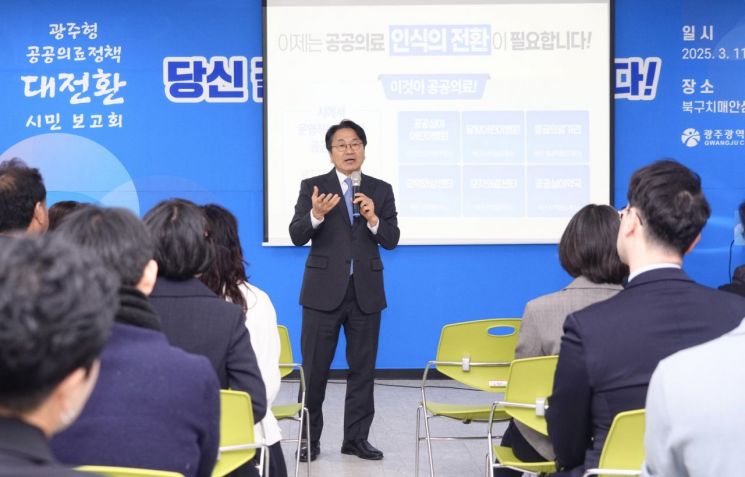 Gwangju Mayor Kang Gijeong attended the 'Gwangju-type Public Healthcare Policy Major Shift Citizen Report Meeting' held at Buk-gu Dementia Safety Center on the 11th and announced healthcare policies. Photo by Gwangju City
The "Gwangju-style Public Healthcare System," which allows any Gwangju citizen to easily access medical services, is drawing attention. By installing three to four Integrated Health Centers in each district, citizens can receive a variety of health management services in one place. The establishment of an emergency medical system eliminates the so-called "emergency room merry-go-round," and the operation of public late-night children's hospitals (Dalbit Children's Hospitals) allows parents to confidently seek treatment for their sick children late at night.
On the 26th, Gwangju City announced that it is promoting a "major transformation in public healthcare" so that all citizens can live healthy lives in their communities and receive timely treatment.
To reflect the diverse and complex medical needs of citizens, the functions of public health centers will be completely reorganized from a provider-centered to a citizen-centered approach. Until now, citizens had to visit multiple institutions such as public health centers, dementia care centers, and health lifestyle support centers separately for health consultations, exercise, nutrition, dementia screening, and chronic disease management, which was inconvenient.
In response, the city plans to install and operate three to four "Integrated Health Centers" in each district, where citizens can receive all medical services provided by public health centers and their affiliated health institutions (such as dementia care centers and mental health welfare centers) in one place. This year, three centers each in Dong-gu and Seo-gu will be piloted sequentially. In particular, a "health manager" will be assigned to each Integrated Health Center to comprehensively assess citizens' health status and required medical services, providing "one-on-one customized health prevention and management services."
The reorganization of the public health center system will also expand home visit medical and nursing services. Medical staff will strengthen home visit medical and nursing services for citizens in need of health management, such as the elderly with limited mobility or single-person households. The city will cooperate with private medical institutions, such as home care centers, to ensure that vulnerable groups are not left behind in health management.
This year, the city will establish the "Gwangju-style Emergency Medical System." This is a regionally optimized emergency medical system designed to ensure that emergency patients are treated promptly, from first aid to transport and final treatment, without any obstacles, thus preventing delays in receiving emergency care. The goal is to eliminate the "emergency room merry-go-round."
This system allows 21 emergency hospitals in Gwangju and 119 emergency rescue teams to share real-time information on patients' conditions and emergency room status via smartphones or computers. Key information such as whether a patient can currently be treated, how crowded the emergency room is, and the patient's location during transport can be checked immediately, helping patients be transported quickly to the appropriate emergency room.
Through the patient transfer function between emergency medical institutions, if a patient's condition worsens or improves while being treated at the initial emergency room, they can be quickly transferred to an emergency room appropriate for their severity. This is expected to reduce the burden on emergency room medical staff and enable patients to receive timely and appropriate treatment.
Additionally, the system will play various roles such as facilitating communication during patient transport, analyzing transfer data, and supporting communication among medical staff, thereby strengthening swift cooperation and communication between emergency rooms.
The city is expanding public late-night children's hospitals, Dalbit Children's Hospitals, and partner pharmacies so that sick children can be treated late at night, ensuring children's health and easing parents' concerns. In 2023, "Gwangju Christian Hospital" (Nam-gu) was designated and operated as the nation's first public late-night children's hospital (the first Dalbit Children's Hospital), and last year, "Gwangju Central Hospital" (Gwangsan-gu) was designated as the second Dalbit Children's Hospital. In addition, "I-Mom Children's Hospital" and "Mirae Children's Hospital" (Buk-gu) have been designated as the third Dalbit Children's Hospitals and will begin full-scale operation in April.
The third Dalbit Children's Hospitals operate from 6 p.m. to 11 p.m. on weekdays and from 9 a.m. to 6 p.m. on Saturdays, Sundays, and public holidays. On Mondays, Tuesdays, and Wednesdays, I-Mom Children's Hospital operates until 11 p.m., and on Thursdays and Fridays, Buk-gu Mirae Children's Hospital operates until 11 p.m. On weekends and public holidays, both hospitals operate until 6 p.m. Nearby, Dana Onnuri Pharmacy and Ai Sarang Pharmacy are designated partner pharmacies, making it easy to get prescriptions filled at night and on holidays.
While the emergency room treatment fee ranges from 50,000 to 100,000 KRW, the Dalbit Children's Hospital fee is only 10,000 to 20,000 KRW, greatly reducing the financial burden of hospital visits. Last year, the number of pediatric patients who used Gwangju Christian Hospital and Gwangju Central Hospital reached 40,727.
Jung Younghwa, Director of the Welfare and Health Bureau, said, "We will steadily promote the establishment of Integrated Health Centers and the emergency medical system to create a stronger public healthcare delivery system," and added, "We will continue to do our best so that citizens can enjoy healthy daily lives with peace of mind."
© The Asia Business Daily(www.asiae.co.kr). All rights reserved.
![Clutching a Stolen Dior Bag, Saying "I Hate Being Poor but Real"... The Grotesque Con of a "Human Knockoff" [Slate]](https://cwcontent.asiae.co.kr/asiaresize/183/2026021902243444107_1771435474.jpg)















