Gyeonggi Province will focus on identifying 2,500 elderly households discovered through big data on crisis information such as excessive medical expenses and financial delinquency risks by May.
On the 26th, Gyeonggi Province announced that, together with 31 cities and counties, it will provide welfare services such as public support including basic living security and emergency assistance, as well as linkage with private resources, to households identified through the welfare blind spot detection system to resolve welfare blind spots.
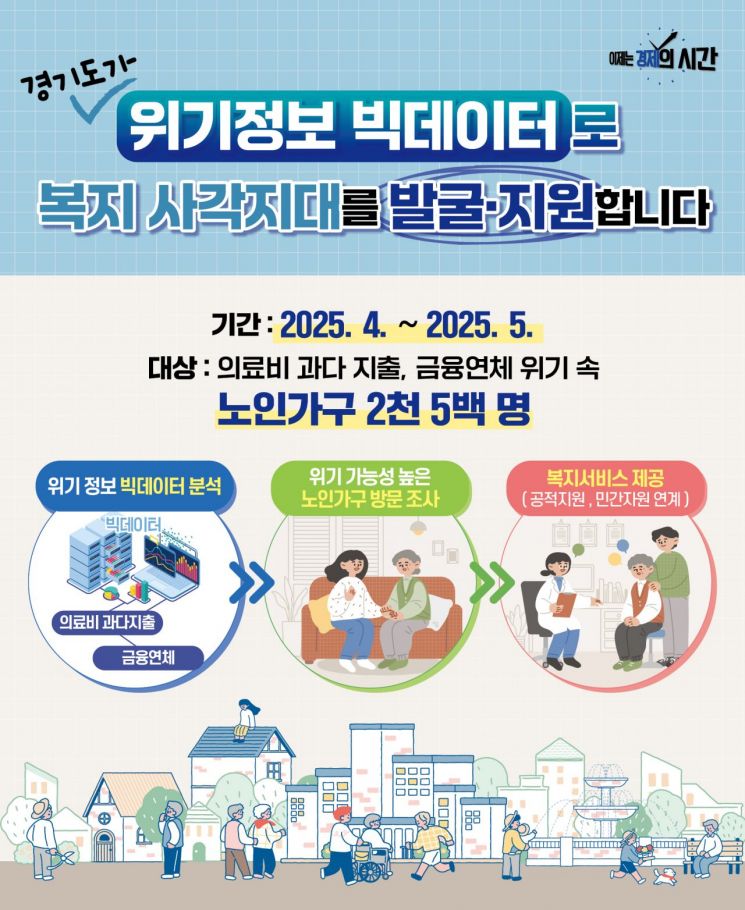
The detection of welfare blind spots is conducted bimonthly (six times a year) according to the central detection schedule of the Ministry of Health and Welfare. In particular, crisis information from 47 items across 21 institutions, including power and water cutoffs, is collected and analyzed to select high-risk targets, and the visiting health and welfare teams in towns, townships, and neighborhoods conduct on-site verification and investigations.
Kim Hana, Director of the Welfare Bureau of Gyeonggi Province, said, "Along with planned detection surveys using big data on crisis information from the welfare blind spot detection system, we are operating a support system for detecting welfare blind spots through cooperation with related organizations and groups." She added, "If you discover neighbors in crisis, please contact the Gyeonggi Province Emergency Welfare Crisis Counseling Hotline (010-4419-7722), Gyeonggi Call Center (031-120), or the town, township, or neighborhood administrative welfare center."
© The Asia Business Daily(www.asiae.co.kr). All rights reserved.
![Clutching a Stolen Dior Bag, Saying "I Hate Being Poor but Real"... The Grotesque Con of a "Human Knockoff" [Slate]](https://cwcontent.asiae.co.kr/asiaresize/183/2026021902243444107_1771435474.jpg)















