"Trump's Suggestion of 'Reciprocal Tariff Exemptions' Draws Attention"
U.S. March Consumer Confidence Index Falls to 92.9, Lowest in Four Years
Consumer Confidence Drops Amid Tariff Uncertainty
Focus on February Core PCE Price Index to Be Released on the 28th
The three major indices of the U.S. New York Stock Exchange are rising in early trading on the 25th (local time). Although consumer confidence in the U.S. economy has fallen to its lowest level in four years, the market is focusing more on President Donald Trump's tariff remarks from the previous day than on concerns about a slowdown in consumption. Since President Trump stated that "exemptions could be granted to several countries" regarding reciprocal tariffs, market concerns about a global trade war appear to be easing.
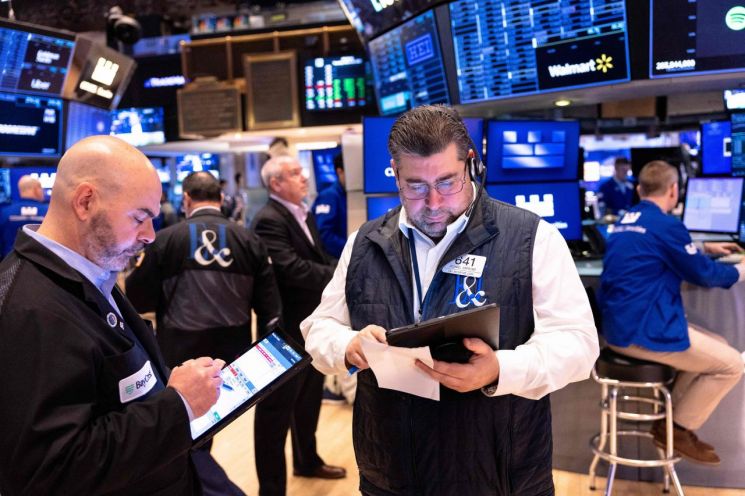
As of 11:05 a.m. in the New York stock market on the day, the Dow Jones Industrial Average (Dow) focused on blue-chip stocks is trading at 42,678.14, up 94.82 points (0.22%) from the previous trading day. The S&P 500, centered on large-cap stocks, is up 16.76 points (0.29%) at 5,784.33, and the Nasdaq, focused on technology stocks, is trading at 18,271.69, up 83.1 points (0.46%).
Following President Trump's reciprocal tariff exemption remarks, the market, which had a strong rally the previous day, is continuing its upward trend today. However, concerns about tariff-induced recession and inflation have caused American consumer sentiment to cool sharply. According to the economic research group Conference Board (CB), the consumer confidence index for March was 92.9, down 7.2 points from the revised February figure of 100.1. This is the lowest level in four years since early 2021. The expectations index, reflecting short-term outlook for the next six months, fell 9.6 points from the previous month to 65.2, marking the lowest level in 12 years. It is well below 80, a level considered a signal of an impending recession. Expected inflation one year ahead rose to 6.2% in March from 5.8% in February, reaching the highest level in two years.
The consumer confidence index is an indicator that reflects consumers' confidence in the U.S. economy, so this survey result suggests that consumers' economic outlook has become more pessimistic recently. The Conference Board stated, "Responses from companies showed that inflation remains a major concern for consumers," adding, "Concerns about trade policies and tariffs have increased, and mentions of economic and policy uncertainties have risen more than usual."
Brett Kenwell, a U.S. investment analyst at eToro, said, "Concerns about the economy and economic policy uncertainty are hitting the psychology of investors, consumers, and businesses, causing their sentiment to continue weakening," and added, "Until clarity on tariffs and macroeconomics improves, sentiment and confidence are expected to remain fragile."
Investors are likely to seek a clearer gauge of the U.S. economic situation through additional indicators to be released this week. The U.S. Department of Commerce will release the February core Personal Consumption Expenditures (PCE) price index on the 28th. Based on Bloomberg's estimates, the core PCE price index is expected to rise 2.7% year-over-year, an increase from 2.6% in January. On the 27th, one day earlier, the final GDP growth rate for the fourth quarter of last year will be announced. The U.S. Department of Labor's March employment report, to be released on the 4th of next month, is expected to provide more accurate information on the U.S. labor market situation.
By stock, Apple is up 1.23%. Microsoft (MS) is up 0.78%. Nvidia and Tesla are down 1.18% and 0.28%, respectively.
Government bond yields are slightly lower. The 10-year U.S. Treasury yield, a global bond yield benchmark, fell 1 basis point (1 bp = 0.01 percentage points) from the previous trading day to 4.31%, and the 2-year U.S. Treasury yield, sensitive to monetary policy, dropped 1 bp to 4.02% compared to the previous day.
© The Asia Business Daily(www.asiae.co.kr). All rights reserved.
![Clutching a Stolen Dior Bag, Saying "I Hate Being Poor but Real"... The Grotesque Con of a "Human Knockoff" [Slate]](https://cwcontent.asiae.co.kr/asiaresize/183/2026021902243444107_1771435474.jpg)















