Sales and Visitor Numbers Did Not Improve Year-on-Year in January and February
High Exchange Rates and Economic Downturn Continue to Impact Industry
Government to Implement Temporary Visa Waiver in Q3
Industry Welcomes Growing Demand from China, Korea's Largest Inbound Market
The duty-free industry has not experienced a clear surge in demand during January and February of this year, which included the Lunar New Year holidays, the biggest holidays in both South Korea and China. This is due to a combination of factors such as high exchange rates, sluggish consumption, and changes in shopping patterns of foreign tourists visiting Korea. However, there is growing anticipation that the South Korean government's plan to temporarily waive visas for Chinese group tourists, the largest market for inbound tourism, starting from the third quarter of this year, may help overcome the prolonged downturn in the industry.
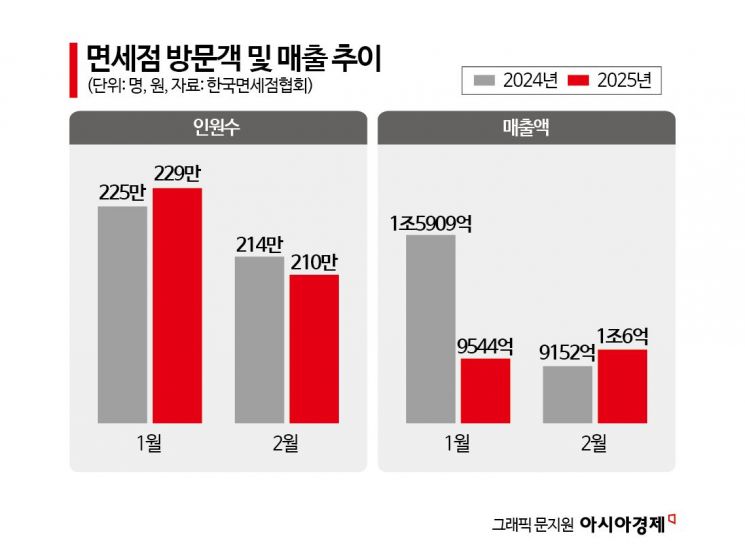
According to the Korea Duty Free Association on the 25th, the number of visitors to duty-free shops last month was approximately 2.099 million, a 1.73% decrease compared to 2.14 million in the same period last year. During the same period, sales increased by 8.53% to 1.006 trillion won, but this is not considered a clear upward trend. An industry insider explained, "Depending on whether the Chinese Lunar New Year falls in January or February, there can be slight changes in the number of foreign visitors and related sales. Although these figures fluctuate compared to the same period last year, it is difficult to call it a 'dramatic change.'"
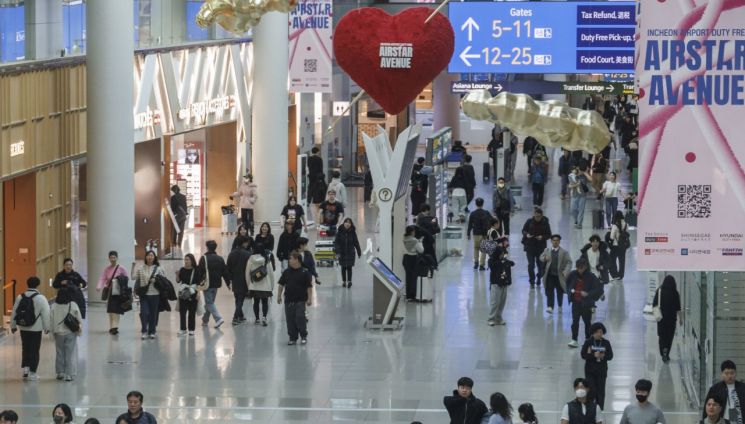
This was also evident in January, when the Korean Lunar New Year holiday took place. During the longest holiday period of nine days, the number of passengers using Incheon International Airport reached about 2.18 million, a record high. However, the number of visitors to duty-free shops in January was 2.29 million, only a 1.5% increase compared to the same period last year, and sales amounted to 954.4 billion won, a 40.0% decrease from 1.5909 trillion won in the same period last year.
An industry official said, "Domestic consumers feel burdened by the high exchange rate when using duty-free shops, and foreign tourists tend to prefer shopping experiences that emphasize cost-effectiveness, such as CJ Olive Young or Daiso, rather than domestic duty-free shops. Additionally, the continued economic downturn in China means that transactions through Chinese 'daigou' (personal shoppers) are not as effective as before." For this reason, Lotte Duty Free, the industry leader, has completely stopped transactions with daigou this year to improve profitability, and competitors such as Shilla Duty Free and Shinsegae Duty Free plan to reduce commissions paid to daigou by up to 50% to decrease their sales dependency.
The duty-free industry is hopeful that the government's plan to temporarily waive visas for Chinese group tourists in the third quarter, aimed at diversifying the inbound market, will provide relief to the struggling sector. Earlier, at the 'Livelihood Economy Inspection Meeting' held in Gyeongju on the 20th, the government announced plans to implement a temporary visa waiver for Chinese group tourists recruited by designated travel agencies during the third quarter.
Additionally, the Ministry of Culture, Sports and Tourism plans to support the recovery of the Chinese inbound tourism market by holding the largest-ever 'K-Tourism Roadshow' with 74 Korean and over 100 Chinese tourism companies, totaling 330 participants, in Beijing (on the 25th) and Shanghai (on the 27th). Last year, the number of Chinese tourists visiting Korea was 4.6 million, ranking first among all countries, and it is expected that 1.2 million Chinese tourists will visit Korea in the first quarter of this year alone, an approximately 18% increase compared to the same period last year.
An industry insider noted, "Travelers using package tours centered on group tourists often have visits to local shopping centers or duty-free shops included in their itineraries. If the visa waiver policy increases the proportion of group tourists, duty-free shops can expect an increase in visitors and sales."
The duty-free industry is also devising self-help measures to attract foreign group tourists and improve profitability. Lotte Duty Free attracted about 1,000 employees of the Taiwanese Amway Group who visited Korea earlier this month for a corporate meeting to shop at duty-free shops, and successfully gathered about 3,000 large cruise group tourists who traveled from Shanghai to Busan at its Busan branch. At the end of this month, about 800 group tourists from a Chinese cosmetics company’s incentive (reward) tour are expected to visit the Myeongdong main store.
Shinsegae Duty Free is also planning strategies to attract more than 50,000 high-value group tourists by the end of this year, with about 2,000 corporate and incentive group tourists from China and Thailand visiting just this month. A Shinsegae Duty Free official said, "We are implementing a 'win-win' strategy that focuses on premium business tourists who have higher purchase amounts per customer rather than large numbers of visitors, thereby reducing store congestion and increasing sales efficiency. We expect that the visa waiver for Chinese group tourists scheduled for implementation in the third quarter will revitalize not only the tourism market but also the entire duty-free industry."
© The Asia Business Daily(www.asiae.co.kr). All rights reserved.
![Clutching a Stolen Dior Bag, Saying "I Hate Being Poor but Real"... The Grotesque Con of a "Human Knockoff" [Slate]](https://cwcontent.asiae.co.kr/asiaresize/183/2026021902243444107_1771435474.jpg)
















