Jiji Press Reports on March 25
Ministry of Education Finalizes Textbook Authorization Results
Claims Senkaku Islands (Diaoyu Islands) as "Japan's Inherent Territory"
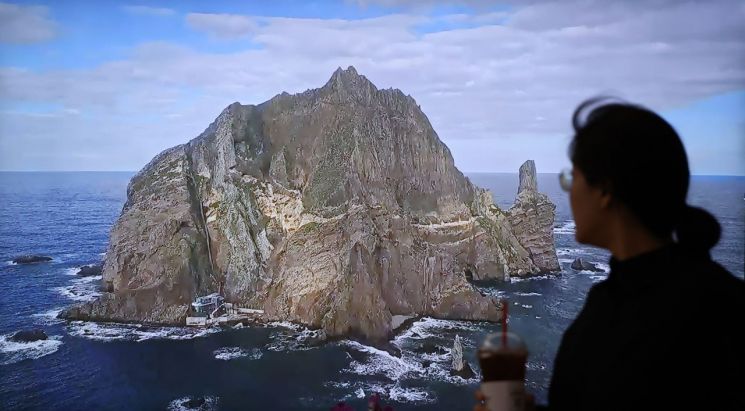 On October 24 last year, a day before Dokdo Day, government officials passed by the Dokdo video monitor installed in the lobby of the Seoul Government Complex. Photo by Yonhap News
It has been confirmed that a significant number of social studies textbooks to be used by Japanese high school students starting next spring contain the unfounded claim that Dokdo is "Japan's inherent territory." Revisions were even demanded for textbooks that initially did not use this expression.
According to Jiji Press, a Japanese news agency, on the 25th, the Ministry of Education, Culture, Sports, Science and Technology of Japan held a general meeting of the Textbook Authorization Review Council and finalized the review results of textbooks to be used by frontline high schools from 2026.
The social studies textbooks that passed the authorization include 7 types of Comprehensive Geography, 11 types of Comprehensive History, 12 types of Public (Kokyo), and 1 type of Politics and Economics. Public (公共) refers to subjects related to social systems, politics, and economics.
Most of the new authorized high school social studies textbooks retained the Japanese government's stance asserting sovereignty over Dokdo, as seen in the textbooks that passed authorization four years ago and are currently in use. Jiji Press reported that although some textbooks did not initially include the phrase "Japan's inherent territory," the content was revised during the authorization process to reflect this opinion.
Previously, in March 2018, the Japanese government mandated in the high school curriculum guidelines that Dokdo is Japan's inherent territory and that efforts are being made for the peaceful resolution of the sovereignty issue.
Accordingly, the current Comprehensive Geography textbook by Teikoku Shoin describes, "South Korea unilaterally drew a boundary line in international waters in 1952, claiming maritime rights, and illegally occupies Takeshima (竹島, the name Japan uses for Dokdo)."
High-ranking Japanese officials also repeatedly make the unfounded claim that Dokdo is "Japan's inherent territory" both historically and under international law whenever the opportunity arises.
Regarding forced labor, one of the Politics and Economics textbooks used the expression "taken to Japan from the Korean Peninsula," but through the authorization process, "taken" was changed to "mobilized."
Meanwhile, this textbook also covers sensitive historical issues such as the ongoing maritime territorial disputes between China and Japan over the Senkaku Islands (Diaoyu Islands) and the Northern Territories. The phrase "Japan's inherent territory" was also used in describing the Senkaku Islands.
© The Asia Business Daily(www.asiae.co.kr). All rights reserved.

















