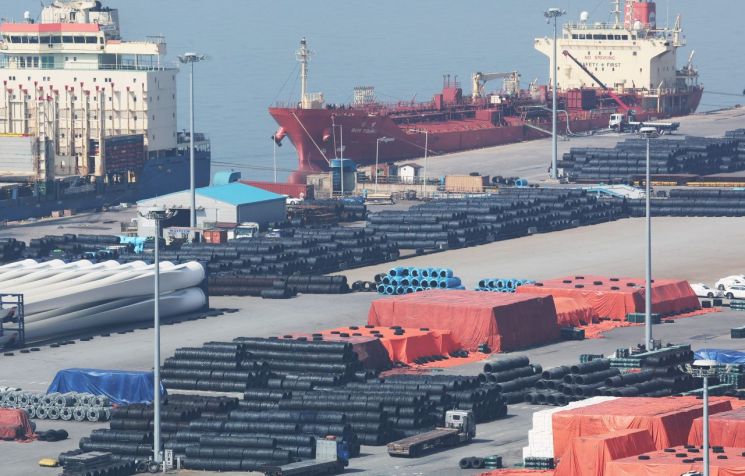
The government has doubled the size of the Supply Chain Stabilization Fund to manage the supply chains of items related to economic security, such as urea and rare earth elements. More than 25 trillion won will be invested over three years in core technology research and development, and the scope of support will be expanded to include shipping and logistics. Exemption benefits for the Export-Import Bank’s fund contributions will also be established.
Choi Sang-mok, Deputy Prime Minister for Economy and Minister of Strategy and Finance, announced on the 25th the ‘2025 Supply Chain Stabilization Implementation Plan’ and the ‘Supply Chain Stabilization Fund Operation and Institutional Improvement Measures’ containing these details. This plan is a follow-up to the ‘Basic Plan for Supply Chain Stabilization’ announced last December.
To encourage direct investment by companies in economic security items, the government decided to provide low-interest loans from the Supply Chain Stabilization Fund when domestic companies invest directly in overseas production facilities. The fund size has been increased from the current 5 trillion won to 10 trillion won. Semiconductor, secondary battery, and cathode material companies that procure core materials or parts domestically will also receive loan benefits totaling about 1 trillion won. Since this is a measure for stable distribution, securing shipping logistics and infrastructure is also included in the support targets.
Measures to reduce dependence on key materials from specific countries are also included. To lower dependence on specific countries to below 50%, the government will launch the ‘Supply Chain Stabilization Support Program’ to diversify import sources, and to prevent a repeat of the past urea crisis, it will expand import countries from Vietnam to the Middle East and Europe. Companies that sign long-term contracts with countries other than China will have half of the price difference in import costs compensated by the government. For crude oil, if imported from regions outside the Middle East by 2027, part of the transportation costs will be refunded from the petroleum import surcharge.
Core technology research and development (R&D) for supply chain and economic security will be supported with more than 25 trillion won over three years, and the R&D support budget for 12 government-designated national strategic technologies will increase from 5 trillion won to 6.4 trillion won.
Among private companies participating in supply chain stabilization, leading businesses will be selected. Leading businesses include companies that diversify import countries for economic security items, increase domestic manufacturing facilities, or develop import substitution technologies. These companies will receive priority support in finance, taxation, and funding. The government plans to select leading businesses twice a year but may designate them as needed.
Meanwhile, legal amendments will be pursued to enable the Export-Import Bank to actively contribute to the Supply Chain Stabilization Fund. Fund support without intentional or gross negligence will be granted exemption benefits, laying the foundation for active support of high-risk projects.
© The Asia Business Daily(www.asiae.co.kr). All rights reserved.

















