A 42% Increase in Seven Years Based on Place of Residence... Annual Average Growth Rate of 5.13%
Rising Expectations for Gwangmyeong-Siheung New Town and Techno Valley Development
The annual average wage income growth rate of residents in Gwangmyeong-si, Gyeonggi-do, was found to be the highest among 157 cities and counties nationwide. This is attributed to the continuous influx of young people working in Seoul as large-scale reconstruction and redevelopment apartment move-ins continue.
According to the National Tax Service's "2024 National Tax Statistical Yearbook," the average wage income based on "residence" in Gwangmyeong-si in 2023 was 46.58 million KRW. This is a 41.9% increase compared to 32.83 million KRW in 2016, seven years earlier. The annual average growth rate was 5.13%, the highest among 157 cities and counties nationwide during this period. Including autonomous districts, it ranks third among 226 basic local governments nationwide.
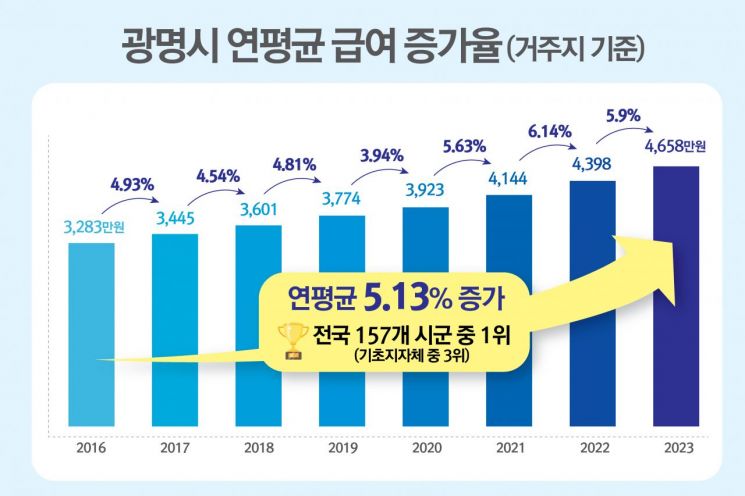
The high income growth rate appears to be due to demographic changes caused by large-scale redevelopment and reconstruction. Around 2010, as apartment move-ins began in earnest following the reconstruction of old low-rise complexes in the Cheolsan and Haan residential development districts, there was a continuous influx of workers based in Seoul. Additionally, the redevelopment of old downtown areas, which were previously filled with detached, row, and multi-family houses, into apartments accelerated this trend.
An official from real estate agency A in the area said, "The accessibility to downtown Seoul and Gangnam via subway is good, and the residential environment has improved with new apartment move-ins, making it increasingly popular as a residential area."
Wage income in Gwangmyeong-si based on "workplace" also increased by 36.1%, from 33.72 million KRW to 45.91 million KRW during this period. The annual average growth rate based on workplace also reached 4.5%. Thanks to such a high growth rate, Gwangmyeong-si's average wage income jumped 36 ranks from 68th in 2020 to 28th in 2023.
Gwangmyeong-si explained that it has been steadily growing from a bedroom community to a city where people come to work, thanks to efforts to attract promising companies and create high-income jobs.
Experts consider Gwangmyeong-si to still have high urban growth potential. This is because large-scale development projects that continue to attract young people are ongoing, along with its location effectively within the Seoul metropolitan area.
Currently, development projects are underway on 42% of the total area of Gwangmyeong-si. In particular, the Gwangmyeong-Siheung New Town development, the largest among the third phase new towns in the metropolitan area with an area of 12.71 million square meters, will enter full-scale progress this year after compensation work. The Gwangmyeong-Siheung New Town will include about 67,000 housing units as well as a 974,800 square meter Techno Valley.
Park Seung-won, mayor of Gwangmyeong-si, said, "Gwangmyeong, once perceived as a bedroom community, has proven its competitiveness as a self-sufficient city in seven years," adding, "We will carry out large-scale development projects without delay to transform into a self-sufficient premium city."
© The Asia Business Daily(www.asiae.co.kr). All rights reserved.

















