Wildfires Intensified by the Climate Crisis
Growing Need for Firefighting Aircraft Capable of Operating at Night and in Strong Winds
Wildfires centered around the Yeongnam region are becoming a disaster. Not only have there been 15 casualties, including 4 deaths, but a vast area has also been burned, and the damage area continues to increase as the fires have yet to be fully extinguished. Due to the growing wildfire damage each year influenced by abnormal weather conditions, there is an increasing need to introduce firefighting aircraft that are less affected by weather conditions and capable of large-scale water spraying.
Lee Cheol-woo, Governor of Gyeongbuk, recently stated at the Central Disaster and Safety Countermeasures Headquarters meeting for wildfire response in Ulsan, Gyeongbuk, and Gyeongnam, "Although many pieces of equipment were sent upon local requests, the scale is too small. The military sent 13 helicopters, but carrying only 800ℓ of water is insufficient to extinguish the fire. We need transport aircraft that can carry 20,000ℓ or 30,000ℓ to put out the fire immediately in the early stages." He appealed, "The Ministry of Strategy and Finance must provide the budget to quickly introduce advanced equipment such as large transport aircraft."
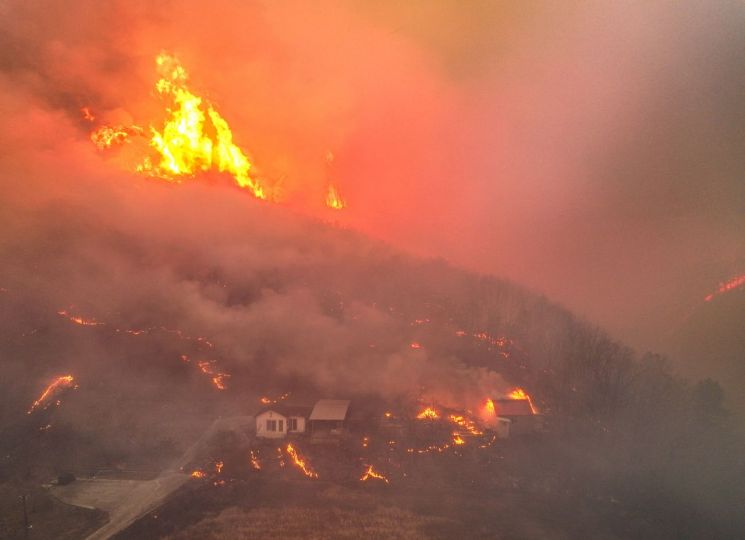 On the third day of the large wildfire in Uiseong-gun, Gyeongbuk, on the 24th, the wildfire spreading with strong winds in Jeonheung-ri, Oksan-myeon, Uiseong-gun, is engulfing residential houses. Yonhap News
The argument for possessing firefighting aircraft capable of carrying large amounts of water for aerial spraying has been raised in the political arena. Former lawmaker Oh Young-hwan emphasized during a current affairs inquiry with the Fire Agency on May 16, 2023, that "fixed-wing aircraft, that is, airplanes, are absolutely necessary for wildfire suppression." Oh introduced, "Firefighting helicopters cannot fly at night and cannot operate in rain or strong winds, whereas airplanes can operate at night and have much larger water capacity and firefighting effectiveness." He also suggested, "If budget is an issue, there is a less costly option by utilizing military transport aircraft." Through media contributions, Oh stressed, "The changing nature of large wildfires is not a distant future but the reality of the climate crisis disaster facing us today," and "We must acknowledge the clear limitations of wildfire response relying mainly on firefighting helicopters and now actively consider introducing alternative measures."
In fact, many overseas cases have firefighting aircraft for wildfire response. According to the National Assembly's report on 'The Modernization Policy and Implications of U.S. Wildfire Response Technology,' the U.S. possesses firefighting aircraft capable of supplying from 2,000 gallons (7,580ℓ) to 4,000 gallons (15,141ℓ), and even 8,000 gallons (30,283ℓ) of water.
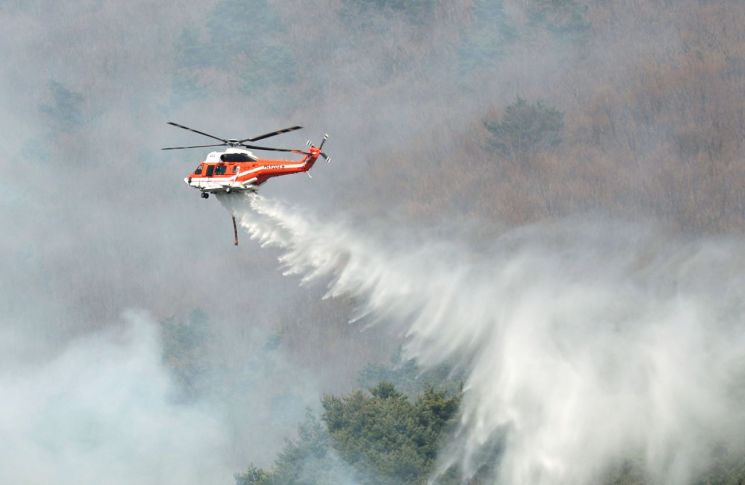
Although discussions have been ongoing as wildfires have gradually become larger, efforts have been sporadic. Last year, the Korea Forest Service attempted to attach water tanks to military transport aircraft with a budget of 8 billion KRW, but the project was reportedly halted after the Ministry of National Defense stated it could not cooperate due to lack of prior consultation with the military.
Earlier, a research project conducted by the National Assembly titled 'Characteristics and Efficient Operation Plans of Firefighting Aircraft for Wildfire Suppression' made specific proposals for introducing firefighting aircraft. The report stated, "In the U.S., during wildfires, the Air Force attaches Modular Airborne FireFighting Systems (MAFFS) to C-130 fixed-wing aircraft for wildfire response," and suggested, "South Korea should consider purchasing C-130 aircraft to use as military transport during peacetime and equip them with MAFFS for wildfire suppression when fires occur." Furthermore, it introduced, "If the Korea Forest Service can secure a budget for aircraft purchase, there is also the option for the Forest Aviation Headquarters to directly purchase civilian C-130 aircraft and equip them with modular airborne firefighting systems (MAFFS) without involving the Air Force."
© The Asia Business Daily(www.asiae.co.kr). All rights reserved.
![Clutching a Stolen Dior Bag, Saying "I Hate Being Poor but Real"... The Grotesque Con of a "Human Knockoff" [Slate]](https://cwcontent.asiae.co.kr/asiaresize/183/2026021902243444107_1771435474.jpg)
















