A total of 2,167 households of Moa Housing will be supplied in Gangseo-gu and Mapo-gu, Seoul.
On the 25th, the Seoul Metropolitan Government announced that it held the 5th Small-scale Housing Maintenance Integrated Deliberation Subcommittee and passed the integrated deliberation on the 'Gangseo-gu Hwagok 6-dong 957-1 Area Moa Town Management Plan (Draft)' and one other case.
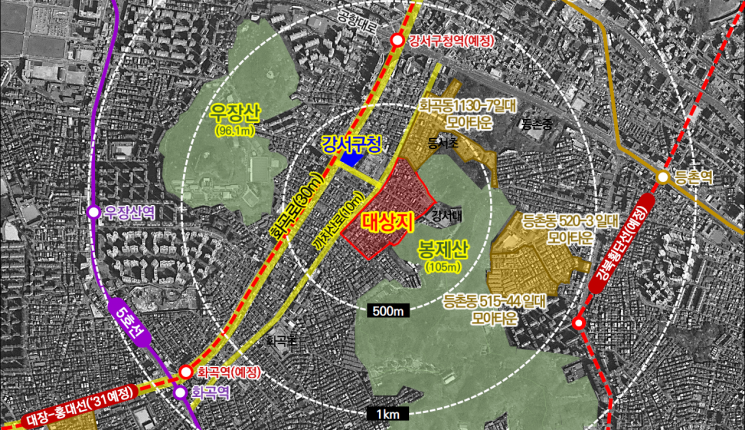
As a result of this decision, a total of 1,636 households in four Moa Housing sites will be supplied in the area of 957-1 Hwagok-dong, Gangseo-gu. In addition, one Moa Housing site with 531 households will be supplied in the area of 78 Jung-dong, Mapo-gu.
In the case of the target site in Hwagok-dong, Gangseo-gu, there were problems such as the concentration of old and poor buildings and narrow roads. However, redevelopment was difficult due to height restrictions under the Airport Facilities Act, but it was selected as a Moa Town target site through a public contest in the second half of 2022.
With this Moa Town designation, it is expected that a total of 1,636 households can be supplied, an increase of 486 households from the existing 1,150 households, when the four Moa Housing projects are promoted.
The draft Moa Town management plan includes plans to improve the residential environment and quality of life in old low-rise residential areas based on upgrading the zoning of the project area, expanding maintenance infrastructure, Moa Housing project promotion plans, and design guidelines. However, parcels included in the Moa Town but not wishing to proceed with the project and preferring to remain or build individually are planned as 'Autonomous Maintenance Zones.'
Also, Hwagok-ro 54-gil, the main road of the target site, includes a plan to improve traffic conditions and pedestrian environment by widening the road (from 8m to 12m) in connection with the Gangseo District central district unit plan, and widening Kkachisan-ro 20, 22, and 24-gil (from 6m and 8m to 12m) to match the scale of Moa Housing development.
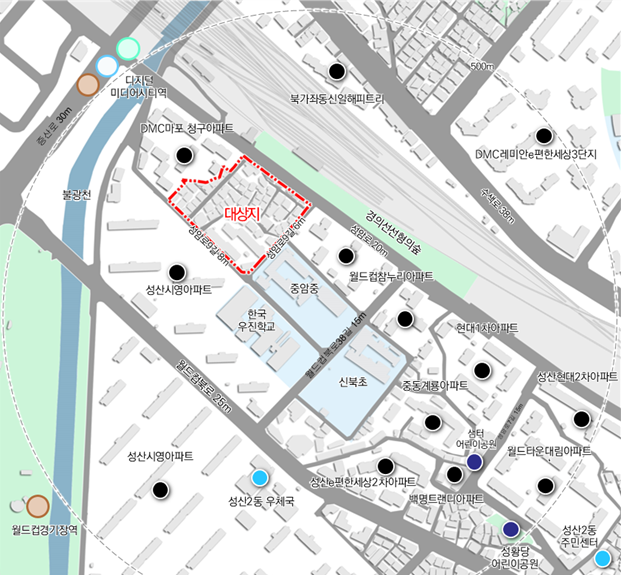
The area around 78 Jung-dong, Mapo-gu is also a low-rise residential dense area with an old building ratio of 68.7% and a semi-basement housing ratio of 77.6%. Due to poor residential conditions, it was selected as a Moa Town target site in 2022 and was submitted for deliberation after expert pre-consultation, resident briefings, and public inspection procedures.
When the Moa Housing project is promoted, it is expected that a total of 531 households can be supplied, an increase of 110 households from the existing 421 households.
The draft Moa Town management plan includes upgrading the zoning of the project area, expanding maintenance infrastructure, supplying necessary local facilities such as open shared facilities, as well as Moa Housing project promotion plans and design guidelines.
The main access road, Seongam-ro 9-gil, has been widened sufficiently (from 6m to 12m) to match the scale of Moa Housing development to ensure pedestrian safety.
In particular, the internal roads of the target site will be closed and integrated into one project area. Instead of the closed roads, public pedestrian paths will be created within the housing complex and connected to the Gyeongui Line linear forest trail. Also, a pedestrian environment will be created to easily access newly established public open spaces and open shared facilities.
The area around 78 Jung-dong, Mapo-gu is adjacent to DMC Station, providing convenient transportation and excellent living and educational environments, but new and old buildings are mixed. The city expects that this Moa Town designation will enable strengthened communication among residents, improved residential environment, and regional development.
© The Asia Business Daily(www.asiae.co.kr). All rights reserved.
![Clutching a Stolen Dior Bag, Saying "I Hate Being Poor but Real"... The Grotesque Con of a "Human Knockoff" [Slate]](https://cwcontent.asiae.co.kr/asiaresize/183/2026021902243444107_1771435474.jpg)
















