The Ministry of Culture, Sports and Tourism announced on the 25th that it will hold the 'K-Tourism Roadshow' targeting the Chinese market in Beijing (March 25) and Shanghai (March 27) in collaboration with the Korea Tourism Organization.
Recently, the Chinese inbound tourism market has shown a clear recovery trend. Last year, the number of Chinese visitors to Korea reached 4.6 million, making China the top inbound market. It is expected that the number of Chinese tourists visiting Korea in the first quarter of this year will reach 1.2 million, an increase of about 18% compared to the same period last year. The Ministry of Culture, Sports and Tourism plans to accelerate the recovery of the Chinese inbound tourism market and revitalize the foreign visitor market through successive K-Tourism Roadshows.
Since the COVID-19 pandemic, Chinese tourists have shown a clear preference for small group tours of five or fewer people focused on experiential travel, rather than individual travel or traditional package tours. In response, the Ministry has been discovering new themes reflecting women, university students, and regional characteristics to meet changing trends and expand demand for travel to Korea.
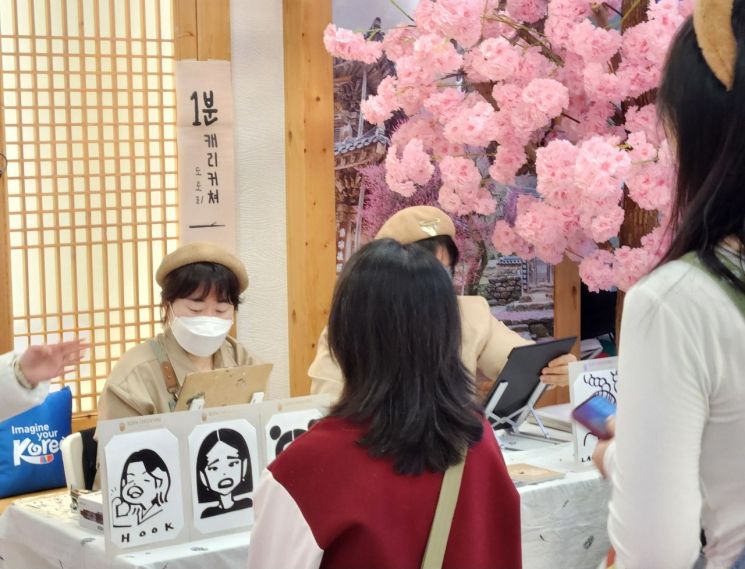 The scene at the K-Tourism Roadshow held in Guangzhou, China on the 6th [Photo by Korea Tourism Organization]
Before the events in Beijing and Shanghai, a K-Tourism Roadshow was held in Guangzhou on the 6th. The Guangzhou K-Tourism Roadshow showcased spring flower-themed tourism and regional tourism, and signed an agreement with the Guangdong Travel Industry Association and others to attract large groups in the exhibition complex industry (MICE).
The Beijing K-Tourism Roadshow will be held at the NUO Hotel in Beijing. A total of 74 organizations, including eight local governments nationwide, 39 Chinese dedicated travel agencies, hotels and resorts, medical and beauty sectors such as ophthalmology and health checkups, tourist attractions, theme parks, non-verbal performances, and immersive media exhibitions, will participate. They will market Korean tourism to about 100 organizations such as travel agencies in Beijing and the North China region, online travel platforms, and cultural and sports associations, and seek cooperation measures between the Korean and Chinese travel industries. During the 'Korea-China Tourism Exchange Night,' the Korea Association of Travel Agents and the China Association of Travel Services are expected to sign the first letter of intent for friendly cooperation.
The Shanghai K-Tourism Roadshow will be held at the MGM Hotel in Shanghai. The East China region, where Shanghai is located, leads the inbound travel trend focused on individual tourists with the highest number of flights to Korea and the highest issuance of individual visas. Considering the advantage of proximity to Korea and the characteristics of a mature travel market based on high income levels, the event will target Chinese individual travelers in their 20s and 30s. In particular, unique themed inbound travel products will be introduced, such as medical and beauty experiential travel including ophthalmology and health checkups for health-conscious Chinese tourists, companion travel for the increasing pet population in China, and walking mountain tours.
Kim Jeong-hoon, Director of Tourism Policy at the Ministry of Culture, Sports and Tourism, stated, "China is the number one inbound tourism market, with one out of every three inbound tourists being Chinese. Especially, the per capita spending reaches 3 million won, making China an important market with high expenditure levels." He added, "The K-Tourism Roadshows held in Beijing and Shanghai will serve as an opportunity to further boost Chinese inbound tourism demand."
© The Asia Business Daily(www.asiae.co.kr). All rights reserved.

















