Gyeonggi Province held a final service report meeting to establish standard building permit criteria for logistics warehouses.
On the 24th, Gyeonggi Province announced that it held the report meeting at the Gyeonggi Economic Science Promotion Agency in Gwanggyo, Suwon, with about 30 attendees including officials from development permit departments of cities and counties with high demand for logistics warehouse construction such as Namyangju, Gwangju, and Icheon.
According to the service results, the supply of logistics warehouses had a positive effect on the local economy in terms of production, added value, and employment inducement effects; however, negative impacts were observed in the analysis of traffic accidents, traffic volume, noise, traffic congestion, and pollutant emissions from freight vehicles.
Specifically, the social cost associated with logistics warehouse operations was 49 million KRW per 1,000㎡ annually, and 36% of respondents living within 500m of logistics warehouses reported inconvenience and losses due to nearby logistics warehouses.
Additionally, 78.3% of Gyeonggi residents responded that it is necessary to establish guidelines related to logistics warehouse supply regulations, and that new logistics warehouses should be located at least 500m away from residential areas. When traffic improvement measures and permit systems involving resident participation are implemented, 75.2% expressed support for the construction of new logistics warehouses.
On the other hand, 62.9% of industry experts in logistics distribution suggested that the minimum separation distance should be relaxed to 200?300m, and 82.9% of them, a majority, expressed the opinion that differential application by region is necessary.
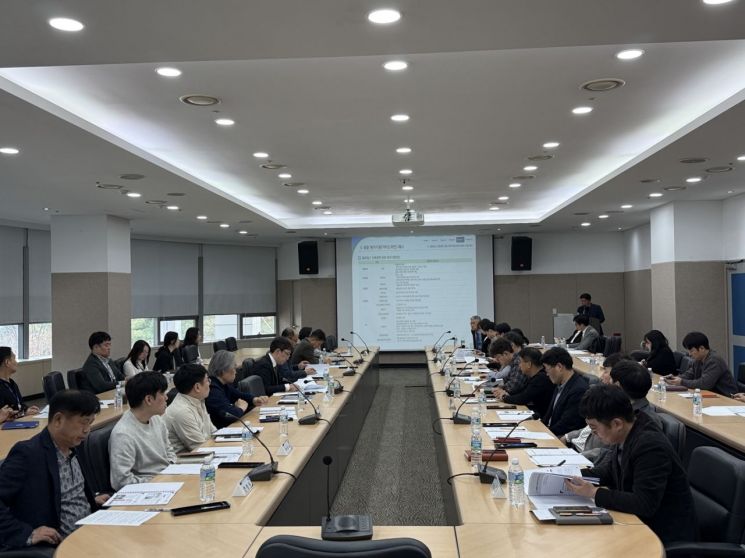 Gyeonggi Province held the final service report meeting on the 24th to establish standard permit criteria for logistics warehouse construction. Photo by Gyeonggi Province
A separation distance of over 300m is generally the level applied to avoidance facilities such as cemeteries and waste treatment facilities. In Japan, commercial warehouses cannot be constructed in residential areas, and in countries with high population density such as the Netherlands and the United Kingdom, regulations require warehouses to be located 300?500m away from residential areas.
Based on the logistics warehouse proliferation prevention and sustainable logistics warehouse supply policies presented at the report meeting, Gyeonggi Province plans to establish a plan to prevent the proliferation of logistics warehouses.
Earlier, in June of last year, Gyeonggi Province initiated the service to prepare optimal building standards that minimize damage to residents caused by indiscriminate proliferation of logistics warehouses while fulfilling the functions of urban infrastructure.
Kim Ki-beom, Director of the Railroad, Port, and Logistics Bureau of Gyeonggi Province, said, "Gyeonggi Province has made great efforts to ensure that the standard permit criteria related to logistics warehouse construction are effective," adding, "We hope that the standard permit criteria will be of great help when cities and counties enact urban planning ordinances."
© The Asia Business Daily(www.asiae.co.kr). All rights reserved.
![Clutching a Stolen Dior Bag, Saying "I Hate Being Poor but Real"... The Grotesque Con of a "Human Knockoff" [Slate]](https://cwcontent.asiae.co.kr/asiaresize/183/2026021902243444107_1771435474.jpg)















