Personal Information Protection Commission Holds Meeting with AI Startups
'Generative AI Adoption and Utilization Guide' to Be Published Soon
The Personal Information Protection Commission (PIPC) is set to support the domestic open-source artificial intelligence (AI) ecosystem. This comes as open-source AI models are being recognized as new opportunities for Korean AI companies.
On the afternoon of the 24th, Ko Hak-soo, Chairperson of the PIPC, met with AI startup representatives at &Space, Startup Alliance in Gangnam-gu, Seoul, and stated, "We will support the full realization of the benefits of open source in the Korean market and its translation into innovative service creation."
 Ko Hak-su, Chairperson of the Personal Information Protection Commission, is delivering a greeting at the AI Startup Meeting held on the afternoon of March 24 at Startup Alliance in Gangnam-gu, Seoul. Provided by the Personal Information Protection Commission
Open source refers to the practice of making programming source code publicly available so that anyone can utilize it for new development. Open-source AI models allow anyone to access high-performance AI models while reducing cost burdens. This is because their operating principles, design methods, and algorithms are all disclosed. Meta’s LLaMA, DeepSeek’s V3, and R1 are examples of open-source models.
As the technology of open-source models advances, it is said to improve cost efficiency for AI startups. Ha Joo-young, a lawyer at ScatterLab, explained, "The cost required to develop large language models (LLMs) is very high, and many high-performance open-source models already exist, so paradoxically, the efficiency of development is not great," adding, "The trend of open-source AI models catching up with closed models will continue."
Although large-scale AI infrastructure is lacking, the PIPC explains that open-source models could be an opportunity for Korea, which has abundant quality data and excellent AI talent.
In fact, the use of open-source AI models is increasing, especially among startups. According to a simple survey conducted by the PIPC, 9 out of 10 companies reported having experience using open-source models for internal research or performance improvement applications. Six out of ten said they use open-source models for additional training with their own user data or for performance enhancement through retrieval-augmented generation (RAG). RAG is a technology that improves LLM performance by searching external databases, enabling accurate and up-to-date responses.
However, caution is needed as personal information processing may occur during the additional training and commercialization process. Companies also have concerns about personal information handling when using open-source models.
In fact, China’s DeepSeek sparked controversy by extensively collecting users’ personal information and storing it indefinitely without clear time limits. Subsequently, the PIPC, after consultations, halted new domestic downloads of the DeepSeek app. Chairperson Ko also mentioned in his greeting, "The PIPC is cooperating with DeepSeek to minimize personal information risks."
Lim Jeong-hwan, Head of AI Business at More AI, said, "It should be emphasized what types of data are used to create open-source models and how to exercise caution," adding, "There is also a need for appropriate regulations from government agencies."
The PIPC introduced cases where specific data processing standards were presented under 'principle-based regulation.' It also explained key points of the recently announced 'AI Data Expansion and Open Access Plan' through the 3rd National AI Committee to reduce barriers to data utilization.
During the subsequent open discussion, participating companies raised issues regarding legal uncertainties when using user data for AI development. Suggestions included ▲clear legal guidelines for lawful user data use ▲specific methodologies for anonymized and pseudonymized data processing ▲establishment of re-identification evaluation criteria for de-identified data.
Based on the results of this meeting, the PIPC plans to prepare a 'Generative AI Adoption and Utilization Guide' from a personal information perspective to provide practical assistance to SMEs and startups.
Chairperson Ko stated, "To develop a competitive AI innovation ecosystem in Korea, it is necessary to maximize the benefits of open source," and added, "We will closely cooperate with SMEs and startups to minimize AI and data processing risk factors during the adoption and use of open-source AI by domestic institutions and companies."
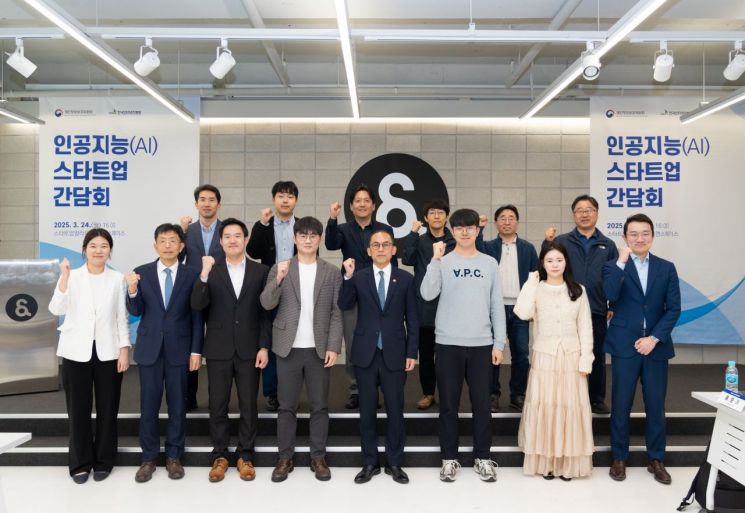 Goh Hak-su, Chairperson of the Personal Information Protection Commission (fourth from the right in the front row), is taking a commemorative photo with participants of the AI startup meeting held on the afternoon of the 24th at Startup Alliance in Gangnam-gu, Seoul. Photo by Personal Information Protection Commission
© The Asia Business Daily(www.asiae.co.kr). All rights reserved.
![Clutching a Stolen Dior Bag, Saying "I Hate Being Poor but Real"... The Grotesque Con of a "Human Knockoff" [Slate]](https://cwcontent.asiae.co.kr/asiaresize/183/2026021902243444107_1771435474.jpg)
















