Demonstration Event Held at Seodaejeon Negeori, Oryong, and Yongmun Stations in Daejeon by Korea Institute of Machinery and Materials
The 'Subway Tunnel Ultrafine Dust Reduction Device,' which minimizes ozone generation and enables dry cleaning instead of water cleaning, is expected to reduce annual maintenance costs by approximately 7.5 to 10 billion KRW after completing demonstration tests, and will be expanded for installation in subways and schools.
In particular, when installed in schools, it can be used semi-permanently with low power consumption without filter replacement, potentially saving about 30 billion KRW annually in filter replacement costs.
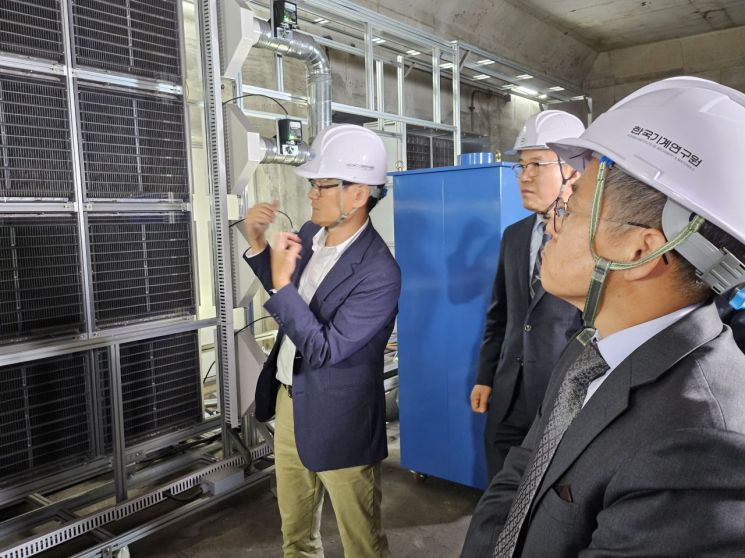 At Seodaejeon Negeori Station of Daejeon Subway, Kim Hak-jun, Principal Researcher at the Korea Institute of Machinery and Materials (left), is explaining the operating method of the subway ultrafine dust reduction device to Hwang Pan-sik, Director of Research and Development Policy at the Ministry of Science and ICT (right). Photo by Kim Jong-hwa
The Ministry of Science and ICT and the Korea Institute of Machinery and Materials held a demonstration event for the subway ultrafine dust reduction technology R&D achievements on the afternoon of the 24th at Seodaejeon Negeori Station of the Daejeon Subway.
This reduction device, based on a low-power electrostatic precipitator method, began research and development in November 2021 by the Korea Institute of Machinery and Materials in response to Daejeon Transportation Corporation’s request for a low-cost and eco-friendly ultrafine dust reduction technology.
Since 2023, the institute developed the reduction technology using microfiber carbon fiber instead of metal plates used in existing reduction technologies, enabling low-power operation. The device was installed and demonstrated for nearly two years at three stations of the Daejeon Subway: Seodaejeon Negeori Station, Oryong Station, and Yongmun Station.
As a result, ozone generation was about 4 ppb, roughly one-tenth of the typical atmospheric ozone level (about 30 ppb, where 1 ppb is one-thousandth of 1 ppm). Ultrafine dust concentration discharged into the tunnel was reduced by 73%, and the ultrafine dust concentration inside the tunnel was reduced by 22%.
This reduction device was designated as an innovative product by the Public Procurement Service in February and the technology was transferred to companies including KC Cottrell Co., Ltd., YT System Co., Ltd., and Segi Co., Ltd. It is planned to be expanded and installed nationwide in subway stations, schools, department stores, and multi-use facilities.
Kim Hak-jun, the lead researcher responsible for the development of the reduction device at the Korea Institute of Machinery and Materials, explained, "As of December 2024, there are 1,093 subway stations nationwide. Assuming two ventilation openings per station, annual maintenance costs can be reduced by 10 billion KRW, and if distributed to schools across the country, filter replacement costs of about 30 billion KRW per year can be saved." He added, "This technology, which applies static electricity, can be expanded and applied to energy production and general manufacturing industries."
Hwang Pan-sik, Director of R&D Policy at the Ministry of Science and ICT, said, "This achievement is very meaningful as it represents true technology commercialization that directly benefits the public, rather than remaining only as academic research results."
© The Asia Business Daily(www.asiae.co.kr). All rights reserved.
![Clutching a Stolen Dior Bag, Saying "I Hate Being Poor but Real"... The Grotesque Con of a "Human Knockoff" [Slate]](https://cwcontent.asiae.co.kr/asiaresize/183/2026021902243444107_1771435474.jpg)















