"Although it may be disappointing for now,
there is potential for further development"
Former People Power Party leader Han Dong-hoon mentioned the exercise of a "veto power" (reconsideration request) regarding the National Pension reform bill, prompting former Democratic Party lawmaker Park Yong-jin to raise his voice, saying, "This shows the extreme of irresponsible populist politics."
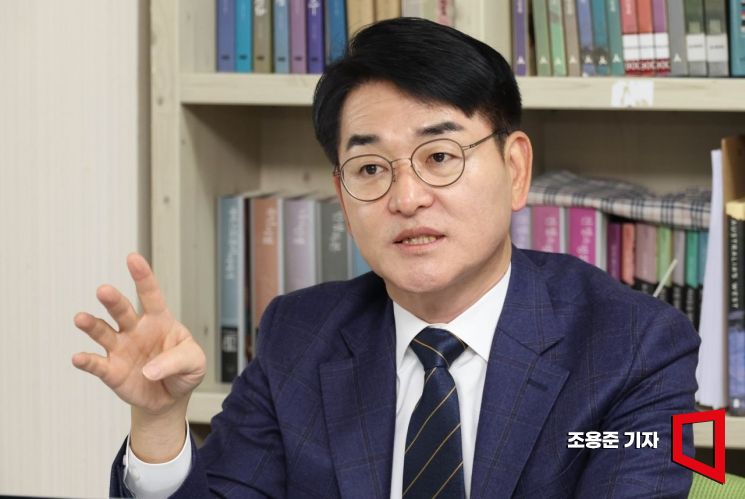 Former lawmaker Park Yong-jin is being interviewed by Asia Economy at the Gangbuk Future Research Institute in Gangbuk-gu, Seoul. Photo by Jo Yong-jun
On the 24th, Park criticized on his Facebook, "A politician who resembles Yoon Seok-yeol (President) more than anyone else, insisting on exercising veto power even on a law passed through bipartisan agreement, not just by the opposition alone."
He acknowledged, "It is clear that this pension reform has many shortcomings for the younger generation," but added, "That does not mean we can delay the depletion point of the pension fund even slightly or push back the achievement of additional pension credits for military service and childbirth."
He continued, "'Pay more, receive more' reform plans may be disappointing at the moment, but through further structural reforms such as improving the fund's rate of return and pensionizing retirement pensions, it can be developed into a reform plan favorable to the younger generation," adding, "We must take even one step forward to overcome the immediate mountain ahead."
Park also questioned, "The fiscal burden caused by the inheritance tax reduction policy advocated by former leader Han is passed on to the youth by several trillion won every year, yet he not only refuses to veto it but actively supports it. Isn't this inconsistent and erratic political wavering?"
He said, "If someone who insists on using veto power even on bipartisan legislation becomes president, which laws would they not veto? Politics that claim all powers granted by law can be used arbitrarily?this is the pathology that appears when a former prosecutor becomes a national leader, and it represents a regression of democracy, which we have fully realized through Yoon Seok-yeol."
On the 20th, the National Assembly held a plenary session and passed an amendment to the National Pension Act that raises the contribution rate from 9% to 13% and the income replacement rate from 40% to 43%. The contribution rate refers to the amount subscribers pay monthly, and the income replacement rate refers to the ratio of the pension amount received compared to the average income during the pension subscription period.
© The Asia Business Daily(www.asiae.co.kr). All rights reserved.
![Clutching a Stolen Dior Bag, Saying "I Hate Being Poor but Real"... The Grotesque Con of a "Human Knockoff" [Slate]](https://cwcontent.asiae.co.kr/asiaresize/183/2026021902243444107_1771435474.jpg)















