Digital Currency Test Transactions for General Users Begin Next Month
Generate QR Codes in Bank Apps and Make Payments at Online and Offline Merchants
Starting next month, general users will begin pilot use of the central bank digital currency. Users can generate QR codes through their banking applications (apps) and make payments at online and offline merchants using deposit tokens converted from existing deposits. Contrary to some concerns about the institutional digital currency system, the government or central bank cannot access individual accounts at all. Merchants can reduce transaction fees, and users are expected to conveniently conduct transactions in traditional markets, which have mainly relied on cash transactions, while also using various vouchers in one place in the future.
On the 24th, the Bank of Korea announced, together with the Financial Services Commission and the Financial Supervisory Service, that from next month 1st until June 30th, the 'Digital Currency Test (Project Hangang)' will begin real transactions for general users. Recruitment of users for this purpose will be conducted from the 25th through participating banks (KB Kookmin, Shinhan, Hana, Woori, NH Nonghyup, IBK Industrial, BNK Busan). Users will be able to open deposit token electronic wallets and make payments at designated places starting from the 1st of next month.
Users can use 'deposit tokens' converted from their bank deposits to purchase goods and services at designated locations.
Since announcing the test plan in October 2023, the Bank of Korea, Financial Services Commission, and Financial Supervisory Service have prepared not only the system but also institutional aspects. The Bank of Korea established regulations governing matters related to test operations. Participating banks must hold digital currency reserves amounting to at least 7% of the deposit token issuance balance. The Financial Services Commission has allowed participating banks to issue deposit tokens through designation as innovative financial services and decided to apply deposit insurance to deposit tokens.
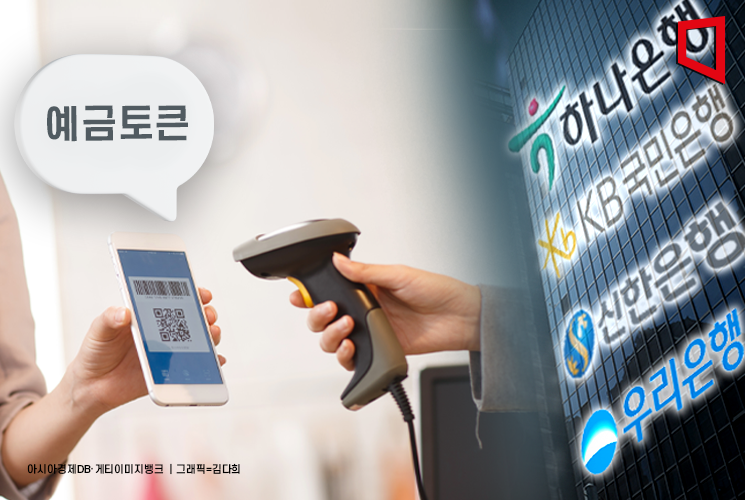
Pre-registration for general users is open to South Korean citizens aged 19 or older who hold a demand deposit account at the respective banks. However, the total number of participants (electronic wallets) is limited to a maximum of 100,000 people, with KB Kookmin, Shinhan, Hana, Woori, and Nonghyup recruiting 16,000 each, and IBK Industrial and BNK Busan recruiting 8,000 each. Pre-registration and issuance of deposit token electronic wallets will be conducted on a first-come, first-served basis.
General users who complete pre-registration can open electronic wallets non-face-to-face through the designated bank apps starting at 10 a.m. on April 1st. Users can link their demand deposit accounts at the respective banks and convert their deposits into deposit tokens to purchase goods and services at online and offline stores. To maintain a meaningful transaction volume during the real transaction period while minimizing the impact on the financial system, the deposit token holding limit for general users is set at 1 million KRW, and the total conversion limit to deposit tokens during the period is set at 5 million KRW.
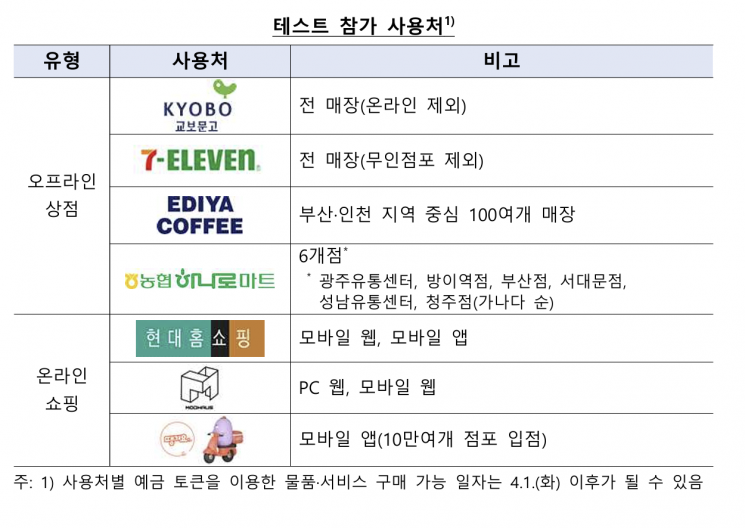
Users can use deposit tokens at offline stores such as bookstores (all Kyobo Bookstore locations except online), convenience stores (all 7-Eleven stores except unmanned stores), coffee shops (Ediya Coffee, about 100 stores mainly in Busan and Incheon), and marts (6 Nonghyup Hanaro Mart locations), as well as online shopping platforms including home shopping (Hyundai Home Shopping - mobile web and app), K-pop goods (COSMO - PC and mobile web), and delivery platforms (Ttaenggyeoyo - mobile app).
Transactions are conducted via QR codes. Payment (by users) and receipt (by merchants) are possible regardless of the electronic wallet issuing bank. In other words, a user holding an electronic wallet from Bank A can make payments at merchants holding electronic wallets from Bank B. Unlike other payment services, merchants receive sales proceeds immediately like cash. No separate fees are paid to electronic wallet issuing banks during the test period. A Bank of Korea official stated, "Even after the test is completed and actual implementation begins, fees will be lower compared to current cards or pay services," adding, "Cards involve value-added network (VAN) companies, and pay services involve payment gateway (PG) companies, which intervene in the payment process, but banks have significantly fewer intermediaries, resulting in lower fees. This will contribute not only to merchants' liquidity management but also to reducing fee burdens."
Real transactions for the digital voucher program will also be conducted. This will be linked with programs related to public welfare such as culture, youth support, childcare, and small business support in local governments like Seoul and Daegu, as well as some universities. A Bank of Korea official said, "Procedures for implementing the digital voucher program are currently underway," and "Separate guidance will be provided when real transactions begin." Through this demonstration, it is expected to improve voucher usage convenience and contribute to finding solutions to complex settlement procedures and fraudulent claims by utilizing the programming functions of digital currency and deposit tokens.
The system will operate continuously during the real transaction period for general users, except during maintenance times for system upkeep. During maintenance, deposit token balance inquiries will be possible, but purchases at merchants and conversions between deposits and deposit tokens will be restricted. Meanwhile, the Bank of Korea and participating banks plan to operate a 24-hour emergency response organization during the real transaction period to ensure stable system operation.
Considering the importance of verifying the normal operation of the system built on new technology through common task execution, this real transaction period is scheduled to end on June 30th. After the real transaction ends, the deposit token balances held by users will be collectively deposited into their linked demand deposit accounts. A Bank of Korea official stated, "After this real transaction ends, we will collect user feedback, reflect necessary improvements, and refurbish the system before conducting follow-up real transactions," adding, "In follow-up real transactions, we plan to discover and apply additional use cases such as person-to-person transfers using programming functions and various digital voucher programs."
© The Asia Business Daily(www.asiae.co.kr). All rights reserved.
![Clutching a Stolen Dior Bag, Saying "I Hate Being Poor but Real"... The Grotesque Con of a "Human Knockoff" [Slate]](https://cwcontent.asiae.co.kr/asiaresize/183/2026021902243444107_1771435474.jpg)


















