Constitutional Court: 5 for Dismissal, 2 for Rejection, 1 for Acceptance
On Key Issues: "No Serious Violation of the Constitution or Laws"
On Impeachment Quorum: "No Problem"
On the 24th, the Constitutional Court dismissed the impeachment of Prime Minister Han Deok-su. The court ruled that the grounds for impeachment presented by the National Assembly did not meet the impeachment requirements of serious violations of the Constitution and laws. Prime Minister Han immediately returned to his position as Acting President and Prime Minister upon the court's decision. This came 87 days after the National Assembly passed the impeachment motion on December 27 last year. With this, the nearly three-month-long 'Choi Sang-mok Acting President' system came to an end.
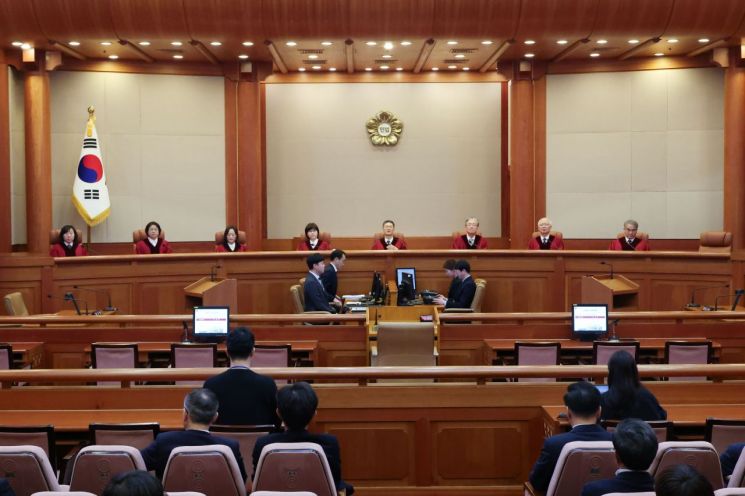
The eight Constitutional Court justices dismissed the impeachment motion with five votes for dismissal, two for rejection, and one for acceptance. The majority of seven justices favored dismissal or rejection. Regarding the quorum required for the impeachment trial, six justices stated there was "no problem." When the National Assembly passed the impeachment motion against Prime Minister Han, it applied the majority of the total members of the National Assembly (151 members), which is the requirement for impeachment of general cabinet members, instead of the two-thirds majority (200 members) required for presidential impeachment. Two justices, Jeong Hyeong-sik and Jo Han-chang, found this part inappropriate.
The six justices who deemed the impeachment vote itself lawful stated, "The quorum for the National Assembly's impeachment motion against the Acting Prime Minister, who is exercising presidential powers, should be the majority of the total members of the National Assembly, which is the quorum for impeachment motions against the Prime Minister in his original capacity." This effectively sets a new standard by the Constitutional Court regarding the impeachment requirements for an Acting President during a presidential impeachment.
Among these six justices, except for Justice Jeong Gye-seon (who supported acceptance), the other five all voted for dismissal, but their detailed opinions were split 4 to 1. Justices Moon Hyeong-bae, Lee Mi-seon, Kim Hyeong-du, and Jeong Jeong-mi stated, "Regarding the grounds for impeachment of Prime Minister Han, including the exercise of the right to request reconsideration of the special prosecutor appointment bill, the declaration of martial law and acts of rebellion, and the request for recommendation of special prosecutor candidates related to joint state administration, there is no violation of the Constitution or laws." However, they found the failure to appoint constitutional court justices to be a "violation of the Constitution and the State Public Officials Act." Nevertheless, they said, "It cannot be definitively concluded that this violation constitutes a betrayal of the public trust indirectly granted through the appointing authority, the President." They considered that although there were some violations of the Constitution and laws, they were not serious enough to warrant dismissal.
Additionally, Justice Kim Bok-hyeong stated, "The failure of the respondent to appoint constitutional court justices is also difficult to see as a violation of the Constitution and laws." Since none of the grounds for impeachment were illegal, he considered them not wrongful. Justices Jeong Hyeong-sik and Jo Han-chang, who issued rejection opinions, stated, "Since the impeachment motion against the Acting Prime Minister exercising presidential powers requires a two-thirds majority of the total members of the National Assembly, this impeachment trial request does not meet the quorum stipulated by the Constitution and is therefore inadmissible." The only justice who believed Prime Minister Han should be dismissed, Justice Jeong Gye-seon, stated, "Regarding the grounds for impeachment related to the request for recommendation of special prosecutor candidates and the failure to appoint constitutional court justices, the respondent's violations of the Constitution and laws are recognized, and the degree of violation is serious enough to justify dismissal of the respondent."
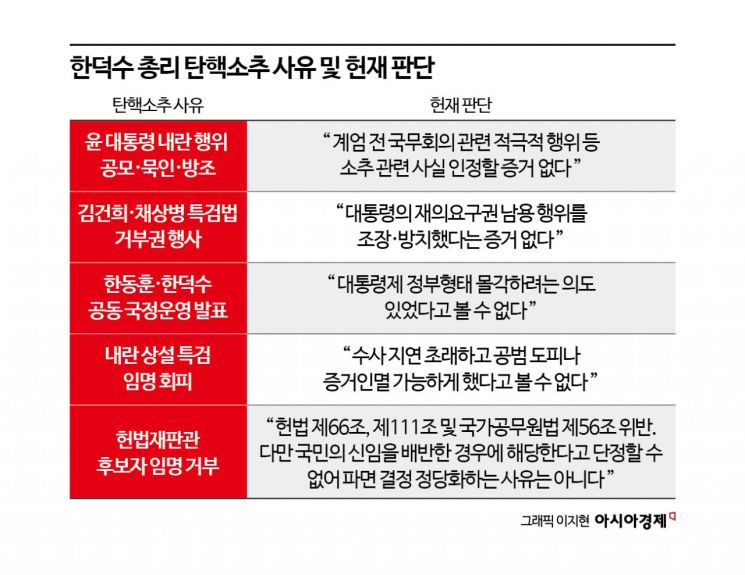
Earlier, on December 27 last year, the National Assembly passed the impeachment motion citing reasons including ▲ conspiracy, connivance, and aiding acts of rebellion under the December 3 martial law, ▲ refusal of the special prosecutor laws for Kim Geon-hee and Chae Sang-byeong, ▲ announcement of joint state administration by Han Dong-hoon and Han Deok-su, ▲ avoidance of appointing a permanent special prosecutor for rebellion, and ▲ refusal to appoint constitutional court justices.
In response, Prime Minister Han, during the final arguments of the impeachment trial held on the 19th of last month, refuted each claim by the National Assembly, stating they could not constitute grounds for impeachment. Regarding one of the key issues, the 'December 3 martial law rebellion conspiracy, connivance, and aiding,' he said, "Amid extreme confrontation between the ruling and opposition parties, I oversaw administrative departments and assisted the President to overcome difficult situations, but I failed to persuade the President to choose a different course." He added, "I was not informed of the martial law in advance and had no involvement in mobilizing the military or police." Regarding the failure to appoint three constitutional court justice candidates as Acting President, he stated, "There is no precedent for appointing justices without bipartisan agreement."
The number of officials returning to duty after impeachment motions rises to nine
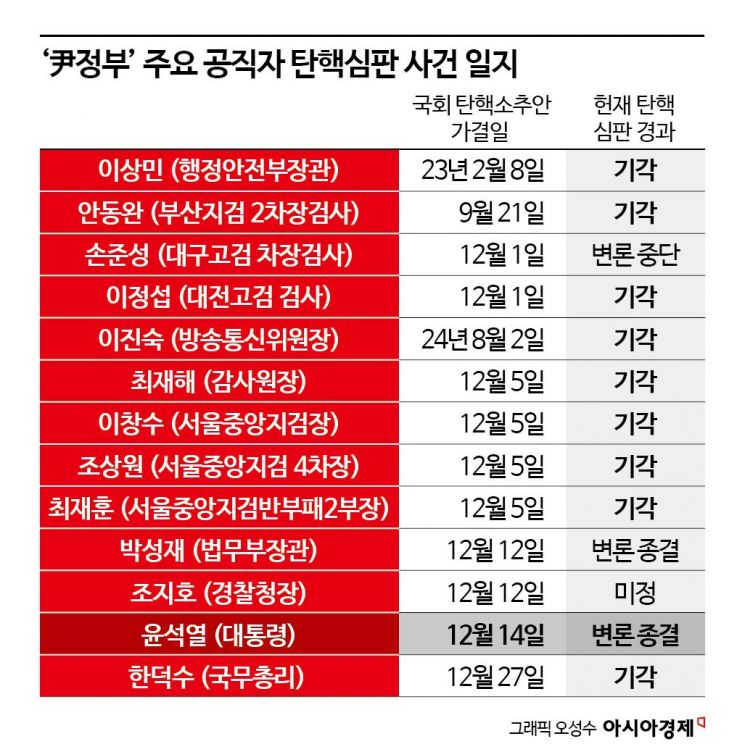
With the Constitutional Court's dismissal of the impeachment motion on this day, the number of public officials in the current administration who were impeached but have returned to their duties has increased to nine. The Constitutional Court began with a unanimous dismissal decision in July 2023 for former Minister of the Interior and Safety Lee Sang-min, ruling that it was difficult to see a violation of the Disaster and Safety Act. In May last year, the court also dismissed the impeachment of prosecutor Ahn Dong-wan, who was impeached over the 'Yu Woo-sung retaliatory prosecution controversy,' with a 5 to 4 vote.
In August last year, the court unanimously dismissed the impeachment of prosecutor Lee Jeong-seop, who investigated Lee Jae-myung, leader of the Democratic Party of Korea, stating that the impeachment was inadmissible and the grounds were not specified. Most recently, in January this year, the court dismissed the impeachment of Lee Jin-sook, Chairperson of the Korea Communications Commission, with a 4 to 4 vote. So far, the National Assembly has impeached 13 major officials of the Yoon Seok-yeol administration, including President Yoon Seok-yeol himself, and all nine who have received impeachment trial rulings by the 24th have had their impeachments dismissed and returned to office.
When will President Yoon's impeachment trial ruling be announced?
The ruling on President Yoon's impeachment is likely to come later this week at the earliest. The Constitutional Court rarely issues rulings on consecutive days. The sentencing for Lee Jae-myung's second trial for violation of the Public Official Election Act is scheduled for the 26th, which coincides with a nationwide mock exam for high school students. Given the Constitutional Court's awareness of the potential fallout from President Yoon's impeachment ruling, it is generally viewed as unlikely that the court will choose that day. Additionally, the court typically issues rulings on general cases such as constitutional petitions on the last Thursday of each month. According to the usual schedule, the 28th would be the day for general case rulings.
Amid the 'Judicial Super Week' sequence of 'Han Deok-su → Lee Jae-myung → Yoon Seok-yeol,' rallies both supporting and opposing President Yoon's impeachment were held across downtown areas last weekend. Approximately 70,000 people (police estimate) gathered on the 22nd at Gwanghwamun and Yeouido from both sides. Furthermore, the 'Jeon Bong-jun Struggle Group' under the National Federation of Farmers' Associations (Jeonnong) has announced another tractor rally on the 25th, with President Yoon's supporters showing signs of counteraction. In response, the police issued a ban on rallies to prevent physical clashes. As the impeachment trial ruling continues to be delayed, the confrontation between factions is intensifying, and lawmakers from both ruling and opposition parties are engaging in all-out efforts outside the National Assembly. The People Power Party is continuing relay protests in front of the Constitutional Court urging dismissal of the impeachment, while the Democratic Party has set up a tent party headquarters near the Constitutional Court in Gwanghwamun, Seoul, and plans to stay there until President Yoon is dismissed.
© The Asia Business Daily(www.asiae.co.kr). All rights reserved.
![Clutching a Stolen Dior Bag, Saying "I Hate Being Poor but Real"... The Grotesque Con of a "Human Knockoff" [Slate]](https://cwcontent.asiae.co.kr/asiaresize/183/2026021902243444107_1771435474.jpg)

















