Middle-Class Surplus Drops to 650,000 Won in Q4 Last Year
Three Consecutive Quarters of Decline Due to Interest, Education, and Tax Burdens
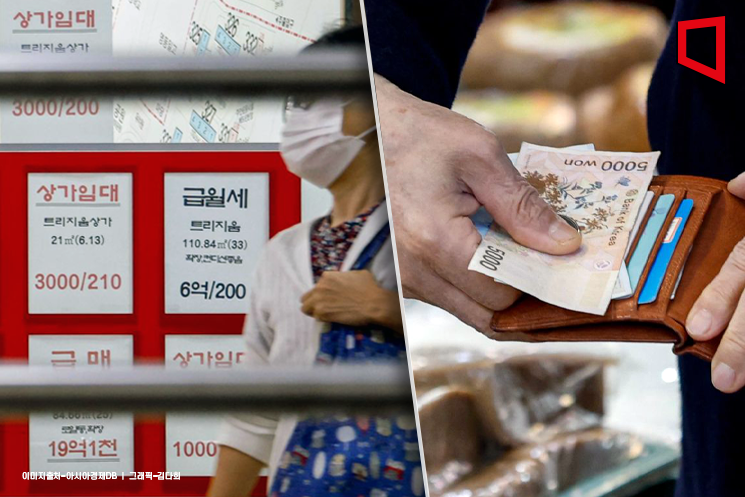
Disposable income for households in the upper-middle-income bracket, classified as the 40-60% income percentile, has decreased for three consecutive quarters, falling below 700,000 won for the first time in five years. Although household income increased, significant rises in acquisition and registration taxes related to real estate purchases, interest payments, and education expenses have impacted this trend. There are concerns that the sharp contraction in disposable income among middle-class households could dampen consumer sentiment, potentially shaking not only domestic demand but the very foundation of the economy.
According to the National Statistical Office’s National Statistics Portal (KOSIS) on the 24th, the real surplus amount for households in the third income quintile (top 40-60%) in the fourth quarter of last year was 658,000 won, down 88,000 won from a year earlier. This is the lowest since the fourth quarter of 2019 (653,000 won), marking the first time in five years that the surplus has fallen below 700,000 won. While the definition of the middle class varies slightly by country and era, it generally includes households in the third income quintile, representing the middle segment of the income distribution.
The surplus amount refers to the income remaining after subtracting non-consumption expenditures such as interest and taxes, as well as consumption expenditures like food, clothing, and housing costs, representing household disposable income. Four years ago, the surplus for third-quintile households exceeded 900,000 won, but it has sharply declined since the end of the COVID-19 pandemic. Since the third quarter of 2022, the surplus has decreased in eight quarters, except for the second quarter of 2023 and the first quarter of 2024. Notably, from the second quarter onward, the surplus has declined for three consecutive quarters with an increasing rate of decrease.
This contrasts with the overall average household surplus, which has increased for two consecutive recent quarters, showing signs of recovery. The third quintile is the only group to have experienced a decrease in surplus for three consecutive quarters. The lowest-income group, the first quintile, recorded a negative surplus in the fourth quarter of last year but had positive surpluses in the previous six quarters. The second, fourth, and highest-income fifth quintiles all saw increases in surplus in the fourth quarter of last year.

The shrinking surplus for third-quintile households is largely due to increased consumption expenditures in health, transportation, and education, as well as non-consumption expenditures such as interest and acquisition/registration taxes. In the fourth quarter of last year, non-consumption expenditures for third-quintile households reached 777,000 won, up 12.8% from a year earlier. This is the highest amount and the largest increase since household income and expenditure statistics began being compiled together in 2019.
Among these, interest costs rose by 1.2% to 108,000 won. After increasing in the fourth quarter of last year, interest expenses surpassed 100,000 won again. Acquisition and registration taxes related to real estate purchases caused non-recurring taxes (55,000 won) to increase nearly fivefold (491.8%), further reducing household disposable income. Education expenses (145,000 won) increased by 13.2%, far exceeding the average increase in education expenses across all households (0.4%).
The rapid contraction of disposable income among middle-class households could lead to weakened consumer sentiment. There are concerns that the tight financial conditions of middle-class households may become a negative factor that not only affects domestic demand but also undermines the economic foundation itself. Kim Kwang-seok, head of economic research at the Korea Economic Research Institute, stated, "The third quintile has a homeownership rate exceeding 50% and desires to maintain education expenses at levels similar to high-income groups. The reduction in disposable income for this group could become a new negative factor for domestic demand."
© The Asia Business Daily(www.asiae.co.kr). All rights reserved.
![Clutching a Stolen Dior Bag, Saying "I Hate Being Poor but Real"... The Grotesque Con of a "Human Knockoff" [Slate]](https://cwcontent.asiae.co.kr/asiaresize/183/2026021902243444107_1771435474.jpg)

















