Paralyzed Patient Received BCI Chip Implant in January Last Year
Chip Control Ability Improved Over One Year
Elon Musk, CEO of Tesla, revealed an update that the first patient implanted with a computer chip developed by his neuroscience startup Neuralink has improved their control abilities one year after the surgery.
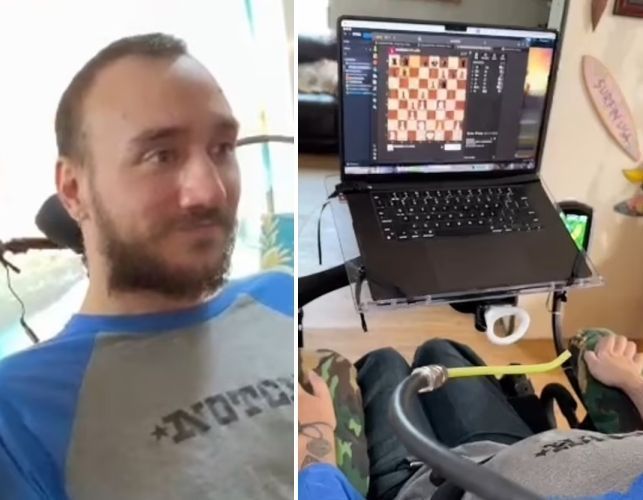 Elon Musk, who leads the neuroscience startup company Neuralink, has for the first time revealed a patient with a computer chip implanted in the brain (photo) playing chess using only their thoughts. Neuralink X
According to the British BBC on the 23rd (local time), Neuralink's first clinical trial participant, Norland Arvo (30), has progressed from being able to play chess and video games using only his thoughts after the surgery to gradually enhancing his ability to use the chip. He said, "I beat my friends in games," adding, "It should be impossible, but it is actually happening."
Arvo, who has been paralyzed from the shoulders down due to a diving accident, received Neuralink's brain-computer interface (BCI) chip implanted in his brain in January 2024, eight years after the accident. The BCI chip converts brainwaves into electrical signals, enabling interaction with electronic devices.
A video showing Arvo, a quadriplegic patient, enjoying online chess was released in March 2024. In the video released by Neuralink, Arvo is seen sitting in a wheelchair without moving his hands, controlling the mouse cursor on a laptop screen with his gaze to play chess.
Regarding Elon Musk, Arvo said they had conversations before and after the surgery and that "he seemed as happy as I was."
However, not all processes went smoothly. On one occasion, the connection between the chip and the brain was lost, making computer control impossible. Arvo said, "I was really upset," and "I didn't know if I could use Neuralink again." Although this error was resolved by adjusting the software, it was criticized for highlighting the technological limitations experts have pointed out.
Some have also raised concerns about privacy issues. Anil Seth, a neuroscience professor at the University of Sussex, said, "Extracting brain activity means not only accessing our behaviors but also our thoughts, beliefs, and emotions," adding, "The moment access to the information inside your head becomes possible, there will no longer be any barrier to protecting an individual's privacy."
© The Asia Business Daily(www.asiae.co.kr). All rights reserved.
![Clutching a Stolen Dior Bag, Saying "I Hate Being Poor but Real"... The Grotesque Con of a "Human Knockoff" [Slate]](https://cwcontent.asiae.co.kr/asiaresize/183/2026021902243444107_1771435474.jpg)















