The Shock of Low-Cost, High-Performance DeepSeek Remains
"Valuation Bubble, Such as PER, Is Not Present"
Interest is focused on whether the 'dot-com bubble' will be recreated as the U.S. stock market has failed to recover after a recent correction. On Wall Street, concerns that the market bubble could burst clash with opinions that this time is different, with AI-related companies securing profitability to justify their valuations.
On the 23rd (local time), Bloomberg News reported, "The echoes of the dot-com bubble are ringing again," adding, "The structure in which AI and the internet correspond evokes frightening memories from 25 years ago."
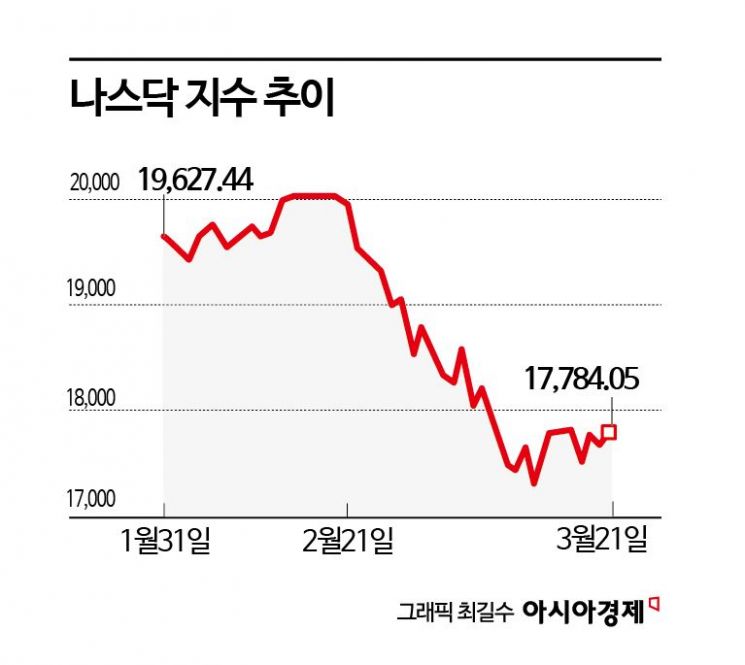
On the 21st, the Nasdaq index, which is tech-stock focused, closed at 17,691.63, down 11.57% from its intraday high on the 18th of last month. This correction has fueled ongoing concerns on Wall Street that the U.S. market could be replaying the dot-com bubble of the past.
Daron Acemoglu, a professor of economics at the Massachusetts Institute of Technology (MIT) and last year's Nobel laureate in economics, said, "During the dot-com bubble, there was massive hype around the technology called the internet, but no company had a business model that made money from the internet." He explained, "This is why the dot-com bubble collapsed." If the big tech companies, which have competitively invested to gain an edge in AI technology, continue to fail to recoup those investments as profits, the dot-com bubble could be recreated.
There are also concerns that the success of DeepSeek, which shocked the world by launching a low-cost, high-performance AI model in January, could trigger a bubble burst. Bloomberg explained that investors realized the reality that dominance in AI technology is not guaranteed just because of large investments, as China's inexpensive AI models could eliminate demand for Nvidia products.
Some analysts argue that the recent AI boom has not reached the extreme overheating seen during the dot-com bubble. In 1999, the price-to-earnings ratio (PER) of the Nasdaq index was about 90 times, whereas it currently remains at around 30 to 40 times. Experts attribute this lower valuation burden to AI development being centered on financially sound big tech companies. Ken Fisher, founder of the global investment firm Fisher Investments, said, "During the dot-com bubble, a significant number of the top 200 companies by market capitalization had negative cash flow. That was the part that caused the bubble."
Bloomberg also pointed out that during the dot-com bubble, there were no companies with the massive capital power like today's big tech firms. "Just this year, Alphabet, Amazon, Meta, and Microsoft are expected to invest a total of $300 billion in capital expenditures to strengthen AI capabilities while generating $234 billion in cash flow," it noted, adding, "In 2000, most investments in the internet were speculative and directed at unprofitable startups."
However, Wall Street unanimously agrees that even if the AI-driven stock market collapses as a bubble, the fact that AI will change the future cannot be denied. Rob Arnott, founder of the investment management firm Research Affiliates, said, "Now everything is connected through the internet, but that was not the case during the dot-com bubble. Internet adoption happened gradually and eventually." Bloomberg pointed out, "In 2000, the internet was a 'right investment' but a 'wrong-timed investment.'"
© The Asia Business Daily(www.asiae.co.kr). All rights reserved.

















