LNG Project Presents Both Risks and Opportunities
Pressure Mounts on Korea to Join After Taiwan's Participation
"Discussion Possible Only After Ministry's Policy Direction Is Set"
Mike Dunleavy, Governor of Alaska, USA, is visiting Korea to request participation in a liquefied natural gas (LNG) development project. Domestic companies are paying close attention to the government's judgment and stance, as opportunities and risks coexist depending on the conditions set by the United States.
According to diplomatic, trade authorities, and the energy industry on the 24th, Governor Dunleavy arrived in Korea on the same day and will meet with Minister An Deok-geun of the Ministry of Trade, Industry and Energy and representatives of domestic companies over two days. POSCO International, SK Innovation E&S, GS Energy, and SeAH Steel are mentioned as participating companies.
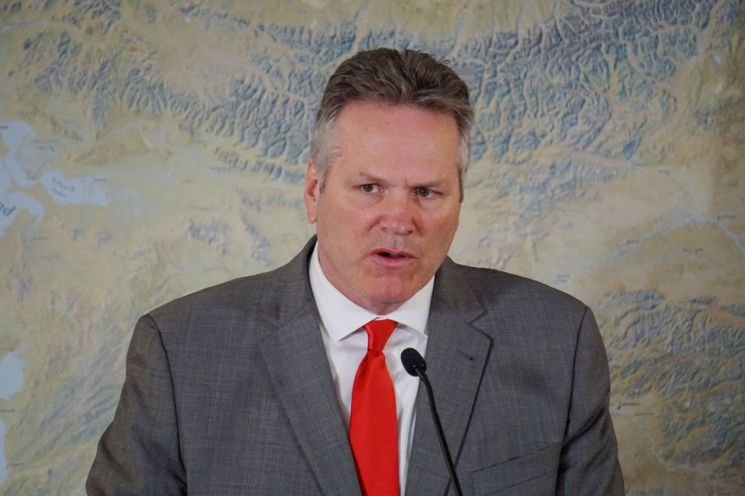
Governor Dunleavy has expressed a desire for Korea to join the Alaska LNG project. This project involves constructing a gas pipeline approximately 1,300 km long to transport natural gas produced in northern Alaska to southern ports for export. Former U.S. President Donald Trump also paid special attention to this, and the industry expects it to be a large-scale project. If production begins as planned by the State of Alaska in 2029 and Korea imports large quantities of LNG, it is expected to contribute to reducing the U.S. trade deficit with Korea, which reached $65.8 billion (about 96 trillion won) last year.
Japan officially expressed its intention to participate in the project during Prime Minister Shigeru Ishiba's visit to the U.S. in February. Taiwan's state-owned oil company, CPC Corporation, also signed a letter of intent for LNG purchase and investment with the Alaska Gasline Development Corporation (AGDC) on the 20th, when Governor Dunleavy visited Taiwan. Since the U.S. regards Japan and Korea, the second and third largest LNG importers worldwide, as key partners, pressure to join the project is increasing.
The Alaska LNG project is evaluated as having both risks and opportunities. As the pipe supply market necessary for large-scale construction opens, related companies such as POSCO International and SeAH Steel can secure major customers. SK Innovation E&S, which is conducting LNG business in the U.S., is also expected to benefit. On the other hand, Alaska's extreme climate is considered a risk factor. The harsh cold and strong winds make maintenance difficult. This is also why large oil fields discovered in the 1960s have not yet been developed.
The industry is waiting for government coordination and judgment. A representative of a company known to attend the meeting with Governor Dunleavy explained regarding the Alaska LNG project, "The Ministry of Trade, Industry and Energy holds the key," adding, "Discussions can proceed only after the specific proposals from Governor Dunleavy and the government's policy direction are confirmed." This project also has diplomatic significance, as the U.S. under the second Trump administration aims to enhance its energy security by utilizing East Asian countries with high demand. The industry explains that since Governor Dunleavy is likely to present specific requests to Minister An, individual companies cannot decide on project participation on their own. Another industry official said, "Taiwan decided very quickly," adding, "Once our government sets its direction, we will analyze the business feasibility accordingly, just like Taiwan."
© The Asia Business Daily(www.asiae.co.kr). All rights reserved.
![Clutching a Stolen Dior Bag, Saying "I Hate Being Poor but Real"... The Grotesque Con of a "Human Knockoff" [Slate]](https://cwcontent.asiae.co.kr/asiaresize/183/2026021902243444107_1771435474.jpg)















