Mackerel production down 72.5% last month
Hairtail and squid also drop by 80% and 91%, respectively
Poor fishing conditions, reduced operations, and climate change are key factors
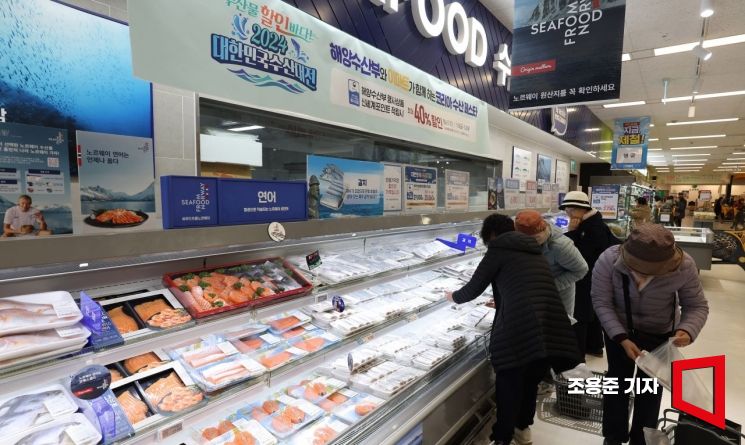 Customers are purchasing discounted products at the "Korea Seafood Expo - Korea Seafood Festa" event at Emart Yongsan branch. This is a stock photo unrelated to the article content.
The production of popular fish species such as mackerel, hairtail, and squid decreased last month, while seafood prices surged, increasing the burden on grocery prices.
According to the Fisheries Industry Observation Center of the Korea Maritime Institute on the 24th, last month's mackerel production was 5,608 tons, down 72.5% from the previous month. This is a decrease of 38.1% and 10.9% compared to last year and the average year, respectively.
While production declined, mackerel prices have risen. Last month, the wholesale price of mackerel was 5,937 KRW per kilogram, up 28.4% from the previous month. The wholesale price also increased by 6.7% compared to the previous month. The consumer price (fresh refrigerated) was 13,620 KRW per kilogram, soaring 21.8% and 23.3% compared to the average year and last year, respectively.
Prices of other popular fish species are also soaring. Last month, hairtail production was recorded at 917 tons, down 80% from the previous month. This represents a decrease of 55.6% and 71.1% compared to last year and the average year, respectively. The wholesale price of hairtail rose 32.7% from the previous month to 20,420 KRW per kilogram. The consumer price also increased by 9.0% to 23,110 KRW per kilogram.
Squid production last month was 194 tons, down 91% from January. This is a decrease of 2.0% compared to the same month last year and 91.3% compared to the average year. As production declined, the wholesale price of squid (fresh refrigerated) rose 18.3% from the previous month to 8,059 KRW per kilogram. This is an increase of 50.9% and 70.7% compared to last year and the average year, respectively. Consumer prices rose 36.7% and 10.7% compared to the average year and last year, respectively.
The causes of the decline in production of popular fish species include poor fishing conditions, reduced fishing days due to weather impacts, and climate change. In particular, it is analyzed that the high water temperature phenomenon caused by climate change is causing fishing grounds to shift, and even when fishing grounds are formed, the low density of seafood is affecting the decrease in production.
However, the Ministry of Oceans and Fisheries expects production to recover this month as fishing conditions improve.
Additionally, the Ministry plans to stabilize prices by releasing stockpiled supplies and holding discount events. Since the 19th, the Ministry has been conducting seafood discount events to commemorate Fisheries Day, and from the 26th, it will also hold a refund event for Onnuri gift certificates when purchasing seafood.
© The Asia Business Daily(www.asiae.co.kr). All rights reserved.
![Clutching a Stolen Dior Bag, Saying "I Hate Being Poor but Real"... The Grotesque Con of a "Human Knockoff" [Slate]](https://cwcontent.asiae.co.kr/asiaresize/183/2026021902243444107_1771435474.jpg)















