KDCA: 58.7% of All Patients Are Aged 65 or Older
Number of Foreign Patients Decreases, but Their Proportion Rises
While the number of tuberculosis patients in South Korea continues to decline, the proportion of elderly patients aged 65 and over and foreign patients has been steadily increasing.
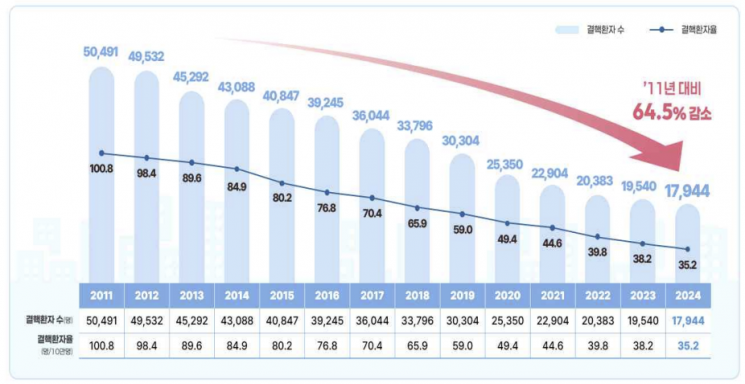
According to the Korea Disease Control and Prevention Agency on the 24th, last year, 17,944 tuberculosis cases were reported domestically, an 8.2% decrease compared to the previous year. Among them, 14,412 were new cases, and 3,532 were relapses or retreatments. The tuberculosis incidence rate, which is the number of tuberculosis patients per 100,000 population, decreased from 38.2 in 2023 to 35.2 in 2024.
The number of tuberculosis patients has decreased by an average of 7.6% annually over the past 13 years, dropping 64.5% since the peak of 50,491 cases (100.8 per 100,000 population) recorded in 2011 after the establishment of the national tuberculosis surveillance system in 2000.
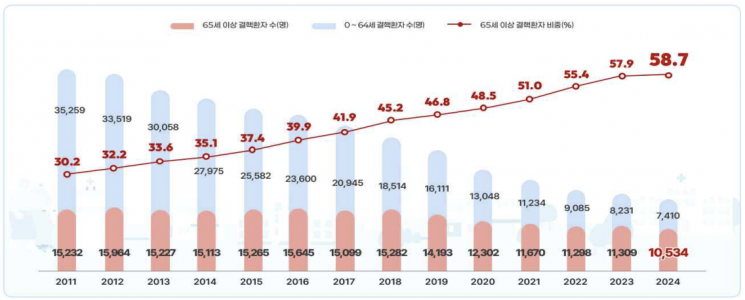
Looking at last year’s tuberculosis patients by age group, the elderly aged 65 and over numbered 10,534, a 6.9% decrease from 11,309 the previous year, but their share of total patients increased again to 58.7%. Previously, the proportion of tuberculosis patients aged 65 and over was 48.5% in 2020, 51.0% in 2021, 55.4% in 2022, and 57.9% in 2023. The tuberculosis incidence rate per 100,000 population for those aged 65 and over was 105.8, about six times higher than that of those under 65 (18.0 per 100,000).
The number of foreign tuberculosis patients has been declining since 2016, when mandatory tuberculosis screening was implemented for long-term residents from high-risk countries. In 2024, there were 1,077 foreign patients, a 2.7% decrease from 1,107 in the previous year. However, the proportion of foreign patients among all tuberculosis cases increased by 0.3 percentage points from 5.7% in 2023 to 6.0% in 2024, following 5.2% in 2020, 5.4% in 2021, and 5.3% in 2022.
By type, among all tuberculosis patients, 14,095 (78.5%) had pulmonary tuberculosis, and 3,849 (21.5%) had extrapulmonary tuberculosis occurring in organs other than the lungs. Additionally, patients with multidrug-resistant or rifampin-resistant tuberculosis, which are difficult to treat due to drug resistance, numbered 461, a 16.3% decrease from 551 the previous year.
In 2023, the Korea Disease Control and Prevention Agency established the "3rd Comprehensive Tuberculosis Control Plan (2023?27)" and is implementing management policies covering the entire tuberculosis cycle (prevention, diagnosis, and treatment). Considering recent tuberculosis characteristics such as the increasing proportion of elderly and foreign patients, thorough tuberculosis screening, epidemiological investigations, and patient management are being conducted to detect and treat tuberculosis patients early, while research to eradicate tuberculosis has also been strengthened.
In particular, the "Visiting Tuberculosis Screening Project" targets vulnerable groups such as the elderly and homeless, who have relatively low access to medical care due to physical and socioeconomic reasons. Last year, approximately 187,000 screenings were conducted, leading to the early detection of 133 tuberculosis patients and preventing further transmission. The tuberculosis epidemiological investigation team, formed in 2013 to enable early detection, conducted investigations on contacts in families, workplaces, and other group facilities, identifying 250 patients early last year, a 25.0% increase compared to 200 patients the previous year.
The government will strengthen investment in advanced practical technology development research to eradicate tuberculosis starting this year. It will advance rapid and simultaneous diagnostic technologies for early detection of multidrug-resistant tuberculosis and prediction technologies for tuberculosis onset in high-risk groups, and actively promote the development of short-term treatment methods to reduce the burden of long-term treatment. Research will also be conducted on post-treatment sequelae and health risk factors in patients who have been cured.
At the commemorative event for the "15th Tuberculosis Prevention Day" held this morning, Ji Young-mi, Commissioner of the Korea Disease Control and Prevention Agency, said, "Despite the global increase in tuberculosis patients, South Korea has maintained a declining trend for 13 consecutive years by steadily implementing the national tuberculosis control program." She added, "Tuberculosis is not a disease of the past but an ongoing issue, so we will continue policy efforts to eradicate it." Commissioner Ji also emphasized the importance of active public participation, urging, "Especially, seniors aged 65 and over should receive tuberculosis screening at public health centers once a year regularly."
© The Asia Business Daily(www.asiae.co.kr). All rights reserved.
![Clutching a Stolen Dior Bag, Saying "I Hate Being Poor but Real"... The Grotesque Con of a "Human Knockoff" [Slate]](https://cwcontent.asiae.co.kr/asiaresize/183/2026021902243444107_1771435474.jpg)
















