Unelected Leader Carney vs. Career Politician Poilievre
Patriotism Surges Amid Trump’s Threats... General Election Moved Up by Six Months
Conservative and Liberal Parties Neck and Neck in Polls
Canadian Prime Minister Mark Carney announced on the 23rd (local time) that Canada is facing "the most serious crisis of our lifetime" due to the influence of U.S. President Donald Trump and will hold an early general election on April 28. This is about six months earlier than the originally scheduled voting date. In this election, 60-year-old unelected leader Carney, who has Wall Street experience, will face off against 45-year-old career politician and Conservative Party leader Pierre Poilievre.
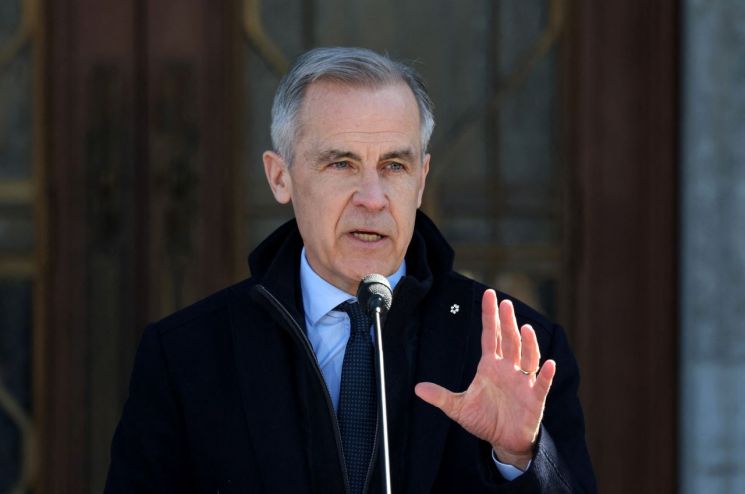
According to the Wall Street Journal (WSJ), The Guardian, and others, Carney held a press conference on the day and stated, "The general election vote will be held on April 28, and prior to that, candidates will undergo a five-week campaign schedule." Under Canadian election law, the original general election date was October 20.
Having served as governor of the Bank of Canada and the Bank of England, he promised middle-class tax cuts and a national reconstruction plan, urging unity in times of crisis. Carney emphasized, "I ask you to vote. Only then can we become a strong Canada."
Foreign media interpreted that Carney pulled the early election card riding on the rising support for the ruling Liberal Party amid tariff threats, provocations of Canada as the 51st U.S. state by President Donald Trump, and patriotic backlash.
The WSJ stated, "The ruling Liberal Party seemed poised for a crushing defeat just weeks ago, but with Trump threatening to impose punitive tariffs on one of America's largest trading partners, voters' concerns that the Canadian economy could be harmed have now put the party in a position to possibly win the election." It added, "Trump also proposed using economic power to merge Canada, a threat that sparked patriotic backlash and heightened public opinion against the U.S."
Carney also launched a fierce attack on President Trump that day, stirring the patriotism of the people. He said, "Due to Trump's unfair trade measures and threats to our sovereignty, we are facing the most critical crisis of our lifetime," adding, "Trump claims Canada is not a real country, seeks to divide us, and ultimately own us."
Carney further stated, "Canada's response must be to build a strong economic foundation and a safer nation," and "We will not let the U.S. take us over."
The Liberal Party, led for over nine years by former Prime Minister Justin Trudeau, has recently experienced a decline in support due to voter dissatisfaction caused by high inflation and rising housing prices. Accordingly, before the tariff war signaled by President Trump, the Conservative Party was expected to easily win the next general election. The Financial Times (FT) reported that Poilievre enjoyed a comfortable 20-point lead in polls from early January, when Trudeau resigned, until Trump took office the same month.
However, after Trudeau announced his resignation in January, anti-American sentiment surged in Canada, and recent polls show a narrow gap between the Conservative and Liberal parties. According to a recent poll by Abacus Data, the Conservative Party holds a slight lead nationwide with 39%, followed by the Liberal Party at 36%. The New Democratic Party, a key ally of the Trudeau government, trails at 12%.
However, Reuters reported that neither the Liberal Party led by Carney nor the Conservative Party led by Pierre Poilievre may secure an outright majority of seats. Even in the recently dissolved House of Commons, the Liberal Party did not hold a majority.
Conservative Party leader Pierre Poilievre said on the day, "The question is whether the Canadian people can endure a fourth Liberal term," blaming the Liberals for weak growth, rising housing costs, damage to what was once a respected immigration system, and setbacks in the country's resource sector projects.
In this general election, Canadian voters will elect 343 members of the House of Commons, five more than the 338 members in the 2021 general election. This change reflects the latest census results.
© The Asia Business Daily(www.asiae.co.kr). All rights reserved.
![Clutching a Stolen Dior Bag, Saying "I Hate Being Poor but Real"... The Grotesque Con of a "Human Knockoff" [Slate]](https://cwcontent.asiae.co.kr/asiaresize/183/2026021902243444107_1771435474.jpg)















