About Half, Including Yonsei University, Have Returned
Re-admission Difficult After Expulsion
Among the 40 medical schools, about half have set the deadline for medical students' registration and reinstatement applications on the 28th, drawing attention to whether the over one-year-long disruption in medical education can be normalized after this week.
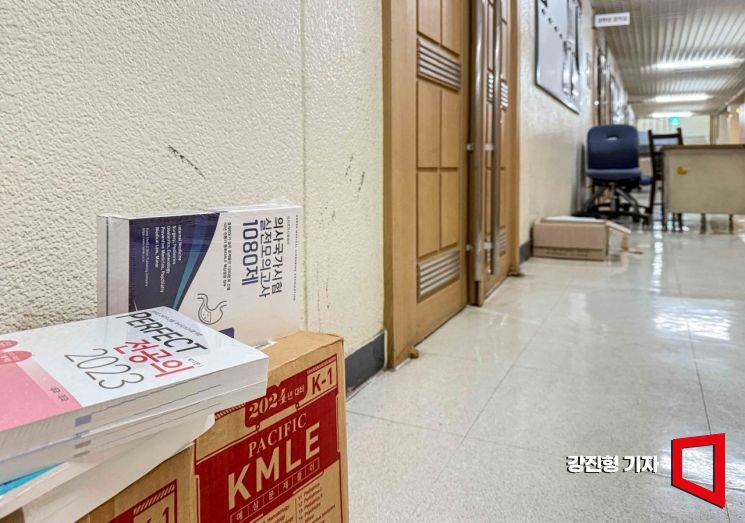 On the 21st, the deadline set by some medical schools including Yonsei University, Korea University, and Kyungpook National University for returning approached, and books were placed in front of the lecture hall at Yonsei University College of Medicine in Seodaemun-gu, Seoul. 2025.3.21. Photo by Kang Jin-hyung
According to the education sector on the 24th, Yonsei University will start sending 'Notice of Expulsion' to students on leave who have not registered. Yonsei University stated in a notice, "There is no change to the existing position of expelling students on the 28th if reinstatement applications are not submitted by the 21st."
As of the 21st, five medical schools, including Yonsei University, Korea University, Kyungpook National University, and CHA University, have completed registration and reinstatement applications. Among them, Yonsei University and Korea University reportedly have about half of the non-returning medical students registered.
As the Ministry of Education and each medical school have maintained a firm stance of handling non-reinstatement according to school regulations without implementing a 'flexible academic policy' this year, a sentiment of "let's at least avoid expulsion" seems to have emerged among medical students. If students pay tuition but do not register for courses, they will fail the year, but if they neither pay tuition nor register for courses, they will be expelled. Especially for the classes of 2024 and 2025, re-admission is difficult after expulsion, so the 'expulsion' factor is considered to have a significant impact on their return.
Re-admission is possible only to fill vacancies in the respective academic year. However, even if medical education normalizes this year, 'doubling' (simultaneous education of the classes of 2024 and 2025) is inevitable, and with the admission of the class of 2026 next year, there will be almost no vacancies in the first year. This means that if expelled, there will be no place to return to.
The Ministry of Education has emphasized that the greatest damage from delayed academic normalization will be felt starting from the class of 2024. Students from the class of 2023 and earlier can return and follow the previous curriculum, but the 2024 and 2025 classes, totaling 7,500 students, must take first-year courses together. If medical students do not return this year, three classes including the class of 2026 will have to attend classes simultaneously, but the Ministry of Education considers 'tripling' (simultaneous education of the classes of 2024, 2025, and 2026) practically impossible. The strict measures, even risking large-scale expulsions, stem from the urgent need to normalize medical education this year. Accordingly, attention is focused on whether the movement for medical students' return will spread to other universities. Among the 40 universities, 18 universities, including Seoul National University, Ewha Womans University, and Pusan National University, will accept reinstatement applications by the 27th, and Kyung Hee University, Inha University, and Catholic University by the 28th. The status of medical students' return at the 40 medical schools is expected to be compiled in early to mid-next month.
If a large-scale expulsion occurs, each university can fill vacancies through transfer admissions. Kim Hong-soon, Director of Medical Education Support at the Ministry of Education (Director of the Medical School Division), said on the radio on the 19th, "(Medical schools with vacancies) are few, but (general transfer admissions) are the usual procedure when vacancies occur." If this happens, the scale of transfer admissions next year is expected to increase by several tens of times. According to Jongro Academy, last year, 54 transfer students were admitted across 17 medical schools nationwide, with a competition rate of 65.4 to 1. The transfer admission competition rate has been rising annually, with 52.2:1 in 2022 (15 universities, 57 students admitted) and 62.0:1 in 2023 (16 universities, 59 students admitted). Lim Sung-ho, CEO of Jongro Academy, said, "The first and second-year medical student quota is 7,500, and if more than half do not return to school, about 4,000 students will be expelled. Considering that universities usually admit about 30% of the dropout rate through transfer admissions, this time each university might admit about 1,000 transfer students."
© The Asia Business Daily(www.asiae.co.kr). All rights reserved.

















