Goblin Fire Leaping Hundreds of Meters
Thick Smoke Hampers Firefighting Efforts
Among the 28 wildfires that occurred simultaneously nationwide, some escalated into large-scale fires. Experts pointed out that the wildfires in Gyeongnam and Gyeongbuk have caused massive damage due to the combination of early summer weather, the hot and dry spring westerly winds, and the phenomenon of 'bihwa' (飛火, fire spotting).
In fact, spring wildfires occurring east of the Baekdudaegan mountain range have often led to large-scale fires. For example, the ‘East Coast Wildfires’ that occurred from March 4 to 13, 2022, in Uljin, Gyeongbuk, and Samcheok, Gangneung, and Donghae in Gangwon burned 20,523 hectares of forest and displaced about 500 people.
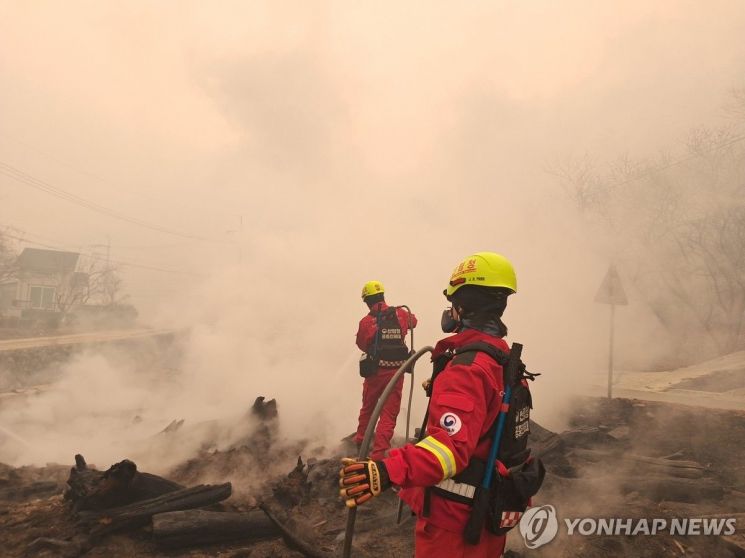 A wildfire suppression team member extinguishing flames at the fire scene. Photo by Yonhap News Agency
Moreover, during the spread of large wildfires, environmental factors such as 'topography, weather (climate), and fuel (tree species)' play a crucial role. It has also been pointed out that the rapid climate change, with early summer hot and dry weather arriving shortly after heavy snowfall, caught wildfire predictions off guard. The wildfires in April 2000 in Goseong, Gangneung, Donghae, and Samcheok, Gangwon, burned 23,794 hectares and spread across the entire East Coast.
The dominant analysis is that the large wildfires in Gyeongnam and Gyeongbuk were driven by the topographical characteristic of 'high in the west, low in the east' (seogodongjeo, 西高東低) and the strong westerly winds caused by the pressure pattern of 'high in the south, low in the north' (namgobukjeo, 南高北低), which served as the basis for rapid spread and enlargement. In spring, a pressure system with high pressure in the south and low pressure in the north maintains westerly winds.
As the westerly winds descend the Baekdudaegan mountain range, temperatures rise, and the steep eastern terrain experiences dry and hot winds. At this time, temperatures east of the Baekdudaegan rise significantly, and the atmosphere rapidly becomes dry.
This is why dry weather warnings were issued in various parts of the East Coast and Yeongnam inland, and strong wind warnings were issued in Gangwon Yeongdong and northeastern Gyeongbuk at the time of the wildfires. Daytime temperatures around 20 degrees Celsius, more than 10 degrees higher than average, resembling early summer weather, act as strong energy that exacerbates these spring climatic characteristics. This is analyzed to have caused unprecedented wildfire damage. The daytime temperature in Onyang-eup, Ulju, the previous day was recorded at 27.8 degrees Celsius.
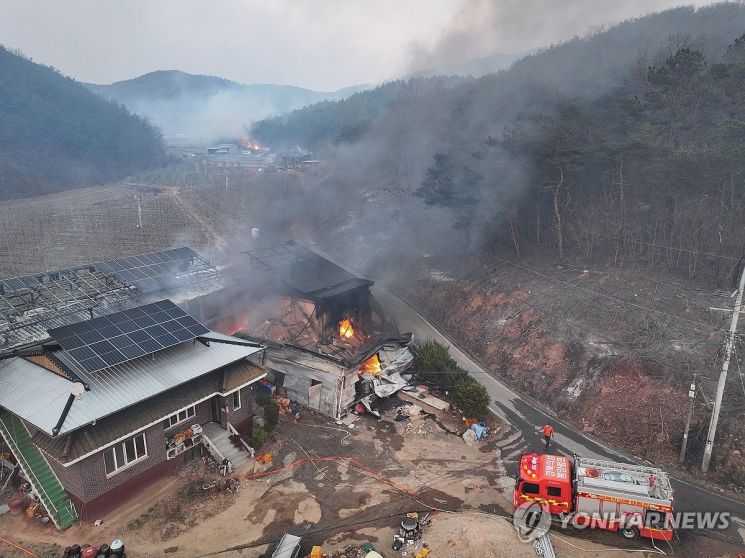 A wildfire that broke out on the 22nd in Gwaesan-ri, Anpyeong-myeon, Uiseong-gun, Gyeongbuk, rapidly spread, causing a residential building to catch fire and be destroyed. Photo by Yonhap News
Therefore, even a small spark in the spring forest can ignite a fuse and lead to an uncontrollable large wildfire, like a detonator exploding.
Additionally, spring strong winds not only increase the speed of wildfire spread but also cause the 'bihwa' (飛火, fire spotting) phenomenon, where embers are carried by the wind to start new fires. Bihwa, which can carry firebrands tens to hundreds of meters away like 'goblin fire,' is considered the biggest obstacle to wildfire suppression.
Dr. Lee Byung-du of the National Institute of Forest Science told Yonhap News on the 23rd, "The most significant features of these simultaneous wildfires are the strong westerly winds, early summer-like high temperatures, and the bihwa phenomenon," adding, "The combination of early summer weather and spring westerly winds is changing the pattern of large wildfires."
Another characteristic of these wildfires is the large amount of smoke generated. Seo Jae-cheol, a senior advisor at Green Korea United, said, "Unlike the dry surface leaf litter of parched mountains, the smoke generated from the moist humus layer renders firefighting helicopters, which are key to wildfire suppression, ineffective and makes it difficult for firefighting teams to approach."
Meanwhile, the Ministry of the Interior and Safety is urging people not to bring fire-related materials such as matches or lighters when entering forests during spring wildfire prevention efforts, and to refrain from burning rice paddies or field ridges near mountains. Unauthorized burning may result in fines, and burning within 100 meters of forest areas can lead to criminal penalties.
© The Asia Business Daily(www.asiae.co.kr). All rights reserved.
![Clutching a Stolen Dior Bag, Saying "I Hate Being Poor but Real"... The Grotesque Con of a "Human Knockoff" [Slate]](https://cwcontent.asiae.co.kr/asiaresize/183/2026021902243444107_1771435474.jpg)
















