Seoul Family Center Survey Results
"Women's Burden as Primary Caregivers"
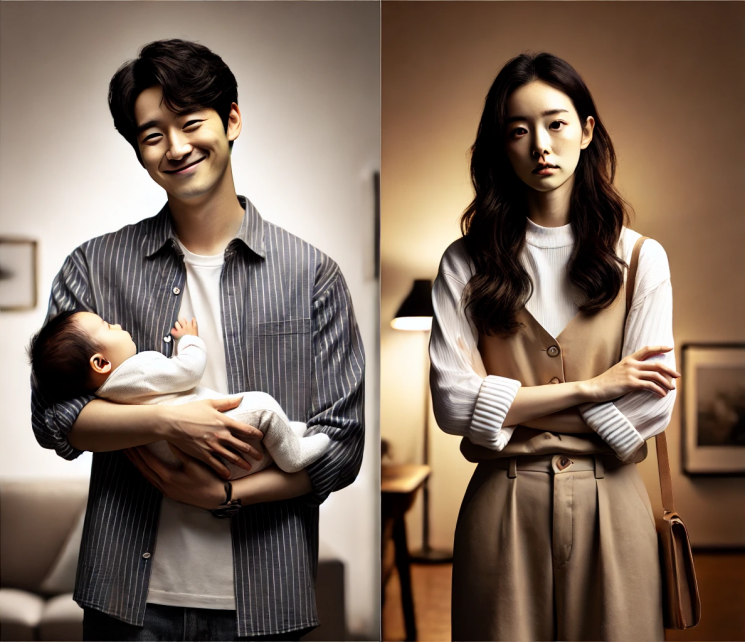
Men living in Seoul without children expressed a desire to become fathers, while women, on the contrary, did not want to, according to a survey.
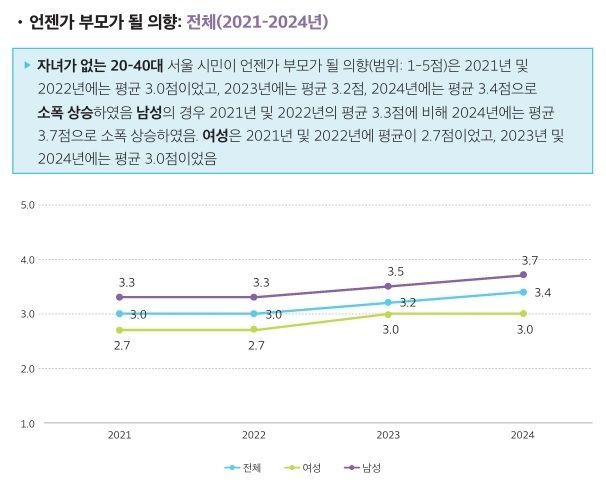
Yonhap News reported on the 23rd the contents of the 2024 Seoul Family Report published by the Seoul Family Center. According to the report, when surveying Seoul citizens aged 20 to 40 without children about their intention to become parents on a scale from 1 to 5, the average score was 3.4.
The online survey was conducted from July 8 to 14 last year with 884 participants, showing an increase from 3.2 the previous year. Men scored 3.7. The scores generally showed an upward trend from 3.3 in 2021 and 2022 to 3.5 in 2023.
Women scored 3.0, the same as in 2023. However, this was higher than the 2.7 recorded in 2021 and 2022.
Among respondents who scored 3 or higher on their intention to become parents, the reasons were also surveyed. The responses ranked as follows: "Because there will be someone to give love to" with 3.9 points, "Because I want to have a child with the person I love" with 3.8 points, and "Because of the fulfillment and joy of raising children" with 3.7 points.

The report analyzed that there was not a significant gender difference in the reasons for intending to become parents. However, for the statement "Korean society is not suitable for raising children," women scored 4.1 points while men scored 3.6 points, showing a difference. Responses related to economic conditions, such as "the burden of child-rearing and education costs," showed no meaningful gender difference.
Regarding this, the report pointed out, "It appears that traditional gender role expectations of women as caregivers are reflected," and added, "The background for women not wanting to become parents includes the burden of being the primary caregiver and the child-unfriendly nature of Korean society."
It further stated, "In the future, policies addressing low birth rates should focus on changing the cultural aspects of Korean society."
Meanwhile, in March, Lee Chang-yong, Governor of the Bank of Korea, warned that if the current low birth rate situation continues, South Korea will face economic contraction after 2050. He diagnosed that if the economy falls into recession due to low birth rates, populist policies such as cash handouts will inevitably increase, leading to a vicious cycle that further raises national debt.
Last year, South Korea's total fertility rate was 0.75, an increase of 0.03 from the previous year (0.72), marking a rebound after nine years.
© The Asia Business Daily(www.asiae.co.kr). All rights reserved.
![Clutching a Stolen Dior Bag, Saying "I Hate Being Poor but Real"... The Grotesque Con of a "Human Knockoff" [Slate]](https://cwcontent.asiae.co.kr/asiaresize/183/2026021902243444107_1771435474.jpg)

















