Jung Moonheon, Mayor of Jongno-gu, Interview
Jongno, Seoul, Lost 20,000 Residents in 10 Years
"No Future for a Town Without People"
Improving Living Conditions Is the Top Policy Priority
"Over the past decade, the population of Jongno-gu has decreased from 160,000 to less than 140,000. It is difficult to expect a future in a town without people. We will envision a future where people return to Jongno."
Jung Moon-heon, Mayor of Jongno-gu, Seoul (58), said in an interview with this publication on the 12th at the Samcheong Park Forest Library, "We must improve the living conditions in Jongno," and added, "We will create a Jongno where people come back."
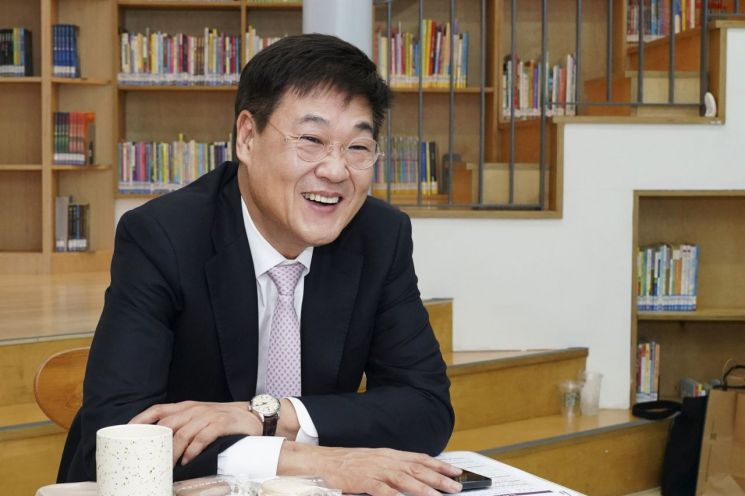 Jung Moon-heon, mayor of Jongno-gu, Seoul, who is originally from Jongno-gu, said, "We will improve living conditions to make Jongno a better place for residents to live." Provided by Jongno-gu.
Mayor Jung was born in Samcheong-dong and attended elementary, middle, and high schools in Jongno during the 1970s and 1980s. Although his father (the late Jung Jae-cheol, former National Assembly member) served as a National Assembly member for the 17th and 19th terms in his hometown of Goseong, Gangwon Province, he returned to his hometown Jongno and became the district mayor. His childhood memories include the oil tteokbokki sold outside Tongin Market in Cheongun-dong, the alleys of Hyoja-dong, and the crayfish he caught in the valley of Buam-dong outside Jahamun.
Mayor Jung said, "The villas built in the 1980s and 1990s remain as they are in this neighborhood, and Jongno as a whole has become a place unsuitable for young generations to live due to various regulations," adding, "We will continue to identify and abolish or improve regulations that cause inconvenience to residents."
He said that the policies he has promoted and will continue to pursue during his first term of 2 years and 9 months are based on these standards and principles. Mayor Jung stated, "Last year, we relaxed the height restrictions in the high-altitude zones around Gugi and Pyeongchang-dong and near Gyeongbokgung Palace, which had been a long-standing wish of residents, and also eased building regulations in the natural scenic zones," adding, "This marked an important turning point for improving the aging residential environment."
Mayor Jung said, "Going forward, we will push for the removal of unreasonable overlapping regulations on the boundaries of natural scenic zones, and maximize the effects of redevelopment linked to the Ministry of Land, Infrastructure and Transport's New Village projects in Ok-in and Sinyeong-dong, as well as Seoul City's Human Town 2.0 project, which will have a significant impact on improving living conditions in low-rise residential areas."
He also cited the rapid integrated planning development of the eastern end of Jongno, including Changsin and Sungin-dong areas (340,000㎡), into a residential area with 6,400 households, and the integrated development of the commercial district on the southern side of Changsin-dong (108,000㎡) as policies that will bring the greatest changes to the future of Jongno.
Jongno-gu's efforts to secure public parking lots and expand living SOC (social overhead capital) by utilizing underground spaces in the city center are also aimed at improving living conditions. Mayor Jung explained, "We are conducting private investment projects such as the construction of an underground parking lot on Bukchon-ro and the complex development of underground spaces at Changgyeonggung-ro and Hyehwa Rotary," adding, "By efficiently utilizing underground spaces, we will overcome the limitations of the old city center, build much-needed parking lots, and expand living convenience facilities as well as cultural and sports facilities that disappeared due to gentrification in Bukchon."
The underground parking lot project on Bukchon-ro, which began early last year, is currently undergoing commercial area analysis. Once completed, the facility will provide about 450 underground parking spaces and cultural and sports facilities in the Bukchon-ro area starting from Anguk Station. The complex development project of underground spaces at Changgyeonggung-ro and Hyehwa Rotary has completed the basic planning study and will commission a traffic feasibility study within the year.
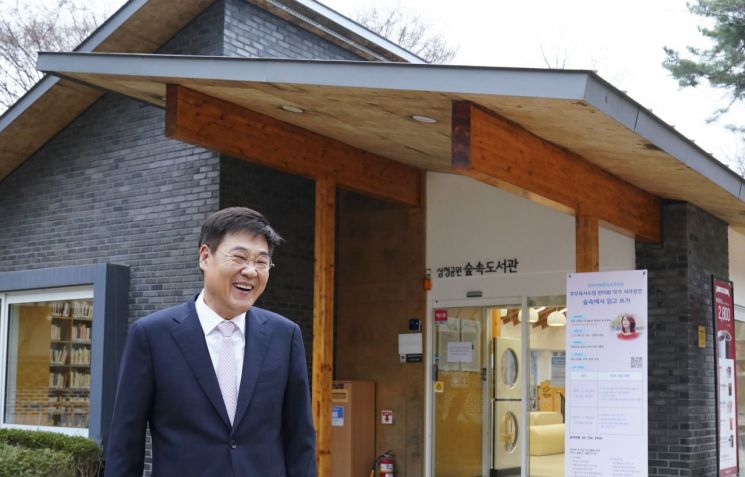 Jung Moonheon, Mayor of Jongno District, said, "We will ease unreasonable regulations to improve living conditions and continue to expand living SOC such as parking lots." Mayor Jung is smiling in front of the forest library created by remodeling the Samcheong Park kiosk. Provided by Jongno District.
Regarding the revitalization of Daehangno, which has seen little development compared to commercial areas like Hongdae and Gangnam, he said, "We plan to revise overly restrictive regulations such as excessive business type restrictions," adding, "We will ease restrictions necessary for residents' daily lives and open up spaces a little."
Regarding the Bukchon visitation time restriction policy (Bukchon Special Management Area), which was fully implemented this month to reduce residents' inconvenience caused by excessive tourism in the Bukchon area, he explained the policy's effect by saying, "Merchants dislike it, but residents who live here like it." Mayor Jung said, "We made flower beds on leftover land, but foreign tourists defecated there," adding, "The increase in group tourists carrying flags is not something to welcome; we need to elevate tourism to high value-added tourism."
© The Asia Business Daily(www.asiae.co.kr). All rights reserved.


















