Submission of Opinion Letter on MOLIT's Amendment Proposal
"Concerns Over Industry Collapse Due to Oversupply"
As the domestic ready-mixed concrete (remicon) industry faces a survival crisis with record-low operating rates, the Ministry of Land, Infrastructure and Transport (MOLIT) is pushing for a revision to relax the installation standards for on-site batching plants, sparking strong opposition from the industry.
On the 23rd, the Korea Ready-Mixed Concrete Industrial Cooperative Federation, Korea Ready-Mixed Concrete Association, Seoul Gyeongin Ready-Mixed Concrete Industrial Cooperative, and other remicon industry groups announced that they submitted a letter of opposition, stating, "MOLIT's revision of the 'Construction Work Quality Management Guidelines' undermines the existing system that protects the sales channels of small and medium-sized remicon companies."
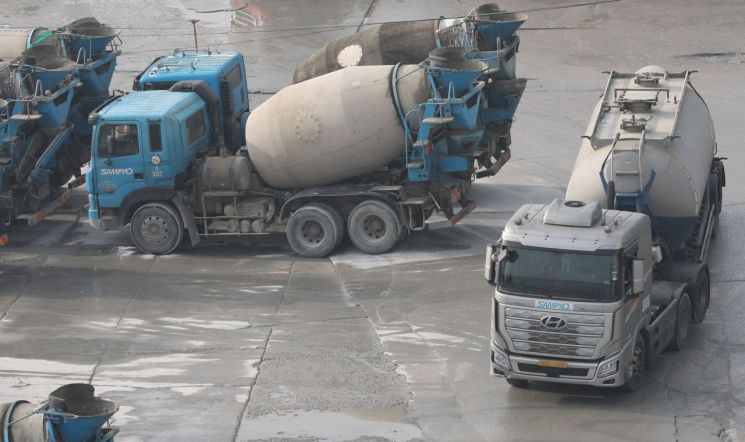 A ready-mixed concrete truck is moving at a ready-mixed concrete plant in Seoul city. Photo by Yonhap News.
Recently, as part of measures to revitalize the construction industry, MOLIT issued an administrative notice on the revision of the Construction Work Quality Management Guidelines to relax the installation and production standards for on-site batching plants and collected opinions until the 20th.
Under current regulations, on-site batching plants may only be installed if a remicon company cannot supply products within 90 minutes, and the external shipment of produced remicon is prohibited. Additionally, under the 'Act on the Promotion of Mutual Growth between Large and Small Enterprises,' when a small or medium remicon company applies for business adjustment, 50% of the production from the on-site batching plant must be supplied by surrounding remicon companies.
The proposed revision includes ▲ blanket rejection of business adjustment applications ▲ allowing full production and supply from on-site batching plants ▲ permitting the shipment of remicon produced at on-site batching plants to nearby sites ▲ and deleting regulations on joint cooperation with surrounding remicon companies.
The remicon industry opposes these revisions, calling them reverse discrimination that stifles construction material suppliers in an effort to revitalize the construction industry. They also pointed out that allowing non-KS (Korean Industrial Standards) certified products produced at on-site batching plants to be shipped to nearby sites violates national industrial standardization policies.
The industry stated, "With remicon operating rates falling to a historic low of 17%, relaxing the installation conditions for on-site batching plants to allow new suppliers to enter deprives surrounding remicon companies of order opportunities," adding, "This is a serious issue that encourages overproduction and threatens the survival of the industry."
They further emphasized, "The root causes of remicon supply disruptions at some construction sites include cement supply shortages (due to reduced production from carbon-neutral facility construction, BCT strikes, etc.) and transport refusals by remicon carriers (strikes over transport fee increases, refusal of tunnel and nighttime transport, 8·5 system and Saturday holidays), which are side effects of government regulations and controls," stressing that "fundamental solutions must be prioritized."
The industry also stated, "While installation of on-site batching plants is possible through consultation for large-scale national projects, expanding this to construction sites nationwide is unacceptable," and added, "The 1,079 remicon companies nationwide will strongly respond to protect their right to survive."
© The Asia Business Daily(www.asiae.co.kr). All rights reserved.
![Clutching a Stolen Dior Bag, Saying "I Hate Being Poor but Real"... The Grotesque Con of a "Human Knockoff" [Slate]](https://cwcontent.asiae.co.kr/asiaresize/183/2026021902243444107_1771435474.jpg)
















