Payment of Collection Rewards for Waste Vinyl and Pesticide Containers
Expansion of Joint Collection Stations and Temporary Storage Locations
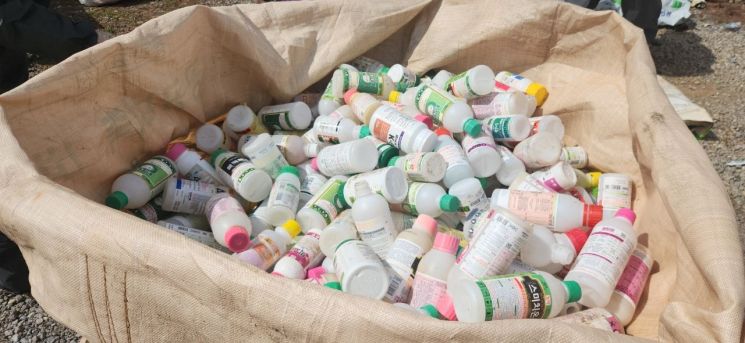
Gwangju City is taking the lead in collecting and processing agricultural waste, which has long been a headache for farmers. On the 21st, Gwangju City announced that it has established and will officially implement the “2025 Agricultural Waste Collection and Processing Support Plan” to prevent environmental pollution and illegal incineration in rural areas and to systematically manage agricultural waste within the region.
Agricultural waste is generated every year after farming in rural areas, but due to factors such as losses for private collectors caused by small collection volumes and the inability of collection vehicles to access individual farms, collection and disposal have not been smooth. As a result, illegal incineration has often been pointed out as a cause of fine dust and environmental pollution.
This year, the city will invest 112 million won in the following: ▲ “Collection Reward Payments for Waste Vinyl and Waste Pesticide Containers” to promote recycling of agricultural waste ▲ “New Installation of Joint Collection Stations” to establish a foundation for joint collection of agricultural waste ▲ Educational programs to raise awareness in rural areas.
The city aims to collect 423 tons of waste vinyl and 267,000 waste pesticide containers generated after this year’s farming season, working in cooperation with local districts and the Korea Environment Corporation to implement the collection reward project.
The collection reward for agricultural waste is classified into four grades (A~D) for waste vinyl depending on the amount of foreign substances. Grades A to C are paid 120 to 140 won per kilogram, while grade D receives no payment. For waste pesticide containers, bottles are paid 100 won each, and bags are paid 80 won each.
In particular, the city is newly promoting the installation of joint collection stations to ensure smooth collection and storage of agricultural waste. These stations are dedicated facilities for storing only agricultural waste, preventing it from being abandoned and facilitating separate disposal, thereby contributing to improved recycling rates and serving as essential infrastructure.
For the first time in the region, the city plans to install a total of six joint collection stations?two in Nam-gu and four in Gwangsan-gu?to effectively collect and store agricultural waste generated in villages. The city will closely review the operational status and plans to expand the program in the future.
To prevent situations where waste is left unattended due to a lack of storage facilities, the city will utilize large spaces such as village open areas, community centers, and parking lots to set up temporary storage locations, supporting the collection of agricultural waste at designated points by village leaders.
In cooperation with related organizations such as the Korea Environment Corporation and the National Agricultural Cooperative Federation, the city will provide on-site education for farmers on proper separation and disposal methods and the collection reward system. In addition, the city plans to actively utilize village leader meetings and community newsletters to conduct tailored education and promotional activities.
Jung Mikyung, head of the Resource Circulation Division, said, “Agricultural waste is a major cause of environmental pollution in rural areas and a significant concern for farmers. We will do our utmost to ensure smooth collection and processing of agricultural waste in cooperation with local districts and related organizations.”
© The Asia Business Daily(www.asiae.co.kr). All rights reserved.
![Clutching a Stolen Dior Bag, Saying "I Hate Being Poor but Real"... The Grotesque Con of a "Human Knockoff" [Slate]](https://cwcontent.asiae.co.kr/asiaresize/183/2026021902243444107_1771435474.jpg)
















