Political Variables Increase in Early Presidential Election Strategy
If the Constitutional Court Rules on President Yoon's Impeachment in April, Lee Faces Judicial Risks
The longer President Yoon Suk-yeol's impeachment trial is delayed, the more variables arise in Lee Jae-myung, leader of the Democratic Party of Korea's, early presidential election strategy. Some speculate that internal disagreements within the Constitutional Court and polarized public opinion are complexly interacting, leading to even talk of an 'April ruling.' If the impeachment ruling extends beyond next week, even if the impeachment is upheld and an early presidential election proceeds, the timing of the final verdict on Lee's election law violation case could remain a source of controversy.
On the 21st, the Democratic Party filed an impeachment motion against Choi Sang-mok, Acting Prime Minister and Minister of Economy and Finance. This marks the 30th impeachment attempt by the Democratic Party since the Yoon administration began. This move is seen as a full-scale offensive for the immediate removal of President Yoon, following the Constitutional Court's confirmation that the ruling on Prime Minister Han Duck-soo's impeachment trial will be on the 24th.
The Democratic Party suspects that the Constitutional Court may be leaving open the possibility of dismissal or rejection regarding the delay in President Yoon's impeachment ruling. Since the cancellation of President Yoon's detention on the 8th, it is reported that the Constitutional Court justices have been engaged in legal debates over the procedural legitimacy of the impeachment process, which is also a concerning point.
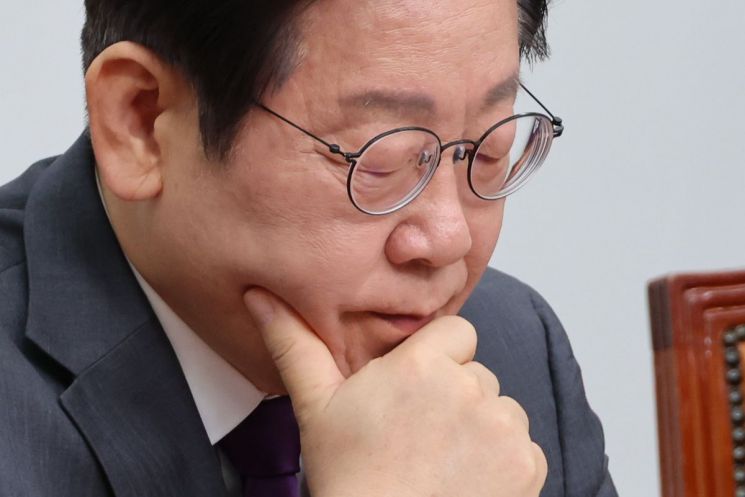
Recently, Lee's remark to Acting Prime Minister Choi to "be cautious" is also interpreted as stemming from anxiety over the impeachment delay, regardless of Lee's original intent. According to a regular survey conducted by Gallup Korea from the 18th to the 20th of March targeting 1,003 adults aged 18 and over nationwide (3rd week of March), 58% of respondents supported the impeachment of President Yoon. This result is the same as the previous survey, with 36% opposing. (Response rate 13.1%. Margin of error ±3.1 percentage points at 95% confidence level. For more details, refer to the Central Election Poll Deliberation Commission website.)
Political commentator Park Sang-byeong diagnosed, "The longer the Constitutional Court's impeachment trial drags on, the more the Democratic Party fears that variables may arise in the ruling outcome."
Attention is also focused on Lee's second trial for election law violations scheduled for the 26th. With the delay in President Yoon's impeachment ruling, the general view is that Lee's second trial is more likely to be held first. While the legal community views the Constitutional Court's impeachment trial and Lee's second trial as separate cases, there is interest in the dynamics between the two trials.
Another reason for the heightened attention to the delayed presidential impeachment ruling is that it could affect the schedule of Lee's Supreme Court ruling. In the first trial, Lee was sentenced to one year in prison with a two-year suspended sentence, but the ruling of the second trial court on the 26th is a variable. If, as some in the Democratic Party hope, a not guilty verdict is issued, the situation would change, but if found guilty, the severity of the sentence is also a matter of interest.
The Supreme Court has articulated the so-called '6-3-3 principle' regarding election law cases. Theoretically, the Supreme Court ruling could come as late as June 26. Of course, the second trial court could issue a different ruling from the first trial court, and the Supreme Court ruling could also involve various scenarios such as remand or reversal, making it difficult to predict the future. However, if an early presidential election unfolds, Lee's election law case could remain an Achilles' heel.
If the Constitutional Court upholds the presidential impeachment between the end of this month and early April, an early presidential election is likely to be held between late May and early June. This is because, according to election law, the next presidential election must be held within 60 days from the date of dismissal. To prevent political turmoil, there are opinions both inside and outside the ruling party that the Supreme Court ruling should be issued before the election is held.
If an early presidential election is held, according to Article 49 of the Public Official Election Act, candidate registration will be accepted for two days starting 24 days before the election day, and official presidential election campaigns will begin in earnest. It remains to be seen whether the Supreme Court will make decisions that could influence the candidacy of a leading presidential candidate after the candidate registration is completed.
© The Asia Business Daily(www.asiae.co.kr). All rights reserved.
![Clutching a Stolen Dior Bag, Saying "I Hate Being Poor but Real"... The Grotesque Con of a "Human Knockoff" [Slate]](https://cwcontent.asiae.co.kr/asiaresize/183/2026021902243444107_1771435474.jpg)















