Promoting the Energy Efficiency Improvement Project for Low-Income Households
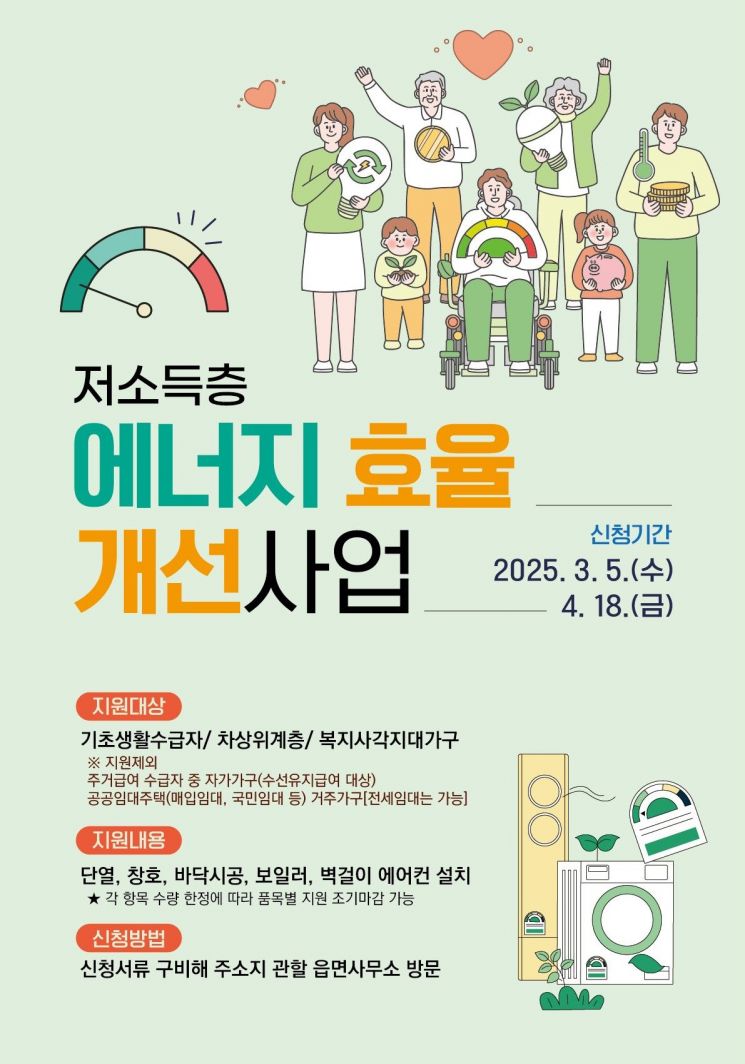
Gokseong County, Jeollanam-do announced on the 21st that it is recruiting beneficiaries for the "Energy Efficiency Improvement Project for Low-Income Households" to enhance the welfare of energy-vulnerable groups.
This project, jointly promoted by the Ministry of Trade, Industry and Energy, the Korea Energy Foundation, and Gokseong County, supports insulation, window installation, and replacement of high-efficiency air conditioning and heating systems for energy-isolated households vulnerable to climate change, such as cold waves and heat waves.
Rather than simple home repairs or one-time financial support, the project aims for fundamental improvement by cumulatively reducing energy costs every year. It aligns with the government’s policy to expand energy welfare and helps lay the foundation for carbon neutrality and a fair energy transition.
Eligible recipients include households receiving National Basic Livelihood Security, near-poverty households, and low-income households in welfare blind spots recommended by the local government head. However, households already receiving repair and maintenance benefits under the Housing Benefit Act, households within the benefit period of the same project (8 years for cooling, 2 years for heating), public rental housing residents, residents of unauthorized housing, and households deemed unsuitable for installation during on-site visits are excluded.
The support amount is 720,000 KRW per household for cooling and an average of 2,430,000 KRW per household for heating. After screening by the Korea Energy Foundation, selected households will receive support for costs such as wall-mounted air conditioner installation, insulation, window replacement, and replacement of outdated boilers. Interested households can apply at their local town or township office; applications for cooling support are accepted until April 18, and for heating until the budget is exhausted.
County Governor Jo Sangrae said, “Energy-vulnerable groups are facing difficulties due to rapid inflation and rising energy fuel costs,” and added, “I hope this project will serve as an opportunity to improve the residential environment of low-income households and realize energy welfare.”
© The Asia Business Daily(www.asiae.co.kr). All rights reserved.
![Clutching a Stolen Dior Bag, Saying "I Hate Being Poor but Real"... The Grotesque Con of a "Human Knockoff" [Slate]](https://cwcontent.asiae.co.kr/asiaresize/183/2026021902243444107_1771435474.jpg)















