Tiff Macklem, Governor of the Bank of Canada,
Calls for Preventing the Spread of Tariff-Induced Inflation
Seven Consecutive Rate Cuts Expected to Be Affected
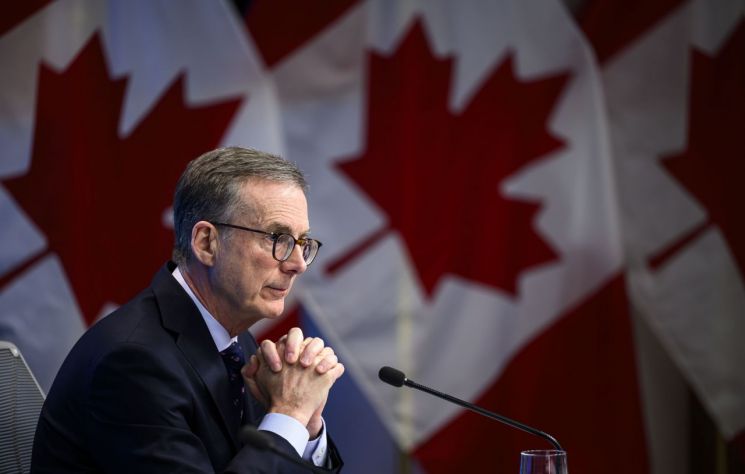 Tiff Macklem, Governor of the Bank of Canada, is seated at the podium during a press conference on the key interest rate held in Ottawa, Canada, on January 29. / Photo by AP, Canadian Press, Yonhap News
As Canada enters a tariff war with the U.S. and China, Tiff Macklem, Governor of the Bank of Canada, argued that the spread of tariff-induced inflation must be prevented. Market analysts have suggested that the seven consecutive interest rate cuts may be halted in April.
According to the U.S. Wall Street Journal (WSJ) on the 20th (local time), Governor Macklem stated in a speech at an event held in Calgary, Alberta, Canada, that regarding monetary policy responses to uncertainties caused by tariff policies, "We know that some prices will rise when tariffs are implemented, and this is a part that monetary policy cannot prevent."
Macklem added, "What monetary policy can and must do is to prevent this initial direct price increase from spreading," and emphasized, "We must ensure that the price increases caused by tariffs do not lead to persistent and generalized inflation."
Governor Macklem also noted his attention to Canada's inflation rate exceeding expectations at 2.6% in February. This statement came shortly after Statistics Canada released the February consumer price index. He also assessed that if high tariffs are maintained over a broad range of sectors for a long period, the Canadian economy is very likely to enter a recession.
The WSJ pointed out that Macklem's speech and remarks at the press conference strengthened the market and economists' expectations that the interest rate cuts would be paused in April. The Bank of Canada's next interest rate announcement is scheduled for the 16th of next month. Previously, the Bank of Canada held a monetary policy meeting on the 12th, lowering the benchmark interest rate by 0.25 percentage points to 2.75%. This marked the seventh consecutive rate cut since the easing cycle began in June last year.
With increasing tariff uncertainties, the economic forecasting approach used by the Bank of Canada to determine the benchmark interest rate is also expected to change. Macklem indicated that next month's monetary policy report might include various scenarios reflecting tariff uncertainties rather than a single scenario as before. This is because it is uncertain how quickly companies will pass on cost increases caused by tariffs to consumer prices.
He stated, "We need to choose one path and reduce the risk of policy failure if that path turns out to be wrong." He added, "We must set policies that minimize risks. Until the situation becomes clear, we should rely less on forecasts than usual, and if developments become clear, we may need to respond quickly." However, he drew a line by saying there would be no irregular interest rate announcements like those during the early stages of the COVID-19 pandemic in 2020.
The U.S. Trump administration imposed a 25% tariff on Canadian imports on the 4th but has suspended the 25% tariff application until the 2nd of next month for items covered under the United States-Mexico-Canada Agreement (USMCA), including automobiles. As a first-stage response, the Canadian government imposed retaliatory tariffs on U.S. imports worth 30 billion Canadian dollars (approximately 30.7 trillion Korean won) and has maintained them. The Canadian daily Canadian Press also noted that the 20th was the first day China imposed new tariffs on Canadian agricultural products. This is a retaliatory measure against the import duties Canada imposed on Chinese electric vehicles last October.
© The Asia Business Daily(www.asiae.co.kr). All rights reserved.
![Clutching a Stolen Dior Bag, Saying "I Hate Being Poor but Real"... The Grotesque Con of a "Human Knockoff" [Slate]](https://cwcontent.asiae.co.kr/asiaresize/183/2026021902243444107_1771435474.jpg)















