Reform Delays Pension Depletion to 2071
Political Circles React, Calling It a 'Worsening'
Structural Reform to Be Discussed Later by Pension Special Committee
Although pension reform was achieved for the first time in 18 years, it is being criticized as an incomplete reform. While it can be evaluated positively for reaching a historic agreement amid a national crisis involving the president's impeachment and for resolving the difficult issue of raising contribution rates, the political circles continue to point out that the reform remains unfinished.
On the 20th, the ruling and opposition parties held a plenary session and passed the amendment to the National Pension Act. According to the National Assembly and the government, the core of this pension reform is that it has significantly improved the pension financial situation. According to the amended National Pension Act passed by the National Assembly, the contribution rate, which corresponds to the money paid in, will be raised by 0.5 percentage points annually for eight years starting next year, increasing from the current 9% to 13%. Regarding the income replacement rate, which corresponds to the money received, it will be raised from the current 41.5% to 43% starting next year. While it is the first increase in the income replacement rate in 18 years, the reform of the contribution rate, considered the biggest challenge, has been achieved for the first time in 27 years.
Pension reform postpones pension depletion by 15 years
With this, the government projected that, based on a 1 percentage point improvement in pension returns along with the pension reform, "the pension depletion point will be delayed from 2056 to 2071." The government explained, "This reform will increase the sustainability of the system and significantly reduce the burden on future generations."
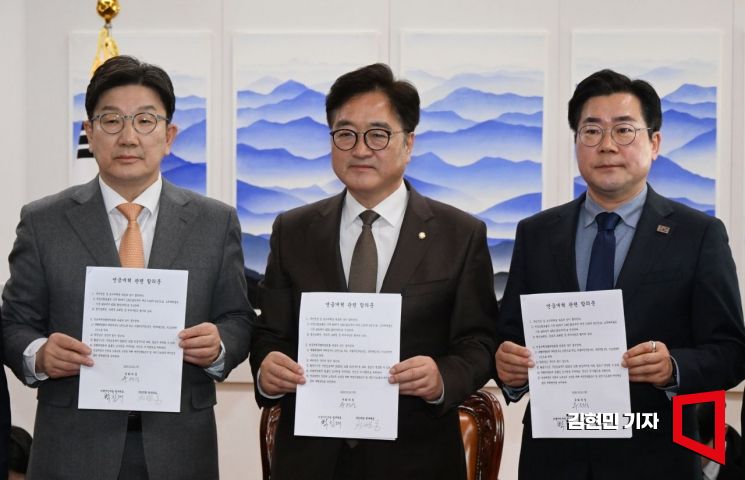 Woo Won-shik, Speaker of the National Assembly, Kwon Seong-dong, Floor Leader of the People Power Party (left), and Park Chan-dae, Floor Leader of the Democratic Party of Korea (right), are announcing the agreement on the National Pension reform plan in the Speaker's office of the National Assembly on March 20, 2025. Photo by Kim Hyun-min
In addition, the ruling and opposition parties and the government improved the credit system and secured payment guarantees. This is an achievement where the ruling and opposition parties reached a rare consensus amid a national crisis, including President Yoon Seok-yeol’s impeachment and awaiting the Constitutional Court’s judgment, as well as severe political polarization. Kim Seong-ju, a former Democratic Party lawmaker who led pension reform negotiations in the 21st National Assembly, said about this pension reform, "It is a great achievement that the ruling and opposition parties reached a political compromise to raise the contribution rate by 4% for the first time in 27 years, which was a difficult task." Kim added, "Fiscal conservatives who argue for lowering the income replacement rate are dissatisfied with the increase, and income security advocates are unhappy about conceding from 50% to 45%, then to 44%, and now to 43%. However, everything cannot be achieved at once, and since this time the parameter reform focused on fiscal stability, the rest must be structural reform." Regarding the direction of structural reform to be discussed in the future pension special committee, he advised, "The ruling and opposition parties should conduct research and engage in genuine politics."
Ruling party’s pension special committee members resign en masse... Political circles 'react'
However, political circles criticize the reform as insufficient.
Members of the People Power Party’s Pension Reform Special Committee protested against this reform and resigned en masse. Park Soo-young, a People Power Party lawmaker who served as the committee chair, said, "I resigned as chair in protest because none of the good proposals made by our party’s pension special committee were reflected, and instead, the reform was worsened." He added, "The party had agreed not to raise the income replacement rate above 40% and to include fiscal stabilization measures, so I am angry about the leadership’s agreement." All members of the People Power Party’s pension reform special committee have withdrawn from the committee.
People Power Party lawmaker Ahn Cheol-soo harshly criticized the reform on SBS Radio, saying, "(This reform) cannot be called pension reform in a word," and "Yesterday’s (plenary session) approval just changed the numbers moderately." He said, "The income replacement rate should have been maintained at 40%, and income should have been guaranteed multilayeredly through basic pensions, etc. Automatic adjustment mechanisms should have been introduced, and special pensions such as military pensions should also have been reformed."
Former lawmaker Yoo Seung-min also explained via social media, "This is not reform but a patch-up," and "A temporary measure cannot resolve the burden and distrust of future generations." Regarding the income replacement rate, which was lowered from 60% to 40% during the Roh Moo-hyun administration and has now been raised again to 43%, Yoo criticized, "It is an irresponsible populism collusion between the ruling and opposition parties." He pointed out, "Fundamental pension reform must be done again," but also noted, "Because the income replacement rate was raised to 43%, future pension reforms will become more complicated and difficult."
Kim Dong-yeon, governor of Gyeonggi Province from the Democratic Party and a former economic bureaucrat, pointed out in a CBS Radio interview, "I think this is a temporary pension reform," and added, "There must be various supplements for old-age income security, and there is a burden issue for future generations."
National Assembly pension special committee tasked with structural reform
The political backlash seems to be less about the fact that the already processed pension reform was conducted through negotiations between the ruling and opposition leadership, and more about the need for additional structural reforms in the future. The goal is to create additional reform momentum so that the momentum for pension reform does not disappear after parameter reform.
Future reforms related to restructuring will be carried out by forming a pension reform special committee in the National Assembly. The committee will discuss fiscal improvement measures such as 'automatic stabilization devices' as well as reform plans for national, basic, retirement, and private pensions. It is expected that the committee will discuss ways to multilayeredly guarantee old-age income through systems centered on the National Pension, basic pensions, retirement pensions, and private pensions.
Kwon Seong-dong, floor leader of the People Power Party who played a key role in pension reform negotiations, told reporters on the 21st, "Realistically, there are limits to our power, and we judged that moving forward with this agreement would help national finances and the economy," adding, "Although we are not 100% satisfied, if we complete structural reform through the pension special committee, we can give hope to the younger and future generations." Regarding the formation of the pension special committee to discuss structural reform, Kwon said, "We plan to form it mainly with younger lawmakers."
© The Asia Business Daily(www.asiae.co.kr). All rights reserved.

















