Ministry of Land, Infrastructure and Transport and Korea Transport Institute Hold Grand Forum on Aviation Safety
Discussion on Strengthening Safety Evaluation in Traffic Rights and Slot Allocation
Proposals for Establishing an Aviation Safety Agency and Improving Low-Cost Carrier Maintenance
Suggestions for Comprehensive Airport Safety Assessments and Advanced Bird Strike Prevention
In the future, airlines that invest heavily in safety and receive high scores in safety evaluations will have an advantage when receiving traffic rights or slots. This is part of the preparations by authorities to revise the aviation safety system following the Jeju Air passenger plane disaster.
Professor Kim Yeon-myeong of Hanseo University announced a countermeasure plan containing these details as part of system improvements at the aviation safety grand forum hosted by the Ministry of Land, Infrastructure and Transport on the 21st. About 200 participants, including public institutions and experts from industry, academia, and research, attended the forum. Professor Kim, who presented on the day, serves as the vice-chair of the safety subcommittee of the Aviation Safety Innovation Committee, which is currently revising the system after the disaster.
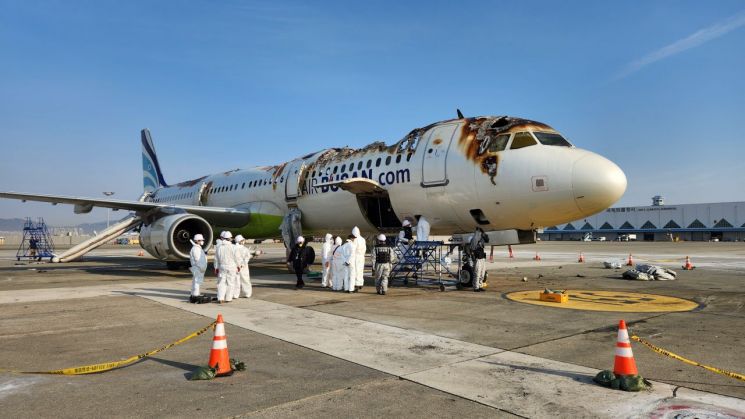 A joint investigation team, including the Ministry of Land, Infrastructure and Transport's Aviation and Railway Accident Investigation Board and the French Bureau d'Enqu?tes et d'Analyses (BEA), is conducting a risk management assessment on the Air Busan aircraft that caught fire last January. Provided by the Ministry of Land, Infrastructure and Transport, Yonhap News Agency
Traffic rights refer to the rights of airlines to operate flights in each region, and slots mean the allocated times for aircraft to take off, land, or move at airports. According to the traffic rights allocation rules, airlines that violate safety-related laws or cause accidents are currently evaluated based on a certain formula to determine which airlines receive traffic rights. The proposal is to refine this process more precisely to manage safety levels.
For example, the qualitative evaluation method could be quantified to encourage airlines to increase safety investments, while areas unrelated to safety, such as market development contributions or Incheon Airport transfer contributions, could be given less weight. A joint public-private safety evaluation tool could be developed to set target values and be used when establishing new routes or introducing new aircraft.
Professor Kim also proposed establishing an Aviation Safety Agency (tentative name), making the chairperson of the accident investigation committee a permanent position, and institutionalizing the aviation safety consultative body, considering the growth of the aviation industry. To improve the maintenance quality of low-cost carriers, the proposal includes strengthening licensing standards by adding related infrastructure and safety personnel requirements, as well as reinforcing standards and personnel related to maintenance and safety supervision.
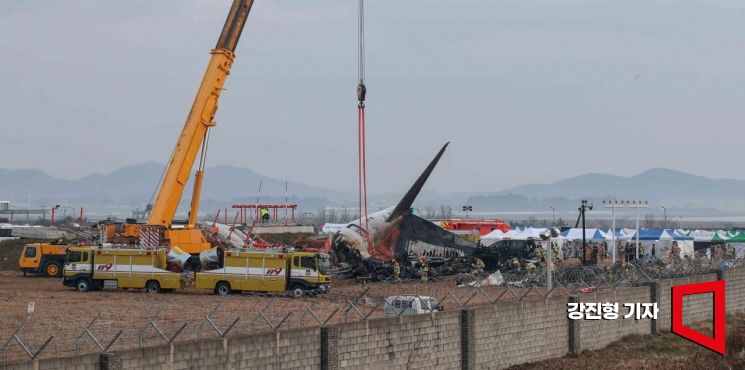 Firefighters are searching for belongings at the site of the Jeju Air passenger plane collision and explosion accident that occurred last December at Muan International Airport in Jeollanam-do. Photo by Kang Jin-hyung
Regarding airport facilities, Professor Song Ki-han of Seoul National University of Science and Technology suggested applying airport safety and service evaluations to all airports, similar to railroads or private roads, to identify deficiencies and provide incentives for well-performing areas. Additionally, considering the continuous maintenance, repair, and expansion after airport construction, he proposed utilizing BIM (Building Information Modeling) for the operational phase after construction. He also emphasized the need to build a ‘Bird Dome’ that learns past bird patterns to detect them in advance and prevent incidents using drones.
The Ministry of Land, Infrastructure and Transport stated that it plans to review the opinions raised at the forum and reflect them in the aviation safety innovation plan to be released next month. Minister Park Sang-woo of the Ministry said, "The aviation industry will lose its foundation and decline the moment safety is shaken, as trust collapses. We will present new standards for South Korea’s aviation safety policy to prevent the recurrence of aviation accidents like the passenger plane disaster."
© The Asia Business Daily(www.asiae.co.kr). All rights reserved.


















