Governor Lee Chang-yong:
"There is no panacea for structural problems"
"Now is the time to endure short-term difficulties"
Lee Chang-yong, Governor of the Bank of Korea, said on the 21st, "There is no panacea in the form of a single policy for structural problems," adding, "Now is the time to endure short-term difficulties."
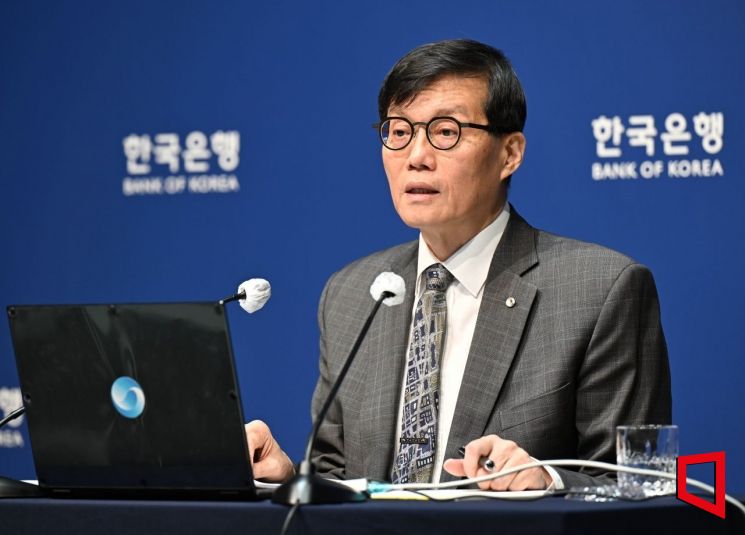 On the 25th, Lee Chang-yong, Governor of the Bank of Korea, held a press conference on monetary policy direction after the Monetary Policy Committee's plenary meeting at the Bank of Korea headquarters in Jung-gu, Seoul, and answered reporters' questions. 2025.02.25 Photo by Joint Press Corps
Governor Lee made these remarks during a congratulatory speech at the opening conference of the Yonsei University Population and Talent Research Institute on the same morning, stating, "The forecast of a potential growth rate in the 0% range is the result of various structural problems."
He pointed out, "Our country has already entered a super-aged society, and last year's total fertility rate was 0.75, facing a serious low birthrate crisis. If the current birthrate continues, the population of South Korea will sharply decline from about 51 million to around 30 million in 50 years, and the potential growth rate is expected to fall from the current level of about 2% to the 0% range by the late 2040s, a gloomy forecast that is hard to avoid."
Governor Lee diagnosed that the population issue, especially the low birthrate phenomenon, is the result of a complex intertwining of various structural problems facing our society. He emphasized, "According to Bank of Korea research, these are the outcomes of structural problems such as concentration in the Seoul metropolitan area, overheated educational competition, employment, housing, and childcare insecurity among the youth, and a rigid labor market. These problems cannot be solved by a single policy, and there is no panacea."
He added, "Now is a critical time when, even if we have to endure some short-term difficulties, long-term efforts are desperately needed for fundamental solutions."
He stressed that for Korea to leap forward as a first-mover, the current entrance exam-centered education system must also change. Governor Lee emphasized, "Rather than nurturing students who strongly tend to obey their parents and conform to given demands, I earnestly hope that the university entrance examination system will change in a direction that fosters talents who are not afraid of new challenges and have diverse backgrounds and experiences."
The Yonsei University Population and Talent Research Institute was established to conduct research and prepare policy alternatives to solve Korea's population and talent issues. The director is Professor Kim Hyun-chul of the Medical School, who is both a physician and an economist. The conference was held on topics including immigration and foreign worker policies, as well as the social and economic adaptation issues of North Korean defectors.
Meanwhile, the Bank of Korea Economic Research Institute signed a memorandum of understanding (MOU) on academic research cooperation with the institute on the same day. Through this agreement, the two institutions will jointly study the impact of life cycle events on household economic activities. They plan to engage in academic exchange activities such as sharing data and analytical techniques necessary for joint scholarly work.
© The Asia Business Daily(www.asiae.co.kr). All rights reserved.

















