Inviting CEOs of 15 Quantum Computing Companies
Jensen Huang Takes the Lead in This Year's First "Quantum Day"
"The Next 10 Years Will Be a Turning Point for Quantum Computing"
Jensen Huang, CEO of NVIDIA, retracted his previous negative assessment of the practical use of quantum computers and announced plans to establish a quantum computing research center in collaboration with Harvard University and the Massachusetts Institute of Technology (MIT).
On the 20th (local time), at the fourth day of the annual developer conference GTC 2025 held in San Jose, USA, during "Quantum Day," CEO Huang admitted that his earlier statement this year that "it would take at least 20 years for a usable quantum computer to emerge" was incorrect and made this announcement.
On that day, he invited representatives from 15 major quantum computing companies, including IonQ, D-Wave, and Rigetti Computing, and personally led a panel discussion.
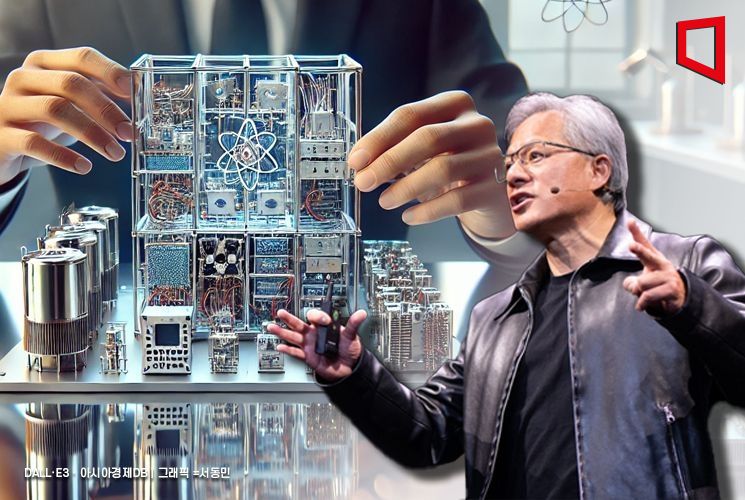
CEO Huang mentioned that his previous remarks had caused the stock prices of major quantum computing companies to plummet by nearly 60%, saying, "I invited the top CEOs myself to prove that my statement was wrong."
He also confessed his lack of interest in the industry by admitting, "I didn't even know these companies were publicly traded."
Although NVIDIA does not manufacture quantum computers itself, it is focusing on developing accelerated computing technologies that support quantum computing.
CEO Huang specifically announced plans to establish a "Hybrid Quantum Computing Institute" in Boston in collaboration with Harvard University and MIT. He added, "There will be remarkable innovations in the field of quantum mechanics next year."
The company representatives attending the session agreed that the combination of quantum computing and artificial intelligence (AI) has greatly increased the possibility of solving problems that existing supercomputers could not handle.
They also identified error correction technology as a key factor for the advancement of quantum computing. Attendees noted that the recent improvement in error correction rates?from 1 in 10,000 to about 1 in 100?will likely accelerate the practical use of quantum computing.
In the final session, CEO Huang emphasized, "Quantum AI may emerge," and stressed, "We must achieve innovation in quantum computing through industry-wide collaboration."
© The Asia Business Daily(www.asiae.co.kr). All rights reserved.
![Clutching a Stolen Dior Bag, Saying "I Hate Being Poor but Real"... The Grotesque Con of a "Human Knockoff" [Slate]](https://cwcontent.asiae.co.kr/asiaresize/183/2026021902243444107_1771435474.jpg)















