Purchase of Modern and Contemporary Postcards, Photographs, and Books Until April 28
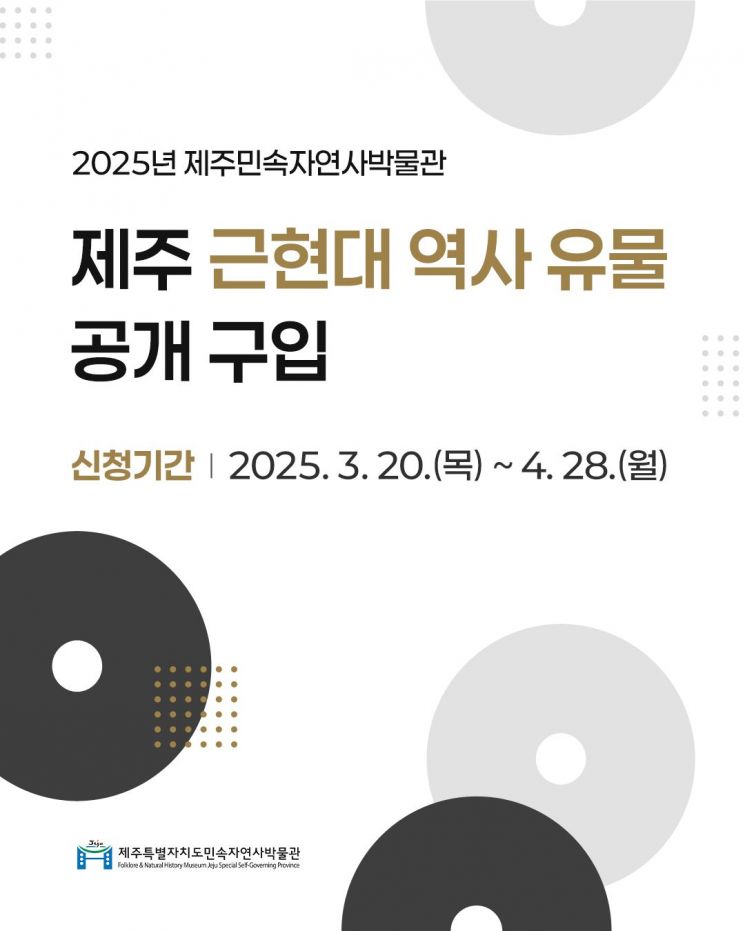 The Jeju Special Self-Governing Province Folklore and Natural History Museum is purchasing materials that offer a glimpse into Jeju's modern and contemporary history until April 28. Provided by Jeju Folklore and Natural History Museum.
The Jeju Folklore and Natural History Museum announced that it will publicly purchase materials offering a glimpse into the modern and contemporary history of Jeju until April 28.
This acquisition of artifacts aims to secure exhibition materials related to the (tentatively named) Jeju History Museum, and to utilize them as foundational and academic resources for content development.
The items eligible for purchase include postcards, photographs (albums), books, maps, documents (printed materials), newspaper clippings, posters, and more, all related to Jeju's modern and contemporary politics, economy, society, and culture.
Specifically, the museum plans to prioritize the purchase of: △Postcards and photographs from the Japanese colonial period △Materials related to Jeju haenyeo who migrated during the Japanese colonial period, Jeju people residing in Japan, and local capitalists △Materials related to Jeju's modernization (such as waterworks, electricity, and road construction) from the 1960s to 1980s △Materials on Jeju tourism development from the 1950s to 1990s △Materials related to the Saemaeul Movement in Jeju from the late 1960s to 1980s. In addition, old books, ancient documents, and old maps related to Jeju are also included in the purchase list.
However, illegally obtained artifacts, such as those acquired through looting or theft, or those with unclear ownership or provenance, will not be purchased.
Individuals, cultural property dealers, corporations, or organizations wishing to sell artifacts may download the relevant forms from the Jeju Provincial Government or Jeju Folklore and Natural History Museum website, complete them, and submit them in person, via electronic submission, or by registered mail to the museum by April 28.
Submitted materials will undergo a document review and an in-person evaluation committee before a final purchase decision is made.
In addition to public purchases, the museum, as Jeju's representative provincial complex museum, accepts donations and deposits year-round for Jeju-related historical and folkloric materials, as well as natural history (geology, flora and fauna, marine) materials that align with its identity.
Anyone may apply to donate or deposit materials, and for more details, inquiries can be made to the artifact manager at the Jeju Folklore and Natural History Museum's research department.
Donors will receive a certificate of donation, have their names displayed, and the museum plans to highlight the noble meaning of donation and the value of the materials through a dedicated exhibition corner for donated items in the future.
Park Chansik, Director of the Folklore and Natural History Museum, stated, "The purpose of this artifact collection is to prepare for the establishment of the (tentatively named) Jeju History Museum and to discover and collect artifacts that reflect the rapidly disappearing and deteriorating aspects of Jeju's modern and contemporary era," adding, "We ask for much interest and active participation in artifact purchases, as well as donations and deposits, so that these precious cultural assets can be continuously passed down and preserved for future generations."
© The Asia Business Daily(www.asiae.co.kr). All rights reserved.
![Clutching a Stolen Dior Bag, Saying "I Hate Being Poor but Real"... The Grotesque Con of a "Human Knockoff" [Slate]](https://cwcontent.asiae.co.kr/asiaresize/183/2026021902243444107_1771435474.jpg)















