Gangnam Area Leads Seoul's Weekly Apartment Price Surge
Three Gangnam Districts See Highest Increase Since 2018
Attention Focused on Re-Designation of Land Transaction Permit Zones
This week, apartment sale prices in the Gangnam area of Seoul rose significantly compared to the previous week. The weekly rate of increase has been growing over the past few weeks, with Gangnam-gu showing the largest rise. Prices have steadily increased since Seoul City lifted the land transaction permit zone, but attention is focused on whether the market will stabilize following the recent announcement of plans to re-designate the zone.
According to the weekly apartment price trend survey released by the Korea Real Estate Board on the 20th, the overall apartment sale price in Seoul rose by 0.25% in the third week of this month (as of the 17th) compared to the previous week. Since the third week of February, when Seoul City lifted the land transaction permit system, the rate of increase has steadily grown until the second week of this month. Last week's increase was 0.20%.
Among the Gangnam area districts, Gangnam-gu's increase stands out. Gangnam-gu rose by 0.83% in just one week, marking the highest increase. Songpa-gu followed with 0.79%, and Seocho-gu with 0.69%. All three districts recorded their highest weekly rate of increase since January 2018.
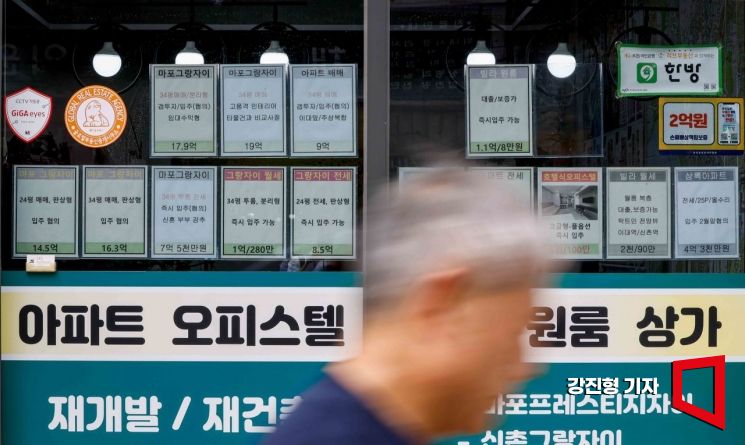 Apartment sale and jeonse prices are posted on real estate in Mapo-gu, Seoul. Photo by Jinhyung Kang aymsdream@
These three Gangnam districts, along with Yongsan-gu, will be designated as land transaction permit zones starting from the 24th. Apartment prices in Yongsan-gu also rose by 0.34% compared to the previous week, an increase from the 0.23% rise the week before. This is the largest weekly increase since August last year. In Gangnam-gu, the rise was mainly centered on major complexes in Apgujeong and Daechi-dong, while in Songpa-gu, it was concentrated in large complexes in Jamsil and Sincheon-dong.
Seoul is also showing a clear upward trend in other districts. Yangcheon-gu (0.32%), Mapo-gu (0.29%), Gangdong-gu (0.28%), Seongdong-gu (0.37%), and Gwangjin-gu (0.25%) all saw larger increases compared to the previous week. The Real Estate Board explained, "There is steady buyer interest focused on preferred complexes such as those near subway stations, newly built apartments, and large complexes, and the expectation of price increases has led sellers to raise their asking prices."
Gyeonggi-do remained flat at 0.00%, the same as the previous week. In Incheon, prices fell by 0.06% due to declines in Yeonsu-gu and Gyeyang-gu. Provincial areas continued their downward trend with a 0.04% decrease. Nationwide apartment jeonse (long-term lease) prices rose by 0.01%, with the rate of increase expanding in Seoul and the metropolitan area. In Seoul, jeonse prices fell in some outer areas and older complexes, but preferred complexes with good living conditions experienced a shortage of listings, causing prices to rise. Jeonse prices in provincial apartments fell by 0.02%, continuing the downward trend.
© The Asia Business Daily(www.asiae.co.kr). All rights reserved.
![Clutching a Stolen Dior Bag, Saying "I Hate Being Poor but Real"... The Grotesque Con of a "Human Knockoff" [Slate]](https://cwcontent.asiae.co.kr/asiaresize/183/2026021902243444107_1771435474.jpg)
















