After the End of the First Phase of the Ceasefire, Both Sides Refrained from Attacks
Israel Resumes Ground Military Operations Targeting Hamas
Control Begins in Areas Including the Netzarim Corridor... Overnight Shelling Continues
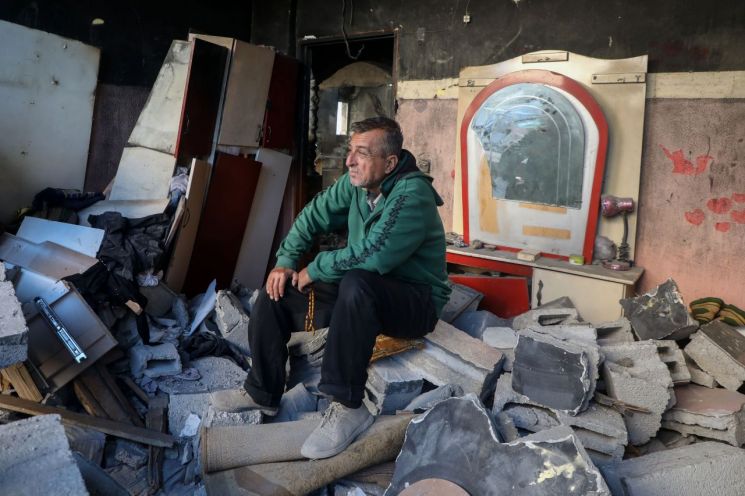 On the 19th (local time), a man sits among the debris of a house in the Sabra area south of Gaza City, which was reduced to ruins by an Israeli airstrike. / Photo by Xinhua News Agency and Yonhap News
The 'ceasefire mode' between Israel and the Palestinian armed faction Hamas has ended. Both sides had refrained from clashes after the first phase of the ceasefire ended on the 1st of this month (local time), but the situation returned to square one as the Israeli military resumed ground operations targeting Hamas on the 19th.
In a statement that day, the Israeli military announced, "We have begun ground activities to expand the security zone and create a partial buffer zone between the northern and southern parts of the Gaza Strip." Accordingly, the Israeli military explained that it started controlling the southern and central areas of the Gaza Strip, including the 'Netzarim Corridor,' a passage dividing Gaza north to south. The Israeli military also continued airstrikes targeting Hamas vehicles and outposts in southern Gaza that day.
Overnight, strikes were also carried out on Hamas military bases in northern Gaza preparing to launch projectiles toward Israel, as well as on vessels along the Gaza coast used for terrorist activities by Hamas and the Palestinian Islamic Jihad (PIJ), an armed group linked to Hamas. Media outlets such as The Times of Israel reported, citing sources, that shelling and helicopter attacks were witnessed across Gaza City, Al-Bureij, Khan Yunis, and other areas throughout the Gaza Strip at dawn.
Israeli Defense Minister Yoav Katz, visiting the Tel Nof Airbase, said, "First, Sinwar destroyed Gaza, and second, Sinwar will completely destroy Gaza," adding, "This is the last warning to the residents of Gaza." This statement referred to Muhammad Sinwar, the brother of Yahya Sinwar, the Hamas leader killed by Israel, who now leads the military organization. He also said, "The evacuation of civilians from combat zones will resume," and "Following the advice of the U.S. President, if hostages are returned and Hamas is eliminated, other options may open up."
Hamas expressed a complex stance, stating that Israel violated the ceasefire agreement but remains open to discussions. Reuters reported that Hamas condemned the Israeli ground forces' re-entry into the Netzarim Corridor as "another violation of the ceasefire agreement." Hamas senior official Taher Al-Nunu told AFP, "Hamas has not closed the door to negotiations," urging a return to the ceasefire. However, he added, "Since there is an existing agreement signed by all parties, there is no need for a new agreement," indicating that the ceasefire agreement should be implemented as is without new negotiations.
The 42-day first phase of the ceasefire agreed upon by Israel and Hamas expired on the 1st of this month. During this period, Israel had insisted on extending the first phase of the ceasefire by 50 days, accepting the proposal of Steve Witkoff, the U.S. special envoy for the Middle East under President Donald Trump. However, Hamas insisted on implementing the second phase as originally agreed, which requires the complete withdrawal of Israeli forces from the Gaza Strip and the release of remaining hostages, leading to a deadlock in negotiations mediated by third parties.
© The Asia Business Daily(www.asiae.co.kr). All rights reserved.
![Clutching a Stolen Dior Bag, Saying "I Hate Being Poor but Real"... The Grotesque Con of a "Human Knockoff" [Slate]](https://cwcontent.asiae.co.kr/asiaresize/183/2026021902243444107_1771435474.jpg)















