No Ruling Date Set as of the Morning of the 20th
"Deliberations May Not Be Proceeding Smoothly"
Various Analyses Emerge from Legal Circles
Lee Jaemyung's Appellate Ruling Scheduled for the 26th
The Constitutional Court's ruling on President Yoon Seok-yeol's impeachment trial is likely to be postponed until next week. As of the morning of the 20th, the court had not yet set a date for the ruling. Based on precedent, where the date is usually announced 2-3 days in advance, the ruling is expected to take place after next week. The impeachment trial for President Yoon will mark its 100th day this Saturday, the 23rd. This far exceeds the previous longest impeachment trial period of 91 days for former President Park Geun-hye. Even counting from the day the court concluded the oral arguments (February 25), 23 days have passed. As the 'court's time' lengthens, various analyses and theories are pouring out from the legal community and around the court, indicating that the situation differs from general expectations.
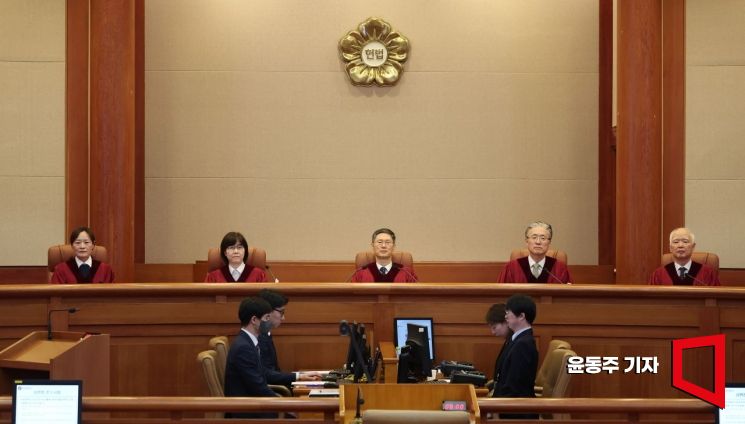 Acting Chief Justice Moon Hyung-bae of the Constitutional Court, along with the constitutional justices, attended the case concerning the dispute over the appointment suspension of candidate Ma Eun-hyuk, filed by Speaker Woo Won-sik against Prime Minister and Acting Minister of Economy and Finance Choi Sang-mok, held at the Constitutional Court in Jongno-gu, Seoul on the 27th. 2025.02.27 Photo by Yoon Dong-joo
So far, the Constitutional Court justices have been reviewing reports compiled by the impeachment trial task force (TF), which included constitutional researchers, to organize the key issues. They have repeatedly discussed the five issues presented by the National Assembly. Through this process, multiple draft versions of the decision, including rulings for acceptance or dismissal, are created. However, the legal community speculates that even the organization of the key issues may not yet be complete. Naturally, the verdict and the drafting of the decision document by the justices have not yet begun.
Professor Cha Jin-ah of Korea University Law School said, "If the justices had reached a consensus within the court, the ruling should have already been issued, but the fact that the ruling date has not even been announced suggests that the deliberations are not proceeding smoothly." She added, "Even if opinions differ, there should have been sufficient deliberation to make a decision, so I suspect that intense debates are still ongoing." Professor Kim Seon-taek of Korea University Law School said, "If some of the eight justices have not yet settled their positions, it becomes difficult to proceed further, so it can be seen as waiting." He further speculated, "If three of the eight justices are leaning toward dismissal or rejection, they might be waiting for candidate Ma Eun-hyuk to be appointed and join the court's deliberations."
The key issues in President Yoon's impeachment case include five points: ▲the unconstitutionality and illegality of the December 3 emergency martial law, ▲the substance of Martial Law Proclamation No. 1, ▲obstruction of the National Assembly's activities, ▲attempts to seize control of the National Election Commission, and ▲orders to arrest politicians and other key figures. Accordingly, some justices may consider all these points as grounds for impeachment, while others may recognize only some. Coordinating these views is not an easy task. Professor Han Sang-hee of Konkuk University Law School said, "Some justices may see all as grounds for impeachment, while others may consider only four, and the process of discussing how to handle the remaining points is expected to cause delays."
The impeachment trial of Prime Minister Han Duck-soo, whose oral arguments concluded before President Yoon's case, also poses a variable for the ruling. Since the grounds for impeaching Prime Minister Han include conspiracy or complicity in President Yoon's martial law proclamation, there is overlap between the two cases. From the court's perspective, if the Prime Minister's case, which is likely to be dismissed, is ruled on first, it could complicate the drafting of the decision for President Yoon's impeachment acceptance. A legal expert who requested anonymity said, "Since there are overlapping parts between President Yoon's and Prime Minister Han's cases, the logic must be consistent whether the ruling is acceptance or dismissal," adding, "Because the court is drafting the decisions simultaneously, it seems to be taking time."
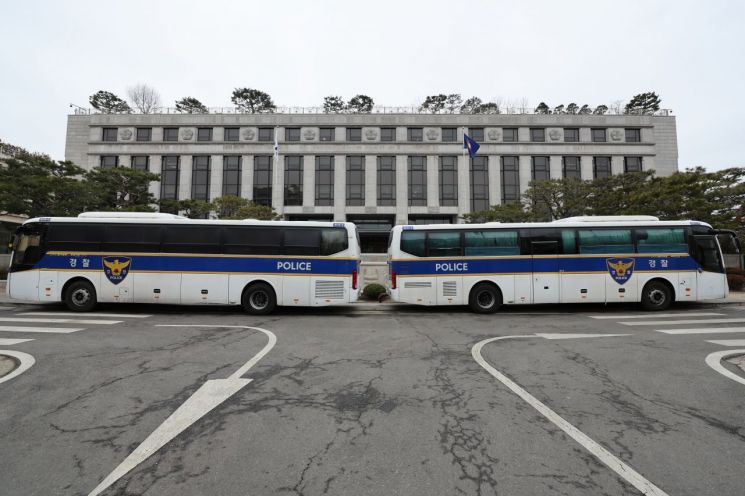
There is also a view that growing public opposition to the impeachment due to procedural issues is influencing the court's final judgment. The court may be compelled to put extra effort into drafting a decision that emphasizes the fairness and procedural integrity of the trial. President Yoon's side has raised procedural issues throughout the impeachment arguments.
Meanwhile, on Wednesday the 26th of next week, the appellate ruling for Lee Jae-myung, leader of the Democratic Party of Korea, in the Public Official Election Act case is also scheduled. If President Yoon's impeachment ruling is postponed to next week, the judiciary will decide the fates of two leading political figures in the same week. This is being called the so-called 'Judicial Super Week.' On the 19th, a week before the appellate ruling, Lee submitted a roughly 30-page 'Defendant's Statement' to the court, asserting his innocence and mounting a full-scale defense.
© The Asia Business Daily(www.asiae.co.kr). All rights reserved.
![Clutching a Stolen Dior Bag, Saying "I Hate Being Poor but Real"... The Grotesque Con of a "Human Knockoff" [Slate]](https://cwcontent.asiae.co.kr/asiaresize/183/2026021902243444107_1771435474.jpg)
















