Introduction of 'Gaussian Splatting'...
Analyzing Accident Scenarios
Volvo Cars is developing new safety software using an artificial intelligence (AI) virtual world.
Volvo announced on the 18th (local time) at the 'NVIDIA 2025 GTC Conference' held in San Jose, USA, that it will strengthen the development of new safety software such as advanced driver assistance systems (ADAS) by utilizing an AI-based virtual world.
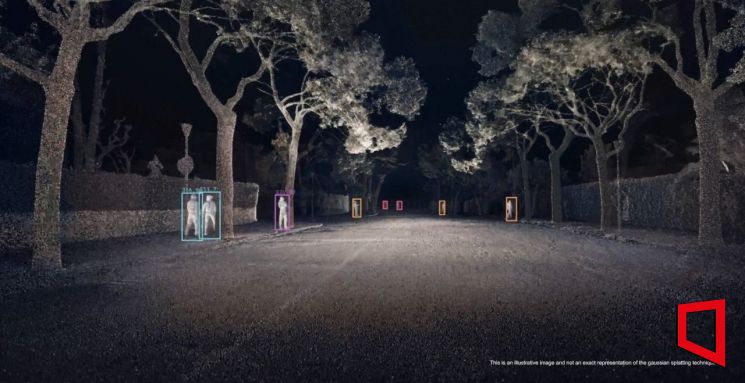 Volvo Cars announced that it will utilize AI and virtual worlds to develop safer vehicles. Image of the virtual world built on AI basis (Provided by Volvo)
Through the AI-generated virtual world, the goal is to reconstruct accident scenarios and explore new methods such as emergency braking, sudden steering changes, and manual interventions to more effectively understand ways to avoid accidents.
An advanced computational technique called 'Gaussian Splatting' is used, which generates vast amounts of high-resolution 3D scenes and objects. The virtual environment can be altered by adding or removing pedestrians on the road, or changing traffic conditions and obstacles, allowing for diverse learning outcomes.
Alwin Bakkenes, Head of Global Software Engineering at Volvo Cars, explained, "With Gaussian Splatting, we can create thousands of variations of each accident case and train and validate models that can respond to them. This enables data analysis on a scale previously impossible and holds the potential to prevent accidents before they occur in the real world."
Meanwhile, next-generation Volvo electric vehicles will be equipped with an AI supercomputing platform based on the NVIDIA DGX system, which analyzes various sensor data collected inside and outside the vehicle to better understand the surrounding environment. This will allow for the analysis of vast amounts of data and the derivation of new insights to train future safety models, as well as accelerate AI development speed.
© The Asia Business Daily(www.asiae.co.kr). All rights reserved.
![Clutching a Stolen Dior Bag, Saying "I Hate Being Poor but Real"... The Grotesque Con of a "Human Knockoff" [Slate]](https://cwcontent.asiae.co.kr/asiaresize/183/2026021902243444107_1771435474.jpg)















