Concerns Over Inflation, Confirmation Needed on Spread to Real Economic Indicators
Some Investment Banks Still Worry Rate Cuts May Be Reduced to Once This Year
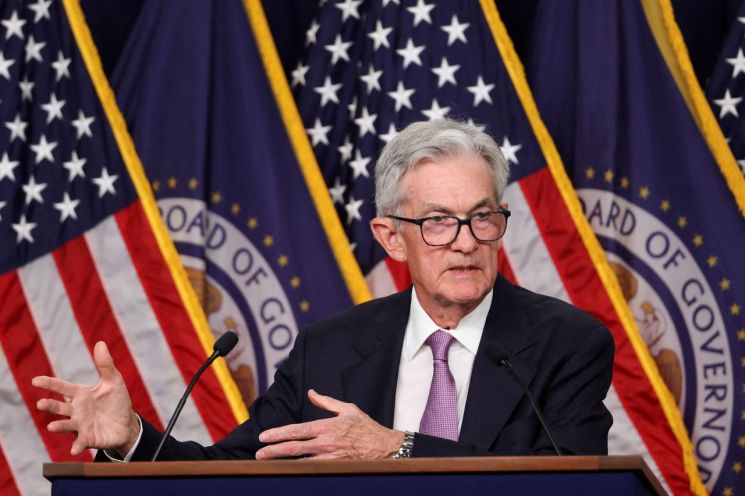
On the 19th (local time), the U.S. Federal Reserve (Fed) kept the policy interest rate unchanged for the second consecutive time as expected by the market. The wait-and-see stance regarding policy decisions was also maintained. However, it was considered somewhat dovish (favoring monetary easing) due to the decision to slow down the pace of quantitative tightening (QT) and the maintenance of two expected rate cuts within the year on the dot plot.
According to the report titled "Market Participants' Evaluation of the March FOMC Meeting Results and Financial Market Reactions," published on the 20th by the Bank of Korea's New York office, the majority of local market participants expect the Fed to take an additional evaluation period through April's government revenue results and decide the direction of the policy rate at the May meeting. However, caution regarding the reduced expectation for the magnitude of rate cuts remains. Some investment banks (IBs) expressed concerns that the forecast for policy rate cuts within the year could be reduced to one time, reflecting rising expected inflation based on recent surveys and inflation outlooks due to tariff issues.
The Fed announced through the policy statement released after the Federal Open Market Committee (FOMC) regular meeting that it decided to keep the federal funds rate at 4.25-4.5% per annum. This is the second consecutive hold following January. The interest rate differential with Korea was maintained at 1.75 percentage points at the upper bound.
In the policy statement, the Fed changed the phrase "risks to the achievement of employment stability and price stability objectives are roughly balanced" to "uncertainty about the economic outlook has increased." It lowered the GDP growth forecast for this year from 2.1% to 1.7%, raised the year-end unemployment rate forecast from 4.3% to 4.4%, and increased the inflation rate based on the core Personal Consumption Expenditures (PCE) price index, which the Fed prioritizes most, from 2.5% to 2.8%.
However, the outlook for two rate cuts this year was maintained. Through the dot plot released on the same day, the Fed kept the median year-end rate forecast unchanged at 3.9%, implying two total 0.25 percentage point rate cuts this year. The pace of quantitative tightening was also set to slow. Currently, the Fed is conducting QT by not reinvesting up to $25 billion of maturing Treasury securities monthly, but starting next month, it will reduce the monthly QT cap on Treasuries to $5 billion.
U.S. inflation is moving toward the 2% target, but progress has slowed and uncertainty has increased. Fed Chair Jerome Powell did not express special concerns about high inflation during the press conference but acknowledged downside risks to sentiment indicators (soft data). Therefore, market participants expect a period over the next few months to confirm whether sentiment indicators translate into weakening actual economic indicators (hard data).
Nomura stated, "The repeated emphasis on a strong labor market and a good economy paradoxically indicates that the Fed is concerned about an economic slowdown," but added, "The core PCE inflation forecast in this economic outlook was below Nomura's expectations, and the medium-term core PCE forecast for 2026-2027 (median) remained unchanged. This suggests that the inflation shock from tariffs may be temporary and can be interpreted as dovish." Bank of America also assessed this meeting as dovish, noting that "despite the increase in core PCE, the median rate forecast for this year remains at two cuts." However, regarding the addition of uncertainty-related language in the policy statement, BNP Paribas said, "It can be interpreted that there were differing views within the Fed about the risk balance."
Meanwhile, although the federal government's mass layoffs have significantly impacted those involved, it is still difficult to consider the overall labor market as critical, and close monitoring of future developments is necessary. Regarding the slowing of the QT pace, UBS evaluated that "the pace was slowed to reduce risks amid the ongoing debt ceiling issue."
© The Asia Business Daily(www.asiae.co.kr). All rights reserved.

















