Chairman of the Joint Chiefs of Staff Emphasizes
Maintaining Readiness for Peace on the Korean Peninsula
The South Korea-U.S. joint exercise, 'Freedom Shield (FS)', concluded on the afternoon of the 20th. FS is a regular joint exercise conducted by the South Korean and U.S. military authorities for the defense of the Korean Peninsula, which took place from the 10th. According to the military, this exercise involved numerous soldiers from United Nations Command member countries and expanded joint field maneuver training, enhancing the interoperability of the South Korea-U.S. alliance.
According to the military, this FS exercise was jointly planned and prepared over more than a year from the planning stage through close cooperation between South Korea and the U.S., and during the exercise, the Joint Chiefs of Staff and the Combined Forces Command effectively operated the South Korea-U.S. joint control group, doubling the results.
In particular, South Korea and the U.S. conducted realistic exercises by reflecting in the scenarios the North Korean military’s strategic and tactical changes and force shifts derived from analyses of Russia-North Korea military cooperation and various trade disputes, thereby enhancing the combined defense posture and response capabilities of the South Korea-U.S. alliance.
Furthermore, to effectively respond to the rapidly changing battlefield environment, efforts across various domains beyond land, sea, and air?including space, cyber, and electromagnetic?were integrated. The military explained that this served as an opportunity to advance the combined operational capabilities of the South Korea-U.S. alliance to the next level. Additionally, in light of the importance of countering misinformation highlighted by cases such as the Russia-Ukraine war and the Israel-Hamas armed conflict, training was strengthened to promptly verify accurate facts regarding various types of misinformation and deliver timely information, as well as to respond to visual information that North Korea may intentionally disseminate.
The integrated defense training was conducted with active cooperation from civilian, government, police, and fire departments, aiming to cultivate integrated defense capabilities based on the consensus on the importance of training shared during the Central Integrated Defense Meeting held in February.
Moreover, considering recent North Korean provocations, the exercise assumed scenarios such as ▲terrorist attempts on national critical facilities like nuclear power plants and ports by unidentified drones ▲complex terrorist situations including explosions and fires at multi-use facilities. Through this, the capabilities of national defense elements were verified, and the cooperation system among related agencies was checked to strengthen practical integrated defense operation capabilities.
Notably, the Strategic Command and the Mobile Fleet Command participated for the first time since their establishment. The Strategic Command, in particular, enhanced strategic deterrence and response capabilities against North Korean nuclear and weapons of mass destruction (WMD) threats, improving the completeness of mission execution.
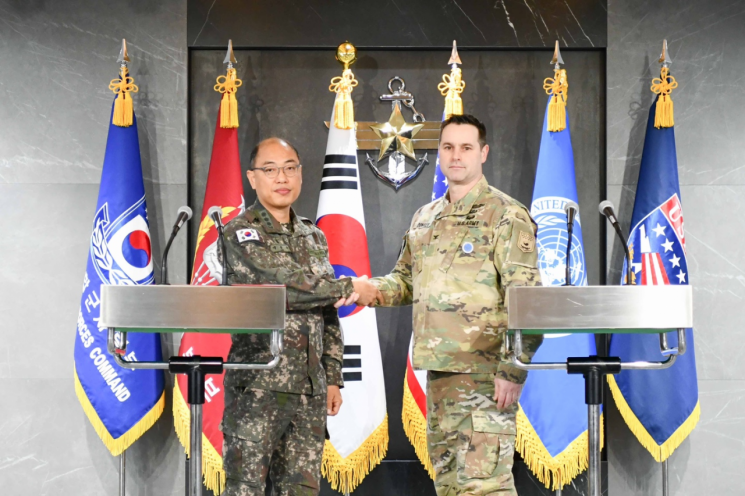
Chairman of the Joint Chiefs of Staff Kim Myung-soo stated, “I had in-depth discussions with the Combined Forces Command commander on the impact of Russia-North Korea military cooperation on security in the Korean Peninsula and on South Korea-U.S. cooperation measures,” adding, “We will maintain a firm readiness posture to preserve stability and peace on the Korean Peninsula.”
The military stated, "Going forward, our military will establish a military readiness posture that deters enemy provocations and firmly retaliates with overwhelming capability in case of provocation."
© The Asia Business Daily(www.asiae.co.kr). All rights reserved.
![Clutching a Stolen Dior Bag, Saying "I Hate Being Poor but Real"... The Grotesque Con of a "Human Knockoff" [Slate]](https://cwcontent.asiae.co.kr/asiaresize/183/2026021902243444107_1771435474.jpg)















