Concerns Grow Over Unsettled Payments Due to Sudden Rehabilitation Procedure
Calls Spread to Shorten Settlement Period, Currently Up to 60 Days
Counterarguments Warn of Negative Impact on Small Merchants from Reduced Purchases
Fairness of Tenant B Contract Terms Also Under Review
As concerns grow that small business owners may suffer damages due to Homeplus's sudden application for corporate rehabilitation procedures, political circles are raising their voices, calling for shortening the payment settlement cycle and examining whether there are any unfair elements in the contract process. Related agencies also plan to review the issues and respond accordingly. However, there are opinions that since the scale and conditions of transactions between large marts and their partners or tenants differ, institutional improvements should be approached cautiously.
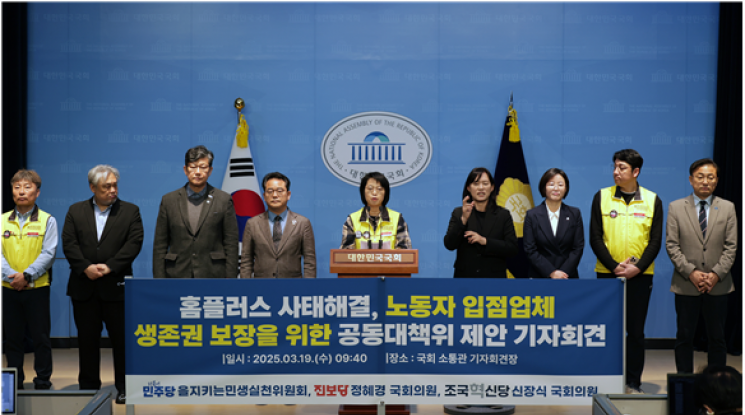 On the morning of the 19th, the Mart Industry Labor Union and opposition party lawmakers held a press conference at the National Assembly Communication Office in Yeouido, Seoul, titled "Proposal for a Joint Countermeasure Committee to Resolve the Homeplus Incident and Guarantee the Survival Rights of Workers and Tenant Companies," proposing the formation of a joint countermeasure committee to resolve the Homeplus incident. Provided by Mart Labor Union
According to the related industry on the 19th, the Mart Industry Labor Union and some opposition lawmakers held a press conference at the National Assembly Communication Office in Yeouido, Seoul, in the morning titled "Joint Countermeasure Committee Proposal for Resolving the Homeplus Incident and Guaranteeing the Survival Rights of Workers and Tenants," proposing the formation of a joint countermeasure committee to resolve the Homeplus incident. The attendees also urged the need for legal and policy responses to minimize employment instability, store closures, and damages to suppliers and tenant store owners following Homeplus's application for rehabilitation procedures.
One representative claim is that as Homeplus's delayed payment settlements have increased anxiety among small and medium-sized merchants, the settlement cycle should be shortened as a result of this incident. Lee Sung-won, Secretary-General of the Korea Federation of Small and Medium Merchants and Self-Employed, emphasized, "Store owners are facing a survival crisis due to uncertainty in sales settlements," adding, "Legal measures are needed to eliminate the discriminatory settlement methods between large corporations and small and medium merchants and to shorten the settlement cycle."
According to the current Act on Fair Transactions in Large Retail Business (Large Retail Business Act), the settlement deadline for large-scale retailers such as Homeplus is within 40 days from the sales closing date for special purchase contracts (where unsold quantities can be returned) and within 60 days from the receipt date for direct purchase contracts. Some small and medium merchants, including political circles, point out that Homeplus's settlement deadline is longer than that of other large marts, which could cause payment issues in unexpected situations like the current rehabilitation procedure. For example, E-Mart's average settlement period is 25 days, Lotte Mart's is 20 to 30 days, whereas Homeplus's exceeds 45 days.
The argument for shortening the settlement period has gained momentum following last year's non-payment incident involving sellers on TMON and WEMAKEPRICE (TMEP).
However, there are counterarguments emphasizing the need to consider the unique structure of offline distribution. An industry insider said, "Retailers, including large marts, procure large volumes of goods and generate funds by selling them before settling payments," adding, "If the settlement period is shortened, inventory burdens will increase, and there will be insufficient time to secure enough cash, inevitably leading to reduced purchase volumes." Furthermore, "From the perspective of partner companies, large firms with diverse clients and better liquidity will be less affected, but small and medium merchants with limited clients may suffer losses due to reduced supply volumes," the insider added.

The contract terms of tenants who operate stores by signing contracts with large marts and placing signboards in specific spaces within the stores have also become a topic of discussion. Previously, on the 18th, Kim Nam-geun, a member of the National Assembly's Political Affairs Committee from the Democratic Party of Korea, pointed out illegal elements in Homeplus's so-called 'tenant B' transactions with small and medium merchants during a related inquiry on the Homeplus incident. Unlike transactions with large corporations, Homeplus reportedly receives the entire sales amount from small and medium merchants, holds it for about 30 to 60 days, and then deducts rent and other fees before returning the balance.
Rep. Kim stated, "Although there is an obligation for advance performance requiring the full deposit of sales proceeds, due to Homeplus's deteriorated creditworthiness, small and medium merchants can refuse this under the civil law's 'defense of insecurity' clause," adding, "Nevertheless, Homeplus's insistence on full deposit of sales proceeds constitutes an abuse of superior bargaining position and requires investigation." Fair Trade Commission Chairman Han Ki-jung said, "Fundamentally, we will consider improving the tenant B system to allow sales amounts to be recognized and collected without first receiving the sales proceeds."
Tenant contracts with large marts are divided into 'tenant A,' who pays a fixed monthly rent, and 'tenant B,' who pays after deducting commissions and management fees from sales. Homeplus is known to have a significantly higher proportion of tenant B contracts compared to competitors. Many tenants have complained of significant damages due to delayed payments from Homeplus amid the rehabilitation procedures, with some not receiving their January settlements. As a result, cases of tenants using their own point-of-sale (POS) systems instead of the calculators (POS) provided by Homeplus to immediately secure sales proceeds are increasing.
Homeplus stated, "Except for large corporations and some brand tenants, delayed payments to almost all tenants have been completed, and operations are currently normal," urging, "To prevent misunderstandings during the settlement process, please use the company POS rather than personal POS." They added, "We are also reviewing measures to alleviate the concerns of tenants worried about potential future payment delays."
© The Asia Business Daily(www.asiae.co.kr). All rights reserved.
![Clutching a Stolen Dior Bag, Saying "I Hate Being Poor but Real"... The Grotesque Con of a "Human Knockoff" [Slate]](https://cwcontent.asiae.co.kr/asiaresize/183/2026021902243444107_1771435474.jpg)
















