Compared to the U.S. trend of talent-based promotions and personnel placement
Korea's seniority, school, and regional ties reduce resource allocation efficiency
Need for ability-based evaluation using fixed standards
Employment flexibility and wage system restructuring required
"Labor resource allocation should be talent-oriented... The key is to quickly and appropriately place capable people in the right positions according to their abilities."
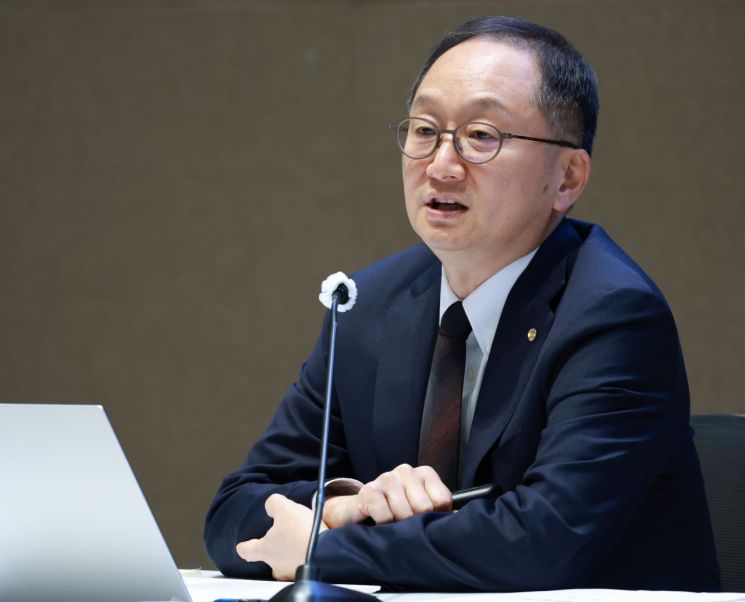 Jang Yong-seong, a member of the Monetary Policy Committee of the Bank of Korea, is giving a presentation on "The Reason Why Korea's Productivity Is Only Half That of the United States" at a press conference held at the Bank of Korea in Jung-gu, Seoul on the 19th. Bank of Korea
Jang Yong-seong, a member of the Monetary Policy Committee of the Bank of Korea, said on the 19th at a press briefing held at the Bank of Korea in Jung-gu, Seoul, on the topic of "Why Korea's productivity is only half that of the United States," "To raise labor productivity in Korea, the seniority system must be abandoned and personnel should be allocated based on talent."
According to the Organisation for Economic Co-operation and Development (OECD), as of 2022, Korea's labor productivity per capita stood at 59, and hourly labor productivity at 56, both below the OECD averages (70 and 76, respectively). This is based on a comparison with the United States' labor productivity set at 100. Jang noted, "In the U.S., promotions and personnel placements are talent-based, so even if a capable person starts as a cashier or other frontline staff, they quickly get promoted to manager and are less visible to customers," adding, "Mistakes by junior staff are minor, but errors by senior management can shake the company's fate, so from an organizational management perspective, it is very important to accurately identify each person's talent and place them in appropriate positions." He also explained that evaluations of individual abilities and corresponding performance must be guaranteed to be fair.
On the other hand, Korea is often criticized for inefficient labor resource allocation due to emphasis on seniority, school ties, regional ties, blood relations, and rotational job systems. Jang said, "The drawbacks of Korea's seniority system are not limited to younger people," adding, "The practice of colleagues quitting when one gets promoted wastes the experience and maturity of talented individuals."
While some cite a lack of talent as a cause of low productivity, Jang disagrees. He referenced Korea's ranking as second after Japan in the 2022 international comparison of middle and high school students' math and science abilities, emphasizing, "There is a large talent pool, but the problem lies in improper talent allocation." He also analyzed that cultural constraints in Korea limit creativity more than individual ability. He said, "You cannot definitively say that students who perform well on exams have higher creativity, but there is likely a positive correlation. The problematic social atmosphere that makes it hard to deny this and the negative view of challenging existing authority are issues."
He added, "Research shows that in China and India, where school ties, blood relations, and regional ties are widespread, losses from inefficient allocation of production facilities (capital and labor) amount to 50% and 60% compared to the U.S., respectively," explaining, "Efficient allocation of capital and labor alone could double the gross domestic product (GDP), and this applies to Korea as well."
Jang emphasized the need for systems that support continuous employment for those who perform well. Alan Greenspan, former chairman of the U.S. Federal Reserve (Fed), served for 19 years from 1987 to 2009. Jang pointed out, "In Korea, it is rare for university presidents to serve two terms," adding, "As a result, there is little investment in people who take a long time to produce results, and focus tends to be on short-term visible achievements like constructing buildings."
He also stated that excessive employment protection for regular workers should be eased to ensure smooth functioning of the overall labor market, as excessive protection can hinder job creation. He said, "When I was at a U.S. university, if research achievements were lacking, people were harshly dismissed, but if teaching was good, they sometimes proposed teaching-only faculty positions," adding, "If a five-year contract is offered, the decision on renewal is notified in the third year. This longer and more predictable continuity compared to two-year contract positions could be an alternative." He explained that employment of non-regular workers in three to five-year terms with mid-term reemployment reviews could complement this system.
He also believes that discussions on extending retirement age should be preceded by employment flexibility and wage system restructuring. He said, "If only the retirement age is extended under the current system, side effects will occur."
Meanwhile, as a monetary policy committee member who decides the base interest rate, he said he is closely monitoring housing price movements in areas such as the "Gangnam 3 districts (Gangnam, Seocho, Songpa-gu)" amid recent household debt increases. He said, "The argument about missing the opportunity to lower interest rates was ultimately about the surge in real estate prices in Seoul last August," adding, "Once the reins are loosened, the 'real estate invincibility' narrative will gain strength again, so the intention was to break that." In the same context, he explained that the Bank of Korea is carefully watching the increase in household debt. If the pace of household debt growth slows due to measures such as re-designation of land transaction permission zones, the Monetary Policy Committee's stance on entering an interest rate cut cycle could become more flexible. However, Jang added, "The interest rate gap with the U.S. is still large, so we need to watch the U.S. movements, and other factors are also variables."
© The Asia Business Daily(www.asiae.co.kr). All rights reserved.

















