Cleaning Up During the Day, But Hiding It at Night
Consideration for Others Should Match Our Love for Pets
A, a 60-year-old private parking lot manager in Seoul, has recently made cleaning up pet waste every morning part of his routine. This is because, for the past two months, someone has been habitually leaving pet waste behind when it gets dark. He has filed several complaints with the district office requesting stricter enforcement, but the response has always been, “We dispatched officers to the scene but could not catch anyone.” A said, “I have stepped on pet waste and had to wash my shoes more than once while walking absentmindedly,” adding, “I worry that parking lot users might express dissatisfaction.”
As the number of pet-owning households has significantly increased, there have been many cases where people frown upon abandoned pet waste. While many carry pet waste bags during the day in crowded places, the number of people who leave waste without cleaning it up at night when there are fewer people has increased.
Pet waste not only harms the urban landscape but also pollutes water and soil. According to an analysis by the Korea Consumer Agency of 79 pet waste samples, parasites were detected in 10 samples, and Staphylococcus aureus was found in 21 samples. In 2004, a child playing in a playground lost their eyesight after being infected by parasites found in pet waste.
The Animal Protection Act stipulates that leaving pet waste unattended can result in a fine of up to 500,000 KRW. However, most local governments impose a fine of 50,000 KRW for the first violation. In some parks, such as Hangang Park, fines start at 70,000 KRW. However, enforcement is not easy. A representative from a district office in Seoul said, “Fines are only imposed when someone reports a habitual offender to the police on the spot and they are caught,” adding, “Even when there are witnesses, offenders sometimes deny everything until the end.”
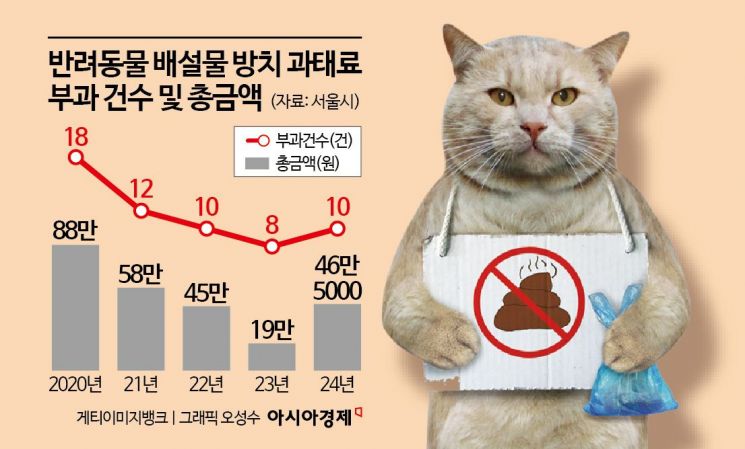
According to Seoul City on the 20th, the number of fines imposed for failure to clean up pet waste was 18 in 2020, 10 in 2022, and 10 in 2024. Considering that there are 610,000 registered pets in Seoul, it means that enforcement is hardly taking place. Kim Hak-young (72), who takes a walk in Seoul Forest every morning, said, “I try to avoid the edges of the path to not step on dog waste,” and added, “If enforcement is difficult, I hope the fines are significantly increased.”
Fines abroad tend to be higher than those in Korea. In some cities in France, fines of 237 euros (about 370,000 KRW) are imposed, and in New York, fines can be up to 250 dollars (about 360,000 KRW). However, it is true that many people who have visited France or New York have had unpleasant experiences due to pet waste scattered in parks. This shows that 'fines' or 'enforcement' alone are not the solution.
Experts say that above all, fostering a pet culture is necessary. Professor Noh Jin-chul of the Department of Sociology at Kyungpook National University said, “We need to raise civic awareness through the cultivation of pet etiquette culture,” and added, “We should be cautious about approaching this issue solely through stricter punishment.” Professor Heo Chang-deok of the Department of Sociology at Yeungnam University said, “There should be continuous promotional activities emphasizing that when going out with pets, carrying waste bags and gloves is a must.”
© The Asia Business Daily(www.asiae.co.kr). All rights reserved.
![Clutching a Stolen Dior Bag, Saying "I Hate Being Poor but Real"... The Grotesque Con of a "Human Knockoff" [Slate]](https://cwcontent.asiae.co.kr/asiaresize/183/2026021902243444107_1771435474.jpg)
















