Electronic skin that recovers from damage such as friction or tearing within 10 seconds has been developed in Korea.
The National Research Foundation of Korea announced on the 19th that Professor Kim Hyuk's research team at the University of Seoul developed an "ultra-fast self-healing electronic skin" that can restore more than 80% of its function within 10 seconds without external stimuli.
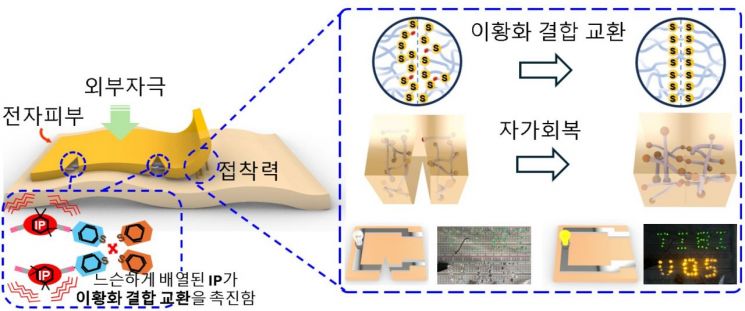 Schematic diagram of electronic skin with self-healing function. Provided by Professor Kim Hyuk, University of Seoul
Electronic skin is designed to mimic human skin. As one of the most advanced forms of wearable devices, it has high applicability in the healthcare field. Actual electronic skin is being developed in various ways to perform functions such as sensing touch when attached to the human body, monitoring biological signals, and healing wounds at the attachment site.
However, it has been highlighted as a challenge that electronic skin is vulnerable to mechanical damage such as friction, tearing, and scratches that occur during repeated use, making long-term wear difficult and causing performance degradation when damaged.
To address this, the research team synthesized various compounds to implement optimal conditions that enhance the self-healing performance of electronic skin.
They introduced disulfide compounds into flexible thermoplastic polyurethane to design disulfide bonds that can recombine without external stimuli such as heat or light, and added compounds with high molecular mobility to maximize self-healing ability for high resilience.
The self-healing electronic skin developed using this method not only achieves a high recovery rate in a short time but also stably measures electromyography and electrocardiography in extreme environments such as high temperature, high humidity, low temperature, and underwater, and maintains stable signals even after self-healing following damage.
The research team also succeeded in implementing real-time biological signal monitoring and AI-based muscle fatigue evaluation technology using this technology.
Professor Kim Hyuk said, "This research result solves major challenges of self-healing electronic skin and will contribute to the advancement and commercialization of next-generation wearable medical technology."
This research, supported by the Mid-Career Research Program promoted by the Ministry of Science and ICT and the National Research Foundation of Korea, was also introduced in the international journal Science Advances on the 12th of last month.
© The Asia Business Daily(www.asiae.co.kr). All rights reserved.
![Clutching a Stolen Dior Bag, Saying "I Hate Being Poor but Real"... The Grotesque Con of a "Human Knockoff" [Slate]](https://cwcontent.asiae.co.kr/asiaresize/183/2026021902243444107_1771435474.jpg)















