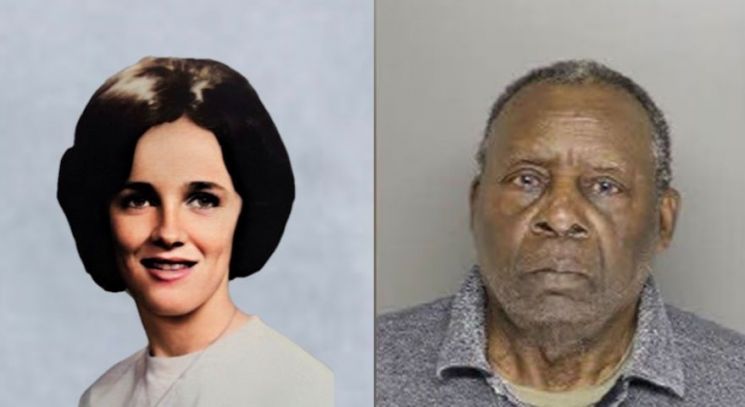
 Katherine Donohue (left), who was murdered 46 years ago, and Roger Jodas Brown, the murder suspect arrested after 46 years. Prince George's County Police Department
A suspect who murdered a woman he had never met in the United States was arrested after 46 years. At the time of his arrest, he was already in his 80s and complied without resistance when the police came. The case, which was almost permanently unsolved, was resolved thanks to genetic genealogy.
On the 19th, American media including ABC News reported that the Prince George's County Police Department's cold case unit in Maryland recently arrested an 82-year-old suspect. The incident occurred on the evening of September 6, 1979. At that time, Catherine Donohue was found murdered in her home. The police immediately launched an investigation, collecting forensic evidence at the crime scene, interviewing potential witnesses, and following various leads. However, the investigation hit a dead end due to the limitations of forensic technology at the time. The existing DNA testing methods could not identify a strong suspect, leaving the case unsolved.
Last year, the Prince George's County Police Department (PGPD) cold case unit decided to reinvestigate the Donohue case and entrusted the forensic evidence to the latest DNA analysis technology. The evidence was sent to a forensic laboratory called Othram. Othram extracted DNA from the evidence collected at the crime scene and constructed a detailed genetic profile. This profile was delivered to the FBI forensic genetic genealogy team, who used it to trace the suspect’s relatives. As a result, Rodger Zodas Brown emerged as a prime suspect. After Brown was identified as a suspect, the PGPD investigation team conducted further inquiries to obtain his DNA sample. It was then confirmed that his DNA perfectly matched the evidence collected at the crime scene.
Rodger Zodas Brown, now in his 80s, was arrested at his home in North Carolina without much resistance. At the time of the crime in 1979, Brown lived in the area where the crime occurred but was not on the suspect list. Authorities are currently investigating whether Brown is connected to other unsolved cases that occurred around the same time. He is scheduled to be extradited to Virginia and will be charged with first-degree murder.
Genetic genealogy became widely known in 2018. That year, the arrest of Joseph James DeAngelo, the perpetrator of the so-called ‘Golden State Killer’ case, which had remained unsolved for 45 years, caused a stir in American society. DeAngelo committed over 50 sexual assaults and 13 murders in California from 1973 to 1986. The breakthrough in the stalled investigation was DNA obtained from crime scene evidence. Investigators extracted information from this DNA that could confirm familial relationships and created a kind of ‘genetic family tree’ by identifying people presumed to be relatives of the suspect. By analyzing relatives one by one and excluding those who were not the perpetrator, authorities were able to catch the suspect 45 years after the crimes.
© The Asia Business Daily(www.asiae.co.kr). All rights reserved.
![Clutching a Stolen Dior Bag, Saying "I Hate Being Poor but Real"... The Grotesque Con of a "Human Knockoff" [Slate]](https://cwcontent.asiae.co.kr/asiaresize/183/2026021902243444107_1771435474.jpg)
















