With surge in gap investment, land transaction permission zones expanded beyond lifted areas
Adjustment target areas and speculative overheating zones in Mapo, Seongdong, and Gangdong under review
Stronger management of household loans and enhanced monitoring of housing mortgage loans
Gangnam 3 districts (Gangnam, Seocho, Songpa) and Yongsan District will be re-designated as land transaction permission zones for six months. As apartment prices surged along the Han River area centered on Seoul's Gangnam 3 districts, the four districts, which were designated as speculative overheating zones, were grouped into land transaction permission zones. This comes about a month after apartments in Jamsil, Samsung, Daechi, and Cheongdam neighborhoods were removed from the land transaction permission zones. The government plans to consider additional designations of adjustment target areas and speculative overheating zones for surrounding areas such as Mapo, Seongdong, and Gangdong Districts if the overheating continues.
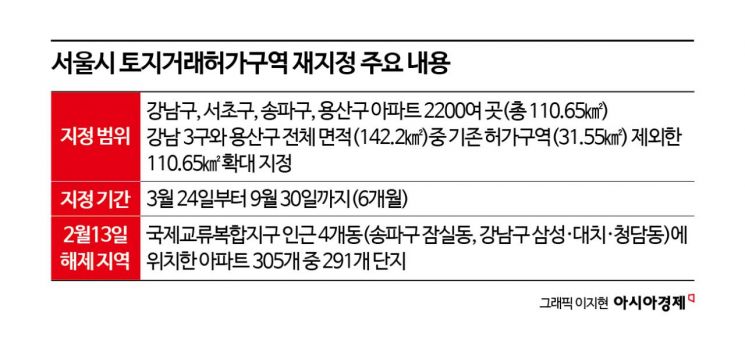
On the 19th, the Ministry of Land, Infrastructure and Transport and Seoul City held a briefing on the 'Housing Market Stabilization Measures' at the Government Seoul Office and announced that about 2,200 apartments (totaling 110.65㎢) in Gangnam-gu, Seocho-gu, Songpa-gu, and Yongsan-gu in Seoul would be designated as land transaction permission zones. The designation period is from March 24 to September 30, lasting six months. The regulation applies to new sales contracts concluded from the 24th onward.
Seoul Mayor Oh Se-hoon apologized for the recent situation, saying, "I humbly accept the criticism that market volatility increased centered on Gangnam after the removal of the land transaction permission zones. I am sorry for causing concern." Mayor Oh said, "From March, when the February transaction reporting period ended, the number of reports surged, and it seemed highly likely to lead to price increases. The gap investment ratio increased centered on the Gangnam 3 districts, and signals of increased speculative transactions were detected. If the market overheating continues, we will closely review whether to add neighboring autonomous districts as well."
Minister of Land, Infrastructure and Transport Park Sang-woo said, "If the current housing price rise intensifies further or spreads to other areas, we will actively consider expanding the designation of adjustment target areas and speculative overheating zones currently designated in the Gangnam 3 districts and Yongsan District."
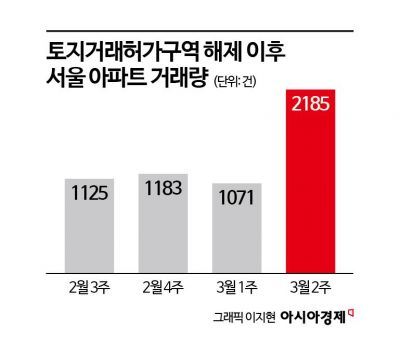
Authorities judged that signs of overheating appeared, such as a surge in apartment transactions centered on the areas where land transaction permission zones were lifted in February and along the Han River. As of the second week of March, the weekly price change rates were 0.72% in Songpa-gu, 0.69% in Gangnam-gu, and 0.62% in Seocho-gu, marking the highest increase rates in the Gangnam 3 districts since 2018. The gap investment ratio in the Gangnam 3 districts was 43.6% in February, up 8.4 percentage points from 35.2% in January. The proportion of non-local buyers also surged from 55.3% to 62.4% during the same period. As of the 19th, February apartment transactions in Seoul totaled 5,506 cases, more than 2,000 cases higher than January's 3,370, and March transactions are also rapidly increasing with 1,754 cases recorded. Since the transaction reporting period is until the end of the contract month, February's transaction volume is expected to exceed 6,000 cases.
With transaction volume and gap investment surging, the '6-month land transaction permission zone' card is brought out again
Seoul City expanded the designation of land transaction permission zones to areas where transaction volume recently surged and price volatility increased, leading to a high possibility of speculative transactions, to stabilize the market. Not only the 291 apartments in Jamsil, Samsung, Daechi, and Cheongdam neighborhoods near the International Exchange Complex District, which were lifted on February 13, but also the Han River riverside complexes in Banpo and Jamwon-dong in Seocho-gu and Yongsan-gu were broadly designated.
Mayor Oh said, "If we do not quickly contain the volatility in the real estate market, it could spread more widely later. Expanding to other areas that could rise is seen as an opportunity for a turnaround. We will closely monitor the market situation and take appropriate measures."
Although the usual designation period for land transaction permission zones is one year, it is unusual that this time it was set for 'six months.' Regarding this, Minister Park explained, "The land transaction permission system is an emergency measure. Various political and economic situations could change after six months. We will comprehensively consider variables such as real estate conditions, interest rates, money supply, and political circumstances and make a judgment then."
The land transaction permission zone designation plan passed the Seoul City Urban Planning Committee review on the 19th and will be fully implemented from the 24th. Once designated as a land transaction permission zone, transactions of apartments above a certain size must receive permission from the district office head. Residential land must be used for actual residence only for two years, during which sales and leases are prohibited. If a land transaction contract is concluded without permission, a penalty of up to two years imprisonment or a fine up to 30% of the land price will be imposed.
With this measure, the land transaction permission zones in Seoul will expand to a total of 163.96㎢ (27% of the entire Seoul area), including △natural green areas in Gangnam and Seocho-gu (26.69㎢), △major reconstruction and redevelopment complexes such as Apgujeong-dong in Gangnam-gu, Yeouido-dong in Yeongdeungpo-gu, Mok-dong in Yangcheon-gu, and Seongsu-dong in Seongdong-gu (4.58㎢), and △Moatown and nearby roads (11.89㎢).
Housing mortgage loan management and lowering of jeonse loan guarantee ratio advanced to May
The government will conduct regional household loan monitoring centered on the metropolitan area and strengthen checks on housing mortgage loans in major areas of Seoul. Loan regulations for multi-homeowners and gap investors will be applied more strictly through voluntary financial sector regulations, and the reduction of the jeonse loan guarantee ratio will be advanced from July to May. Additional household loan management measures will be considered for areas where overheating due to speculative demand is a concern, and if policy loans become a factor in market overheating, loan interest rate hikes will also be pursued.
The government will operate a joint inspection team of the Ministry of Land, Infrastructure and Transport and Seoul City to focus on monitoring abnormal transactions and price collusion, and will strongly crack down on market disorder acts such as illicit loans and false reporting. If illegal activities are suspected based on investigations, the National Tax Service and financial authorities will be immediately notified for action. A Ministry of Land official said, "Most cases found in investigations are disguised gift transactions, and there are quite a few cases of illicit loans such as buying apartments with corporate loans. As transaction volume increases, such cases are also on the rise."
Additionally, the funding plan submitted when purchasing a house will be frequently investigated and closely managed. In regulated areas, a self-declaration must be submitted regardless of the house price, and in non-regulated areas, it must be submitted for transactions over 600 million KRW. To prevent fraudulent subscription, document verification procedures will also be strengthened. Health insurance care benefit details will be added to practically verify dependents and actual residence status.
Expanding supply through amendments to laws related to maintenance projects
To accelerate maintenance projects, amendments to laws related to reconstruction and redevelopment will be negotiated with the National Assembly, and low-interest initial project cost loans of up to 5 billion KRW per project site will be supported starting this month. To achieve the goal of supplying more than 110,000 households over two years, the government and local governments will operate a consultative body to expedite the early start of new construction purchase agreements, and will also promote the purchase commitment of unsold public land in the metropolitan area.
Support for Corporate Restructuring REITs (CR REITs) will also be expanded. Measures include exemption from acquisition tax surcharges, exclusion from comprehensive real estate tax aggregation, and support for mortgage guarantees from the Housing and Urban Guarantee Corporation (HUG) to ease financing burdens. Since the end of last year, HUG purchase consulting has been actively supported, and new REIT projects totaling 4,200 households are under review in January and February this year alone. The government expects visible results from the second quarter. On the 21st, LH will announce direct purchase of unsold houses after local completion. If necessary, additional purchases beyond the initially announced 3,000 households will also be considered.
Despite these measures, if housing market instability continues, the government plans to consider various countermeasures including financial, tax, and policy loans and implement additional actions. Minister Park said, "Considering the overall economic situation, it was inevitable not to lower interest rates, and the money supply may increase further. For now, the biggest goal is stabilizing the real estate market."
© The Asia Business Daily(www.asiae.co.kr). All rights reserved.
![Clutching a Stolen Dior Bag, Saying "I Hate Being Poor but Real"... The Grotesque Con of a "Human Knockoff" [Slate]](https://cwcontent.asiae.co.kr/asiaresize/183/2026021902243444107_1771435474.jpg)












