Strengthening Cooperation for the Development of Future Emerging Industries
Gwangyang City, Jeollanam-do announced on the 19th that it successfully held a lithium secondary battery technology seminar, co-hosted with the Gwangju Institute of Science and Technology (GIST), at the Citizen Hall of Gwangyang City Hall on the 18th.
This seminar was organized to strengthen industry-academia-research cooperation between Gwangyang City and GIST and to share the latest research trends and technological advancements in the secondary battery industry.
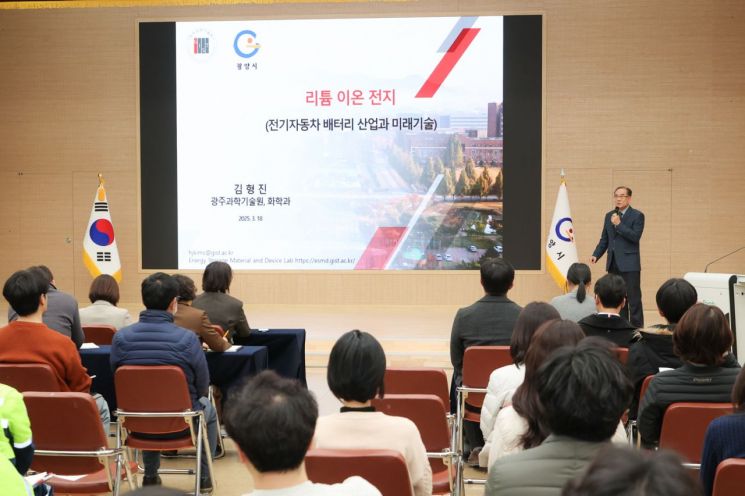 Gwangyang City successfully held a lithium secondary battery technology seminar jointly hosted with the Gwangju Institute of Science and Technology (GIST) on the 18th at the Gwangyang City Hall Citizen Hall. Photo by Gwangyang City
The event was made even more meaningful by the participation of major secondary battery-related companies such as POSCO Future M, POSCO Pilbara Lithium Solution, POSCO HY Clean Metal, and Gwangyang ENS Co., Ltd., as well as related institutions including Jeonnam Technopark, Korea Testing & Research Institute (KTR), and Korea Battery Industry Association.
The seminar featured a lecture by Kim Hyeongjin, honorary professor at GIST, on the topic "Lithium-Ion Batteries: The Electric Vehicle Battery Industry and Future Technologies." He explained the growth of the global electric vehicle market, the core materials and manufacturing processes of lithium-ion batteries, and introduced the latest research and development trends in next-generation battery technologies such as all-solid-state batteries and lithium-sulfur batteries.
Professor Kim is an expert who conducted battery research and development at LG Chem for over 20 years and is currently leading the development of next-generation battery technologies and the training of skilled professionals as an honorary professor at GIST.
He stated, "Lithium secondary battery technology is the core of the future energy industry, and Gwangyang City is strategically fostering the industry with the goal of establishing the nation's only full-cycle supply chain for secondary battery materials. I will contribute to the development of innovative battery technologies and the nurturing of talent in cooperation with Gwangyang City."
In his opening remarks, Gwangyang Mayor Jung Inhwa said, "Gwangyang City is actively promoting cooperation between companies and research institutions to become the center of the secondary battery industry in Korea. Through this seminar, we will further solidify the industry-academia-research cooperation network and do our best to develop advanced battery technologies and nurture talent."
This seminar was held as a follow-up to the business agreement signed in June last year between Gwangyang City and GIST for the development of future new growth industries. Through the agreement, the two institutions agreed to cooperate on joint research, technology exchange, and professional workforce training in emerging industries such as secondary batteries and hydrogen, and this seminar marked the first achievement of that cooperation.
Meanwhile, Gwangyang City was designated as an Opportunity Development Zone (about 400,000 pyeong) in the secondary battery sector last year and is working to establish a full-cycle supply chain and expand cooperation between companies and research institutions. Recently, the city was selected for the Ministry of Industry's "2025 Opportunity Development Zone Workforce Training Project," securing 400 million KRW in national funding and preparing a customized workforce training project totaling 600 million KRW.
Gwangyang City plans to provide practical training on secondary battery materials and processes, use of analytical equipment, and production facility management for 200 job seekers and employees. Through this, the city aims to supply customized talent to companies, strengthen industry-academia-research cooperation, and expand youth employment. In addition, through ongoing network building such as hosting seminars and operating business councils, Gwangyang City plans to foster the Gwangyang Bay Area as a key hub for the secondary battery industry.
© The Asia Business Daily(www.asiae.co.kr). All rights reserved.
![Clutching a Stolen Dior Bag, Saying "I Hate Being Poor but Real"... The Grotesque Con of a "Human Knockoff" [Slate]](https://cwcontent.asiae.co.kr/asiaresize/183/2026021902243444107_1771435474.jpg)















